SQF Certification & SQF Audits

SQF Certification & Auditing

Meet regulatory, food safety, and quality requirements

Meet regulatory, food safety, and quality requirements

Benefits of SQF Certification

Becoming SQF certified show your business's dedication to proactive prevention strategies, due diligence in food safety matters, and a variety of added benefits:

  • Competency in producing, processing, packaging and distributing safe food
  • Customer and consumer confidence
  • Business development
  • Continuous improvement of your food safety and quality systems
  • Proven business risk reduction strategy
  • Improved performance during regulatory inspections and/or other stakeholder assessments
  • Reduced assessment inconsistencies and costs of multiple assessment standards

Working with TÜV SÜD America has been a game-changer for our company, we truly appreciate their outstanding timely audit approach, responsiveness and due diligence. The quality certifications we obtained have not only enhanced our credibility and trust with customers and vendors but also opened up new business opportunities. We are proud to meet the highest standards of food safety and quality, ensuring that our products remain the best in the industry. With TÜV SÜD America, we are now able to partner with big box retailers again, improve our facility to meet higher standards, and plan our goals to work with new vendors.

Donna Chisesi

Chief Administrative Officer at Chisesi Brothers

Discover how Chisesi Brothers, a manufacturer of smoked meat products, benefitted from TÜV SÜD’s SQF certification

Read case study


Our SQF Certification Services

TÜV SÜD is accredited by the ANSI National Accreditation Board (ANAB) under the SQF certification scheme and was one of the first certification bodies in the United States to offer SQF auditing and certification services. We can also evaluate and verify HACCP plans for compliance with regulations of the FDA and the U.S. Department of Agriculture (USDA).

SQF Certification Process

Achieving SQF certification in accordance with the requirements of SQF Code, Edition 9, involves the following steps:

  1. Learn About the SQF Code: Copies of each of the codes used for SQF certification are available for download at www.sqfi.com. In addition, licensed training centers – including TÜV SÜD America – offer training on Code requirements, and how they apply to specific food operations.
  2. Register Your Company on the SQF Assessment Database: Producers, suppliers and retailers seeking SQF certification are required to register on the SQF Assessment Database. Registration is required prior to scheduling an SQF audit and obtaining certification.
  3. Designate an Employee as the SQF Practitioner: The Code requires that parties seeking certification have a qualified SQF practitioner on site to validate and verify compliance with fundamental food safety requirements. Practitioner qualifications include the completion of a HACCP-based training course, and a thorough understanding of the Code requirements.
  4. Choose the Specific Type of Certification: The next step in the certification process is to select the type/level of certification to pursue. These are Fundamentals, Food Safety, or Food Safety and Quality, as described previously.
  5. Obtain Proposals from SQFI-Licensed Certification Bodies: Only testing organizations that have been qualified and licensed by the SQFI may conduct certification audits in accordance with the requirements of SQF Code, Edition 9. Therefore, obtaining proposals from licensed certification bodies can help ensure the timely scheduling and completion of the required certification audit. TÜV SÜD America is an SQFI licensed certification body.
  6. Conduct a Certification Pre-Assessment (Optional): Conducted either by an SQF practitioner or an auditor from a certification body, a certification pre assessment can be an invaluable exercise in identifying gaps between SQF Code requirements and current practices. It provides a roadmap for achieving compliance with Code requirements ahead of a certification audit.
  7. Choose a Certification Body and Schedule an Audit: Having completed all of the previous steps, it’s time to select the certification body that best meets the facility-specific requirements, and schedule the certification audit. Limitations to keep in mind are the size and location of the facilities to be audited, as well as the number of auditors available, and the geographic proximity of auditors to do the certification.
  8. Certification Body Conducts Certification Audit: The initial certification audit consists of both a document review (also known as a desk audit) and a facility assessment (the facility audit). Once issued, certifications are effective for a period of three years. Keep in mind, certified facilities are subject to a minimum of one unannounced audit during the certification period.

SQF CERTIFICATION TIME

The length of time required to complete the entire SQF certification process can vary widely from facility to facility. Considerations such as the current state of a facility’s food safety management system, the number of products or process lines to be covered by the scope of the certification, and the complexity of the processes to be evaluated can lengthen (or shorten) the process. However, an average of one year from the beginning of the SQF certification process to achieving certification is a reasonable estimate for most facilities.
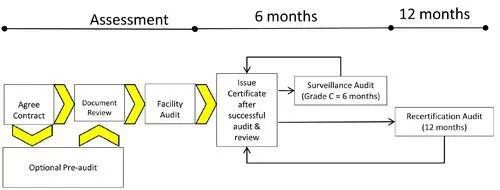
SQF Certification Process

Transferring your safe quality food Certification to TÜV SÜD

With the right certification partner, you can improve your business performance. When transferring your SQF certification, we will review your current certificate and most recent SQF audit report to:

  1. Confirm the certificate is current, valid, and relates to the SQF System as certified;
  2. Confirm your site’s food sector category falls within the new certification body’s scope of accreditation; 
  3. Confirm any complaints received are actioned;
  4. Review your site’s audit history (where you can demonstrate such history to the satisfaction of the new certification body by way of copies of audit reports completed by any previous certification body(ies) and the impact of any outstanding non-conformances); 
  5. Confirm the stage of the current certification cycle.

Once confirmed, we will conduct the next recertification audit, and upon successful completion, issue a new certificate.


learn more about What is Safe Quality Food Certification, Benefits and Why Partner with TÜV SÜD

The U.S. Federal government estimates that there are about 48 million cases of foodborne illness annually — the equivalent of making 1 in 6 Americans ill each year. And each year, these illnesses result in an estimated 128,000 hospitalizations and 3,000 deaths. Illnesses include Salmonella, E. coli, Botulism and more.  

Candice Carmichael

SQF certification can prove senior management commitment and effective food safety management controls. With TÜV SÜD's expertise and years of experience in Safe Quality Food (SQF) certification, you can ensure the highest standards to mitigate food safety hazards, enhance the safety of your food product while implementing a strong food safety culture. Our SQF Audit Services provide you with the assurance that your customers and stakeholders need to maintain a strong food safety management system.

Candice Carmichael

Food and Feed Program Manager at TÜV SÜD America


Becoming Safe Quality Food (SQF) Certified will showcase your company’s dedication to proactive prevention strategies, due diligence in food safety matters, and a variety of added benefits. Watch the video to learn more!


Frequently asked questions on SQF audit and certification

  • 1. What are GMP’s?

    Good Manufacturing Practices (GMP) are a system that ensures manufactured products—such as food, cosmetics, and pharmaceutical goods—are consistently produced and controlled according to set quality standards.

    Implementing GMP can help cut losses and waste, and avoid recalls, fines, and jail time. Overall, it protects both the company and the consumer from negative food safety events. Companies that obtain SQF Certification must also follow GMP guidelines.

  • 2. What is a Safe Quality Food (SQF) Audit?

    A Safe Quality Food (SQF) audit is a system of food safety requirements created and managed by the SQF Institute. It is a Food Safety Management Certification program used to control the food safety risks that inherently happen with various types of food processing, packaging, and storage.

    An SQF audit is an assessment by a qualified and registered SQF Auditor. The audit is a systematic assessment of food safety processes for food manufacturing industries. It helps evaluate if suppliers and other businesses in the food supply chain comply with Safe Quality Food (SQF) standards.

    Obtaining SQF Certification allows food production companies and their suppliers to secure partnerships with major institutions in the food industry. 

  • 3. How Often Should an SQF Audit be Conducted?

    The initial audit should be conducted when the food production company first seeks certification. The annual surveillance audit ensures ongoing compliance with SQF standards. And the re-certification audit occurs every three years or as required.

    If your facility has repeated non-conformances, auditors may schedule more frequent checks. 
     

  • 4. What are Some of the SQF Requirements Food Suppliers Must Meet?

    The food production sites must have a robust food safety management system such as a Food Safety Plan, Allergen Program, Food Defense Program, Food Fraud Program, etc. The site must have a list of procedures and policies in place and must follow those documents.

    Following the SQF requirements will help implement strong food safety controls to prevent any biological, physical or chemical hazards.  

  • 5. What Happens if a Food Production Site Fails an SQF Audit?

    If a site fails an SQF Audit and the score is less than 70% the site will have 30 days to reschedule a site visit with the auditor to go over all of the corrective actions for the non-conformities that were found during the initial audit. 

  • 6. What are the correct steps to transfer your current Safe Quality Food (SQF) Certification to TÜV SÜD America?

    If you wish to transfer your SQF Certification to TÜV SÜD America, we will review your current certificate and most recent SQF audit report to: 

    1. Confirm the certificate is current, valid, and relates to the SQF System as certified. 
    2. Confirm that your site’s food sector category falls within TÜV SÜD’s scope of accreditation.  
    3. Confirm any complaints received have been addressed and actions are in place to remedy.   
    4. Review your site’s audit history where you can demonstrate such history to TÜV SÜD’s satisfaction, which may include sharing audit reports completed by previous certification bodies and the impact and corrective action plan for any outstanding non-conformances.  
    5. Confirm the stage of the current certification cycle. 

    Once confirmed, we will conduct the next recertification audit, and upon successful completion, issue a new certificate. 

EXPLORE

Safe Quality Food: The Importance of Certification and How to Achieve It
Webinar

Safe Quality Food: The Importance of Certification and How to Achieve It

Learn why SQFI is important and how TÜV SÜD can help you achieve SQF certification

Read More

Chisesi Brothers case study
CASE STUDY

Chisesi Brothers

The company partnered with TÜV SÜD America to obtain food safety certifications, ensuring compliance, growth, and access to top retailers.

Learn More

GSFI, Food Safety Management System Schemes: The Right Fit for Your Company!
Webinar

GSFI, Food Safety Schemes

Determine which food safety management system certification is best for your company

Learn More

Meiji Case Study
CASE STUDY

Meiji

TÜV SÜD provided certification and auditing services to help Meiji achieve a GFSI benchmarked food safety standard.

Learn More

VIEW ALL RESOURCES

Next Steps

Site Selector