Opportunities and challenges in applying the EU AI Act 2024/1689 to AI-driven medical technologies
Opportunities and challenges in applying the EU AI Act 2024/1689 to AI-driven medical technologies
If you are developing AI-driven medical devices, you are working on two big challenges, building the technology and getting it approved. In addition to MDR compliance, the EU AI Act 2024/1689 adds an additional layer of regulation, introducing specific requirements around algorithm transparency, human oversight, and risk classification. If you don't consider the regulatory landscape early on, you are running the risk of slowing down your go-to-market timeline, stretching limited resources, and increasing regulatory hiccups.
The overlap of the two regulations creates new questions:
This white paper addresses these topics in detail and helps you make informed, compliance-ready decisions.
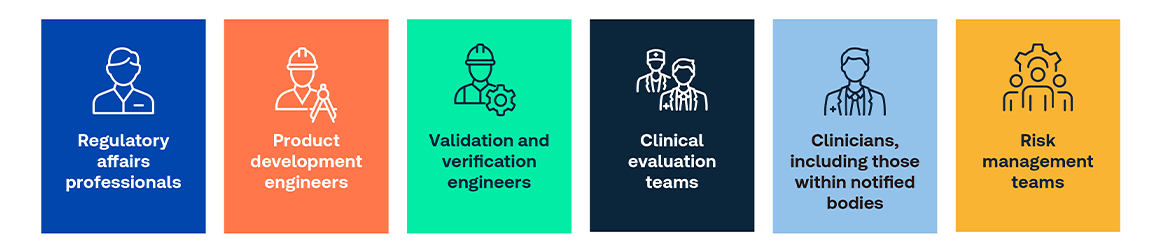
Fig. A Examples (includes but not limited to) of individuals in the medical device industry impacted by the AI Act
Whether you're developing diagnostic software, predictive analytics tools, or embedded AI in connected devices, this white paper cuts through the complexity. Inside, you'll find:
Understand and get expert guidance on how the EU AI Act 2024/1689 impacts your AI-powered medical devices.
 |
Matthew Kirkman Clinical Reviewer, Senior Product Specialist, Clinical Data and Subject Matter Expert, TÜV SÜD Matthew Kirkman completed his neurosurgery training in London prior to working as a Consultant Adult and Paediatric Neurosurgeon in Nottingham. He subsequently joined TÜV SÜD as a Clinical Reviewer in 2023, before moving to his current role. In addition to his clinical qualifications and experience, Matthew also holds a PhD from University College London, as well as Master's degrees from the University of Oxford and Imperial College London. |
 |
Prakash Khunti Senior Software Assessor, AI, TÜV SÜD Prakash Khunti focuses on the evaluation of AI-powered medical devices for regulatory compliance under the EU MDR, IVDR, and the AI Act. He has over ten years of experience in software engineering and AI systems, with a background in both technical development and regulatory assessment. Based in Singapore, Prakash collaborates with international teams to support the safe and effective integration of AI technologies within the healthcare sector. |
 |
Ulrich Nitsche (MD PhD) Global Director of the Clinical Centre of Excellence for Notified Bodies TÜV SÜD NB0123 and TÜV SÜD NB2443. Besides his role as Clinical Reviewer, Ulrich Nitsche is an active member of the German Institute for Standardisation (DIN-Normenausschuss), as part of the Working Body for Clinical Investigations. He is also a member of the Specialised Ethics Committee for Special Procedures of the Federal Institute for Drugs and Medical Devices, as well as the Ethics Committee of the Technical University of Munich. He is a trained visceral surgeon and chief emergency doctor. |
Chọn vị trí
Global
Americas
Asia
Europe
Middle East and Africa
