
November 18, 2026
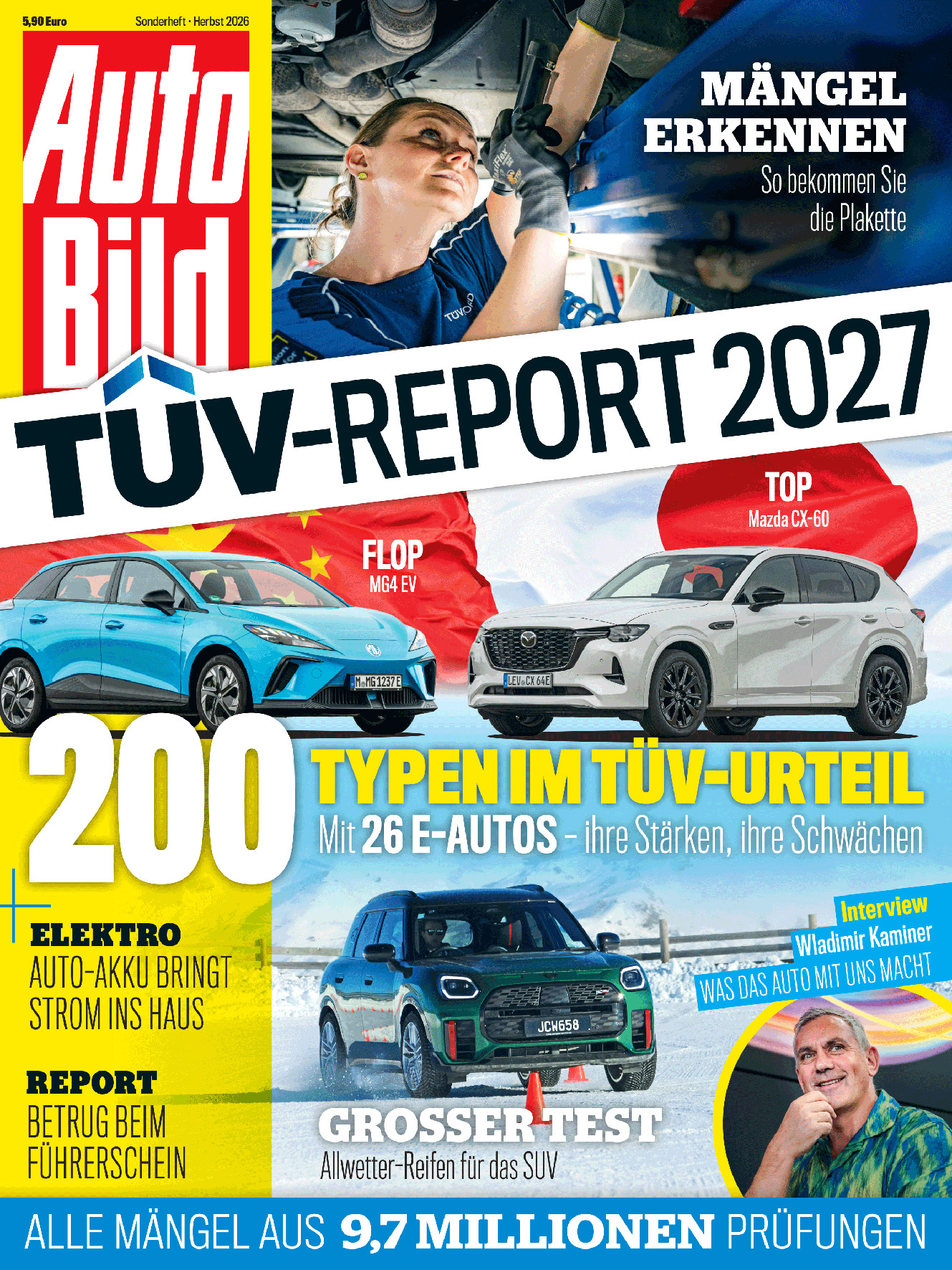
The results of the TÜV Report 2027 show that vehicles in Germany are maintaining roughly the same high level of safety. Despite the fleet’s average age continuing to rise, the overall major-deficiency rate has fallen slightly by 0.6 percentage points to 20.9 percent. Deficiency rates for electric vehicles span the entire spectrum, from very good to very poor. Against the backdrop of currently high fuel prices, generally tight household budgets and overall uncertainty, TÜV SÜD experts have taken a closer look specifically at five-year-old used electric vehicles. European vehicles perform particularly well. By contrast, the first electric car from China ranks right at the bottom of the deficiency table at its first periodic roadworthiness test (PTI).
"The sales figures speak for themselves: primarily because of high fuel prices, more and more people are switching to electric drive, and the used-car market in this segment almost doubled from 2025 to 2026. Another reason is that many of these vehicles are now returning from leasing contracts,” says Jürgen Wolz, member of the Management Board of TÜV SÜD Auto Service GmbH.
According to figures from the Fraunhofer Institute, electric vehicles now account for ten percent of changes of ownership. In the first four months of 2026 alone, around 120,000 used BEVs changed hands. The age threshold is around five years. Reason enough for TÜV SÜD’s experts to take a close look at precisely these electric vehicles in terms of maintenance, wear and safety.
Cool when the quality is right
Many affordable five-year-old electric models feature among the top 20 in the analysis, including the Renault Twingo Z.E. After five years, it has covered an average of only 34,000 kilometres and has a major-deficiency rate of 5.7 percent. The Fiat 500e has 43,000 kilometres on the clock and a major-deficiency rate of 6.7 percent. The Smart Fortwo EQ is also small in terms of both dimensions and major-deficiency rate, at 6.9 percent and 29,000 kilometres. The Smart comes out on top in its class ranking, winning the mini-car category.
Those who need something larger can travel safely and with zero local emissions in the Mazda MX-30 e-Skyactiv: major-deficiency rate 6.1 percent, 45,000 kilometres. After five years, the Peugeot e-2008 is in even better condition, with a major-deficiency rate of 5.5 percent at around 42,000 kilometres.
Good when it’s affordable
Prices offered by one of the leading online retailers of used vehicles are moderate: the Renault is available from EUR 11,000, while the Fiat 500e costs EUR 13,000, as does the small class winner, the Smart Fortwo EQ. The Mazda is available from around EUR 17,000 and the Peugeot from around EUR 20,000.
Bad when you can’t see anything
A look at vehicle components susceptible to wear reveals a fairly uniform picture, with components causing similar problems to those found in vehicles with combustion engines. Historically, lighting has been the main issue across all vehicles. After five years, the Peugeot has an above-average major-deficiency rate of 2.2 percent for dipped-beam headlights. For the Twingo and Fiat 500e, the figure is 1.7 percent. The Mazda stands out positively when it comes to dipped-beam headlights, with a below-average deficiency rate of just 0.5 percent.
A concern when it comes to the brakes
After all, brakes are also safety-critical. The e-2008 and the Twingo need new brake pads after just three years. After five years and the corresponding replacement, the major-deficiency rate improves, but remains above average at 1.5 and 1.2 percent respectively.
On the Fiat and Mazda, the pads are in good condition. After five years, however, the function of the foot brake is criticised more frequently than on other cars, at 0.5 percent for each model. The Mazda also needs new brake discs, with a major-deficiency rate of 3.3 percent, while the Fiat records a major-deficiency rate of 2.2 percent for axle suspension.
Wolz’s conclusion: “The claim that electric cars do not require maintenance is incorrect. For many models, the results of the TÜV Report 2027 paint a different picture.” A look at the individual components also clearly shows that electric cars are mostly used in metropolitan areas and their surroundings. Examples include brake deficiencies potentially caused by vehicles standing unused for extended periods, or axle deficiencies that are not infrequently the result of hitting kerbs. “These are therefore components that deserve particular attention in electric cars, too. Regular maintenance improves safety and also helps ensure there are no issues when it comes to passing the periodic roadworthiness test,” adds the TÜV SÜD expert.
Great when you can be sure
With demand for used electric vehicles rising significantly, TÜV SÜD experts are also seeing a sharp increase in demand for SoH tests. A so-called state-of-health test determines the remaining capacity of the traction battery. The result is expressed as a percentage, similar to the battery-health information familiar from smartphones. Following the SoH test, which can now be carried out at almost every TÜV SÜD Service Center, customers receive a detailed test report on the condition of the traction battery. Such an independent report makes the vehicle more attractive to potential buyers and gives buyers greater confidence. Incidentally, if a seller is unwilling to have the battery checked before the purchase contract is signed, it is advisable to walk away.
Top when it doesn’t cost too much: Mazda CX-60 wins
Now to the overall analysis of almost 10 million periodic roadworthiness tests conducted by the TÜV Association between July 2025 and June 2026. The winner of the TÜV Report 2027 demonstrates that quality does not necessarily have to be very expensive: the Mazda CX-60 has an average major-deficiency rate of just 2.3 percent after three years, with an average mileage of 45,000 kilometres. Second place goes to the Mercedes GLA, with a major-deficiency rate of 2.9 percent and 43,000 kilometres. Third place goes to another Mazda, this time an electric one: the MX-30 e-Skyactiv.
The average major-deficiency rate currently stands at 20.9 percent. This is 0.6 percentage points lower than in the TÜV Report 2026 and affects a total of two million vehicles. This figure includes 0.05 percent with dangerous deficiencies. Almost 70 percent of vehicles pass the test without any deficiencies at all, equivalent to 6.4 million cars. The rate of minor deficiencies currently stands at 12.4 percent.
Notable when it comes to the bottom of the table
As in 2025, the Tesla Model Y finishes right at the bottom of the table, with an 18.5 percent major-deficiency rate and an average mileage of 58,000 kilometres. Second from bottom is the first Chinese car to feature in the statistics: the MG MG4, with a major-deficiency rate of 16 percent, although at a considerably lower mileage of 37,000 kilometres. Just ahead of it is another US model, the Tesla Model 3, at 12.5 percent and 55,000 kilometres.
First-class when it’s electric
In the “Mini” category, the electric Smart takes first place with 4.3 percent, while the Mini Cooper SE wins the small-car category with 3.3 percent. In the compact class, the BMW 1 Series/2 Series comes out on top with 3.6 percent. The Hyundai Ioniq wins the mid-size category. Overall winner Mazda CX-60 takes the SUV category, while the Mercedes B-Class wins among vans with 3.6 percent.
Interesting when it gets regional
TÜV SÜD also analyses its data from the German states of Bavaria, Baden-Württemberg and Saxony, as well as Hamburg. Across all age groups, Bavaria has the lowest deficiency rate at 16.7 percent, followed by Saxony at 17.3 percent and Baden-Württemberg at 19.5 percent. Hamburg recorded the highest rate: in TÜV HANSE’s home territory, 27 percent of all vehicles had to return to the workshop because of major deficiencies.
The TÜV Report is published annually by the TÜV Association and is regarded as one of the most important independent guides for motorists and used-car buyers. It incorporates the results of periodic roadworthiness tests conducted by all TÜV organisations in Germany. The 2027 report is based on almost 10 million periodic roadworthiness tests carried out between July 2025 and June 2026. As Germany’s largest TÜV organisation for vehicles, TÜV SÜD contributed around 40 percent of the data records.
The TÜV Report 2027 will be available from Thursday, 19 November 2026, priced at EUR 5.90, from TÜV SÜD Service Centers and retailers.
Note to editors: Facts and figures are available at tuvsud.com/tuev-report and tuev-verband.de.
Press contact: Vincenzo Lucá
TÜV-Report 2027
