Get started with TÜV SÜD
Start your recycled content certification journey with us.

Allegations of greenwashing, stricter environmental requirements and increasing pressure to act on sustainability raise an important question for companies:
How can the recycled content in materials or products be demonstrated transparently and in conformity with applicable standards?
The answer: through our TÜV SÜD Recycled Content Programme (RCP), an independent certification in accordance with EN 15343, ISO 14021 and EN 45557. These standards ensure the traceability of material flows and the correct declaration of post-consumer recycled material (PCR) and post-industrial recycled material (PIR).
In this way, companies create transparency and legal certainty – also with regard to the Empowering Consumers Directive (EmpCo) and the Green Claims Directive (GCD).
Independent assessment by TÜV SÜD
Certification in accordance with the requirements of EN 15343 and ISO 14021 (e.g. as evidence for GCD and EmpCo).
Implementation of complex standards
Clear technical requirements help recyclers, compounders and manufacturers determine, declare and communicate the share of recycled content correctly.
Transparency throughout the entire supply chain
TÜV SÜD audits document the entire supply chain of the recycled materials without gaps and thus reliably confirm the recycled content.
Faster market access
With evidence that complies with applicable standards you fulfil legal requirements and shorten your time to market.
Avoid greenwashing
Substantiate your sustainability promises with robust data and independent certificates.
Differentiation by type of recyclate
TÜV SÜD certifies PCR and PIR separately in accordance with ISO 14021 to clearly indicate the origin of the recycled materials.
The certification is not mandatory, but it is increasingly required by authorities, funding programmes and public tenders.
In view of the planned Green Claims Directive (GCD), the application of standards such as EN 15343 is more important than ever. Companies that wish to advertise the recycled content of their materials or products will in future need to ensure that their statements comply with the requirements of the GCD.
The Directive requires that voluntary environmental claims such as “contains 60 % recycled material” must be:
Even though the political approval of the GCD is currently delayed, the Empowering Consumers Directive (EmpCo) is still effective. From a consumer-protection perspective, it prohibits vague or unsubstantiated environmental claims. Since March 2026 it is transposed into national law by all EU Member States and must be applied from September 2026 onwards.
Certification in accordance with the TÜV SÜD RCP immediately puts you on the safe side and protects you from legal risks, for example warnings and legal action based on the German Act against Unfair Competition (UWG).
Certification in accordance with EN 15343 is your solution for transparent and standard-compliant sustainability evidence. TÜV SÜD offers you a structured assessment process and extensive sector expertise.
Certification provides legal certainty and gives your company a competitive advantage, in particular with regard to upcoming EU legislation such as the GCD.
Proof of recycled content must be based on a product-based mass balance – not on purely book-keeping or paper-based accounting. The decisive factor is the actual material flow (chain of custody) throughout the entire supply chain.
This means:
The cost of certification in accordance with EN 15343 and ISO 14021 depends on various factors:
After an initial review you will receive a transparent and comprehensible quotation tailored to your specific requirements.

Our recycled content certification services follow these steps:
1. Submit an application to TÜV SÜD
You submit an application for certification, providing all relevant information on products and processes.
2. Receive an offer
On the basis of the submitted information TÜV SÜD prepares an individual offer. The scope of assessment, audit plan and certification costs are presented transparently.
3. Audit preparation and supply chain evaluation
In advance you receive a detailed audit plan including a checklist of required evidence. During the subsequent on-site audit TÜV SÜD reviews the production processes, material flows and traceability along the supply chain.
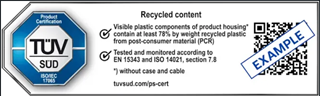 4. Certification with optional TÜV SÜD mark
After successful assessment, TÜV SÜD issues the EN 15343 certificate. For finished products, a TÜV SÜD mark can optionally be used to visibly communicate conformity of the finished product.
5. Regular surveillance
TÜV SÜD performs regular surveillance audits to ensure ongoing compliance with the certification requirements. Certificates are usually valid for one year; in individual cases (e.g. one-off or batch-based production) validity may be up to three years.