
Product Carbon Footprint (PCF) – Advanced Training
Calculating and Reporting the CO₂ Footprint of Products with Life Cycle Assessment according to ISO 14067 and ISO 14040/44 – Expert Training with Exam
Organizations increasingly need reliable Product Carbon Footprints (PCFs) and Life Cycle Assessments (LCAs) to meet customer expectations, support sustainability strategies, respond to regulatory requirements, and drive product decarbonization. This advanced training provides participants with the knowledge and practical skills required to calculate, interpret, validate, and communicate PCFs using internationally recognized methodologies and standards.
Participants will learn how to apply ISO 14040/44 and ISO 14067 in practice, develop robust LCA and PCF models, assess data quality, perform hotspot and sensitivity analyses, and manage emissions data across complex supply chains. The course also addresses supplier data management, industry frameworks such as PACT, Catena-X and TfS, Chain of Custody approaches, and third-party verification requirements, preparing participants for the TÜV examination leading to the qualification "Product Carbon Emissions Accounting Expert – TÜV."
Upon completion of this course, participants will be able to:
- Explain the principles, structure, and requirements of ISO 14040, ISO 14044, and ISO 14067.
- Define goals, scopes, system boundaries, functional units, and reference flows for LCA and PCF studies.
- Build and document life cycle inventories using primary and secondary data.
- Assess and validate data quality according to recognized quality criteria.
- Apply allocation rules, recycling approaches, and electricity modeling requirements.
- Select appropriate impact assessment methodologies and interpret environmental results.
- Conduct contribution, hotspot, sensitivity, uncertainty, and scenario analyses.
- Prepare standards-compliant LCA and PCF reports.
- Distinguish between critical review, verification, validation, and certification activities.
- Evaluate supplier data, EPDs, and Product Carbon Footprints.
- Apply industry frameworks and digital data exchange concepts for supply-chain carbon accounting.
- Support organizational decision-making and product decarbonization strategies using LCA and PCF results.
This course is designed for:
- Sustainability and ESG professionals
- Environmental managers
- Climate change managers
- Product sustainability specialists
- Product managers
- LCA practitioners and analysts
- Carbon accounting professionals
- Product stewardship professionals
- Supply chain and procurement professionals
- Decarbonization teams
- Environmental reporting specialists
- Quality and compliance professionals
- Consultants supporting sustainability initiatives
- Professionals responsible for sustainability reporting and product environmental performance
Day 1–2: Advanced Life Cycle Assessment and Product Carbon Footprint Methodology
Foundations and Standards
- LCA and PCF fundamentals
- ISO 14040/44 and ISO 14067 requirements
- Relationship between relevant standards
Phase 1: Goal and Scope Definition
- System boundaries
- Functional and declared units
- Reference flows
- Product Category Rules (PCRs)
- Cut-off criteria
- Data quality requirements
Phase 2: Life Cycle Inventory Analysis
- Activity data collection
- Primary and secondary data
- Inventory modeling
- Allocation approaches
- Recycling methodologies
- Dataset selection
- Electricity modeling
- Handling missing data
- Data quality assessment and validation
Phase 3: Life Cycle Impact Assessment
- Impact categories
- Greenhouse gas assessment
- Impact assessment methods
- Environmental footprint methodologies
- Contribution analysis
- Hotspot identification
- Sensitivity and scenario analysis
Phase 4: Interpretation and Reporting
- Result interpretation
- Conclusions and recommendations
- Reporting requirements
- PCF and LCA report structures
- Common methodological errors
Third-Party Assurance
- Critical review
- Verification and validation
- Audit processes
- Assurance requirements
Day 3: Supply Chain Carbon Accounting
Supplier Data Management
- Supplier data collection
- Data quality and representativeness
- Managing missing data
- Modeling supplier emissions
Evaluation of External Assessments
- Product Carbon Footprints (PCFs)
- Environmental Product Declarations (EPDs)
- Impact assessment compatibility
- Methodological consistency
Industry Standards and Frameworks
- PACT
- Catena-X
- Together for Sustainability (TfS)
- Digital PCF data exchange
Chain of Custody (CoC)
- Identity Preserved
- Segregated
- Controlled Blending
- Mass Balance
- Book-and-Claim
- Implications for PCF calculations
Practical Case Studies and Recommendations
- Decision-making frameworks
- Supply-chain modeling approaches
- Best practices and implementation guidance
Examination
Product Carbon Footprints (PCFs) and Life Cycle Assessments (LCAs) have become essential tools for organizations seeking to quantify environmental impacts, support decarbonization initiatives, and demonstrate transparency across product value chains. As customer requirements, ESG expectations, and sustainability regulations continue to evolve, organizations increasingly require professionals capable of producing credible, standards-based environmental assessments.
This advanced training provides a comprehensive and practical approach to Product Carbon Footprint development using internationally recognized methodologies, including ISO 14040, ISO 14044, and ISO 14067. Participants gain an in-depth understanding of the complete LCA framework, from goal and scope definition through inventory analysis, impact assessment, interpretation, reporting, and third-party review.
Through practical exercises and case studies, participants learn how to collect and validate activity data, assess data quality, select appropriate datasets, apply allocation and recycling methods, handle uncertainty, and conduct sensitivity and contribution analyses. The course also explores reporting requirements, verification processes, common methodological pitfalls, and the interpretation of results to support sustainability decision-making.
A dedicated module focuses on carbon accounting within supply chains. Participants learn how to obtain, evaluate, and integrate supplier emissions data, assess Product Carbon Footprints and Environmental Product Declarations (EPDs), and manage challenges related to data consistency, comparability, and transparency.
The training additionally introduces current industry frameworks and digital data exchange initiatives, including PACT, Catena-X, and Together for Sustainability (TfS). Participants gain practical insights into Chain of Custody approaches, mass-balance concepts, and emerging best practices for exchanging PCF data across complex value chains. Successful completion of the examination demonstrates professional competence in product carbon accounting and leads to the qualification "Product Carbon Emissions Accounting Expert – TÜV."
You will be able to:
- Apply advanced Life Cycle Assessment (LCA) methodologies in accordance with ISO 14040/44 and ISO 14067.
- Develop robust and traceable Product Carbon Footprints (PCFs).
- Define appropriate system boundaries, functional units, and reference flows.
- Collect, evaluate, and validate primary and secondary data.
- Assess data quality and uncertainty using industry best practices.
- Apply allocation principles and recycling methodologies correctly.
- Perform contribution analyses, sensitivity analyses, and scenario evaluations.
- Understand environmental impact assessment methods and their practical applications.
- Prepare standards-compliant LCA and PCF reports.
- Understand third-party review, verification, and audit requirements.
- Evaluate supplier-provided PCFs, LCAs, and Environmental Product Declarations (EPDs).
- Improve emissions transparency across complex supply chains.
- Understand industry PCF frameworks such as PACT, Catena-X, and TfS.
- Support sustainability reporting, product stewardship, and decarbonization initiatives.
- Qualify for the TÜV examination and expert certification.
This instructor-led training combines theoretical knowledge with practical application through:
- Expert-led presentations
- Interactive discussions
- Guided exercises
- Real-world case studies
- Spreadsheet-based calculations
- Practical LCA and PCF modeling activities
- Group exercises and problem-solving sessions
- Contribution, sensitivity, and scenario analyses
- Knowledge checks and exam preparation activities
Participants are encouraged to actively engage in exercises and discussions throughout the training.
Participants who attend at least 90% of the training will receive a TÜV SÜD Certificate of Attendance.
The training concludes with a final examination which lasts 30 minutes. Upon successful completion of the exam, participants will receive an officialcertificate as “Product Carbon Emissions Accounting Expert – TÜV” issued by TÜV SÜD Academy.
To obtain the certification, participants must complete an online proctored examination independently. Exam access is activated on the final day of the training at 5:00 p.m., and candidates may schedule and complete the exam at a time convenient to them within six days of course completion. Examination access details and instructions will be provided via email.
Participants should have access to a laptop with Microsoft Word and Microsoft Excel installed inorder to take part in practical exercises.
- Basic understanding of sustainability, carbon accounting, or environmental management concepts.
- Prior knowledge of Life Cycle Assessment (LCA) methodology is highly recommended.
- Familiarity with environmental or sustainability reporting is beneficial but not mandatory.
- Participants should have access to a laptop with Microsoft Excel and Microsoft Word installed for practical exercises.
Learning Paths:
The Carbon Management curriculum offers two specialized learning paths that allow learners to build expertise based on their professional focus: the Corporate Carbon Learning Path and the Product Carbon Learning Path:
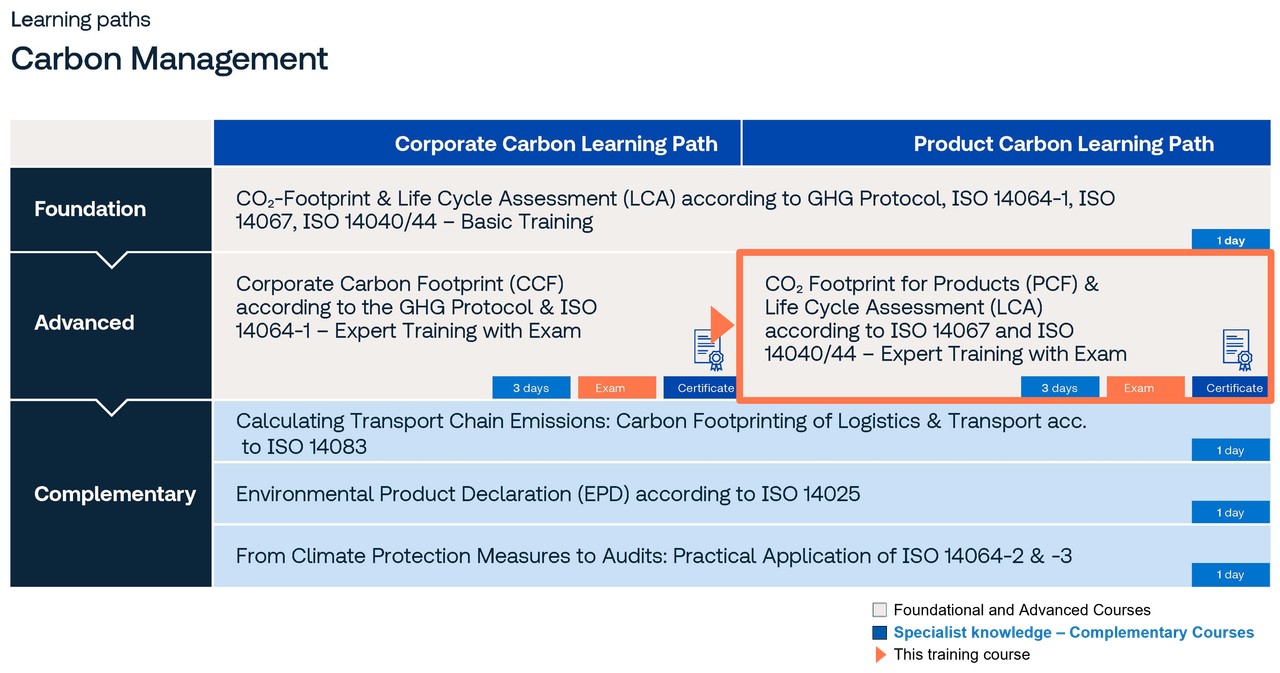
As illustrated in the learning path overview, both pathways begin with the same foundational course, Carbon Footprint and Life Cycle Assessment (LCA) – Fundamentals (25-03-26-0012), which introduces the core principles of carbon footprinting, life cycle assessment methodologies, and the relevant international standards and frameworks. This foundation ensures that all participants develop a consistent understanding of carbon accounting before progressing to more advanced topics.
After completing the foundation course, learners can select the path that best aligns with their role and objectives:
- Those interested in organizational greenhouse gas accounting and reporting can follow the Corporate Carbon Learning Path by attending Corporate Carbon Footprint (CCF) – Advanced Training (25-03-26-0015), or
- Alternatively, learners focused on evaluating and reducing product-related emissions can pursue the Product Carbon Learning Path through Product Carbon Footprint (PCF) – Advanced Training (25-03-26-0016).
Both learning paths are further supported by complementary courses that expand practical carbon management knowledge, including Calculating Transport Emissions: Carbon Footprint of Logistics and Transport according to ISO 14083 (25-03-26-0008).
Additional courses planned for future release include Environmental Product Declaration (EPD) according to ISO 14025 and From Climate Protection Measures to Audits: Practical Application of ISO 14064-2 & -3, providing learners with broader expertise in sustainability reporting, verification, and climate action implementation.
What is the difference between LCA and PCF?
LCA evaluates multiple environmental impact categories across a product's life cycle, while PCF focuses specifically on greenhouse gas emissions and climate change impacts.
Which standards are covered in the course?
The course primarily covers ISO 14040, ISO 14044, and ISO 14067, while also discussing related standards and frameworks relevant to carbon accounting and verification.
Does the course focus only on carbon footprint calculations?
No. Participants learn advanced Life Cycle Assessment methodology, environmental impact assessment, reporting, data quality management, supplier data integration, and verification principles in addition to PCF development.
Will I learn how to calculate a Product Carbon Footprint?
Yes. The course provides practical guidance on developing, documenting, interpreting, and reporting Product Carbon Footprints using internationally recognized methodologies.
Are practical exercises included?
Yes. The training includes case studies, spreadsheet-based exercises, inventory modeling activities, allocation calculations, sensitivity analyses, and reporting exercises.
Is supply-chain carbon accounting covered?
Yes. A dedicated module focuses on supplier data collection, evaluation of external emissions data, supply-chain modeling, and PCF data exchange.
Will the course cover supplier PCFs and EPDs?
Yes. Participants learn how to evaluate Product Carbon Footprints, Environmental Product Declarations (EPDs), and other supplier-provided environmental data.
What is Chain of Custody and why is it important?
Chain of Custody describes how material attributes and environmental information are tracked through supply chains. The course covers various CoC models and their implications for carbon accounting.
Are industry initiatives such as Catena-X and PACT included?
Yes. The course introduces major frameworks including PACT, Catena-X, and Together for Sustainability (TfS) and their role in exchanging PCF data.
Does the course address data quality and verification?
Yes. Participants learn data quality assessment, validation procedures, sensitivity analysis, critical review, and verification concepts.
Is software training included?
The course discusses common LCA software tools and databases, but the primary focus is on methodology, modeling principles, and practical application.
What certification can I obtain?
Participants who successfully complete the examination receive the qualification:
Product Carbon Emissions Accounting Expert – TÜV
issued by TÜV SÜD Academy.
How long is the course?
The training is delivered over three days.
What are the prerequisites?
Basic knowledge of LCA is highly recommended. Participants should also bring a laptop with Microsoft Excel and Word to participate in practical exercises.
Who should attend this training?
The course is designed for sustainability professionals, product managers, environmental specialists, ESG teams, carbon accounting practitioners, supply-chain professionals, and anyone responsible for product-level emissions and environmental impact assessments.
Train with Industry Experts
Learn from specialist instructors at TÜV SÜD Academy—recognized leaders with deep expertise in their fields. For over 35 years, our global network of 2,500+ trainers has delivered practical, real-world knowledge that you can apply immediately.
Our courses are continuously updated to reflect the latest regulatory changes and industry best practices, ensuring you gain relevant, up-to-date skills with every session.