
Calculating Transport Emissions: Carbon Footprint of Logistics and Transport according to ISO 14083
Recording and Evaluating Greenhouse Gas Emissions Along the Transport Chain in Accordance with ISO 14083
This training provides a structured and practical introduction to calculating greenhouse gas (GHG) emissions from logistics and transport operations in accordance with ISO 14083. Participants will learn how to quantify emissions consistently across multimodal transport chains, ensuring transparency, comparability, and compliance with international standards.
The course combines conceptual foundations with hands-on calculation methods, enabling participants to apply ISO 14083 step-by-step—from defining transport chains to calculating emission intensity and reporting results.
By the end of this training, participants will be able to:
- Explain ISO 14083 principles, system boundaries, and terminology
- Break down transport chains into elements and operations
- Distinguish between TTW, WTT, and emission intensity metrics
- Calculate GHG emissions and emission intensity across transport operations
- Apply ISO 14083 methodology to real-world case studies
- Interpret and report results for internal and external stakeholders
This course is ideal for professionals involved in transport, logistics, and sustainability, including:
- Logistics and supply chain managers
- Freight forwarders and logistics service providers
- Sustainability, ESG, and environmental professionals
- Procurement and operations teams
- Anyone responsible for Scope 3 emissions or carbon accounting in transport
Key topics covered include:
- Introduction to ISO 14083 and transport emissions accounting
- Transport chain structure and system boundaries
- Step-by-step calculation methodology (TC, TCE, TOC, HOC)
- Emission factors, activity data, and data quality
- Emission intensity calculation across transport modes (road, rail, air, sea)
- Case studies and practical exercises
- Integration into GHG Protocol and ESG reporting
- Reporting, communication, and compliance
Transport and logistics are among the most significant contributors to global greenhouse gas emissions, making accurate measurement and reporting essential for any organization committed to sustainability. This course introduces participants to ISO 14083, the international standard for quantifying and reporting emissions from transport operations, providing a consistent framework for calculating carbon footprints across complex logistics networks.
Participants will gain a deep understanding of how transport chains are structured and how emissions are assigned to individual transport and handling activities. Through a step-by-step methodology, the course explains how to calculate emission intensity using real operational data, emission factors, and standardized approaches. From road and rail to air and maritime transport, learners will explore how different transport modes contribute to total emissions.
A key feature of the training is its strong practical orientation. Participants will work through real-world case studies, applying ISO 14083 calculation steps to actual logistics scenarios. This includes defining transport chains, categorizing operations, calculating activity data, and aggregating emissions to produce meaningful insights for reporting.
The course also addresses the integration of ISO 14083 into broader frameworks such as the GHG Protocol and ESG reporting requirements. Participants will learn how to ensure transparency, data quality, and compliance while generating reliable, comparable results that support strategic decision-making.
By the end of the training, attendees will be equipped with the knowledge and tools needed to quantify transport emissions accurately, identify reduction opportunities, and strengthen their organization’s sustainability performance in line with global standards.
Transport chains are the backbone of our global economy and a crucial lever for climate protection. Demand for climate-neutral transport solutions is steadily increasing. Those who take responsibility today will shape future-proof logistics processes tomorrow. This training course enables you to transparently record and assess emissions along your supply chains in accordance with ISO 14083 and GHG Protocol. You will also gain insight into deriving targeted measures for avoiding and reducing emissions.
- Gain a clear, standardized methodology for calculating transport emissions across complex supply chains
- Improve Scope 3 emissions accounting and sustainability reporting capabilities
- Enable data-driven decision-making for emissions reduction initiatives
- Align your organization with ISO 14083, GHG Protocol, and ESG reporting expectations
- Strengthen credibility through consistent, transparent carbon footprint calculations
This is a live, instructor-led virtual classroom training with a strong practical focus. Participants benefit from:
- Expert-led lectures
- Interactive discussions and Q&A
- Hands-on exercises and case studies
- Real-world calculation examples
- Peer learning and collaboration
Participants engage in a fully interactive online environment using webcam and audio.
Participants who attend at least 90% of the training will receive a TÜV SÜD Certificate of Attendance, validating their knowledge of ISO 14083 transport emissions calculation.
Basic understanding of carbon accounting, LCA, or sustainability concepts is recommended.
Additional Information:
- Participants should ensure access to a laptop/computer with Word and Excel installed.
- Familiarity with Excel and data handling is beneficial
How This Course Fits into the Carbon Management Learning Path
As organizations mature their carbon management programs, they need to move beyond general greenhouse gas accounting and develop the capability to measure emissions within specific operational areas. Transport and logistics emissions often represent a significant portion of Scope 3 emissions, making accurate quantification increasingly important for sustainability reporting, supplier engagement, and decarbonization initiatives.
The Calculating Transport Emissions: Carbon Footprint of Logistics & Transport according to ISO 14083 course is positioned as a complementary specialization course within the Carbon Management Learning Path. It expands on the carbon accounting principles introduced in the Foundation training and provides focused, practical guidance on calculating greenhouse gas emissions from transport chains and logistics activities using the internationally recognized ISO 14083 standard.
Learners who have completed the Carbon Footprint and Life Cycle Assessment (LCA) – Fundamentals (25-03-26-0012) will find this course a natural next step to deepen their understanding of transport-related emissions. Likewise, participants enrolled in or completing theCorporate Carbon Footprint (CCF) – Advanced Training (25-03-26-0015) or the Product Carbon Footprint (PCF) – Advanced Training (25-03-26-0016) can use this course to strengthen their expertise in one of the most important and challenging categories of Scope 3 emissions. The course provides detailed methods for calculating emissions from road, rail, air, maritime, and multimodal transport operations and demonstrates how these calculations integrate into broader corporate and product carbon footprint assessments.
Unlike the Foundation and Advanced courses, which provide comprehensive coverage of carbon accounting frameworks, this 1-day training focuses exclusively on the quantification and reporting of transport emissions. Participants learn how to apply ISO 14083 calculation methodologies, assess data quality, determine emission intensity, and generate transparent and comparable results for reporting and decision-making.
Whether you are responsible for corporate carbon accounting, product carbon footprinting, logistics operations, procurement, or sustainability reporting, this course provides valuable specialist knowledge that complements and strengthens your overall carbon management capabilities. It is particularly beneficial for professionals seeking to improve the accuracy of transport-related Scope 3 emissions calculations and support transport decarbonization strategies across the value chain.
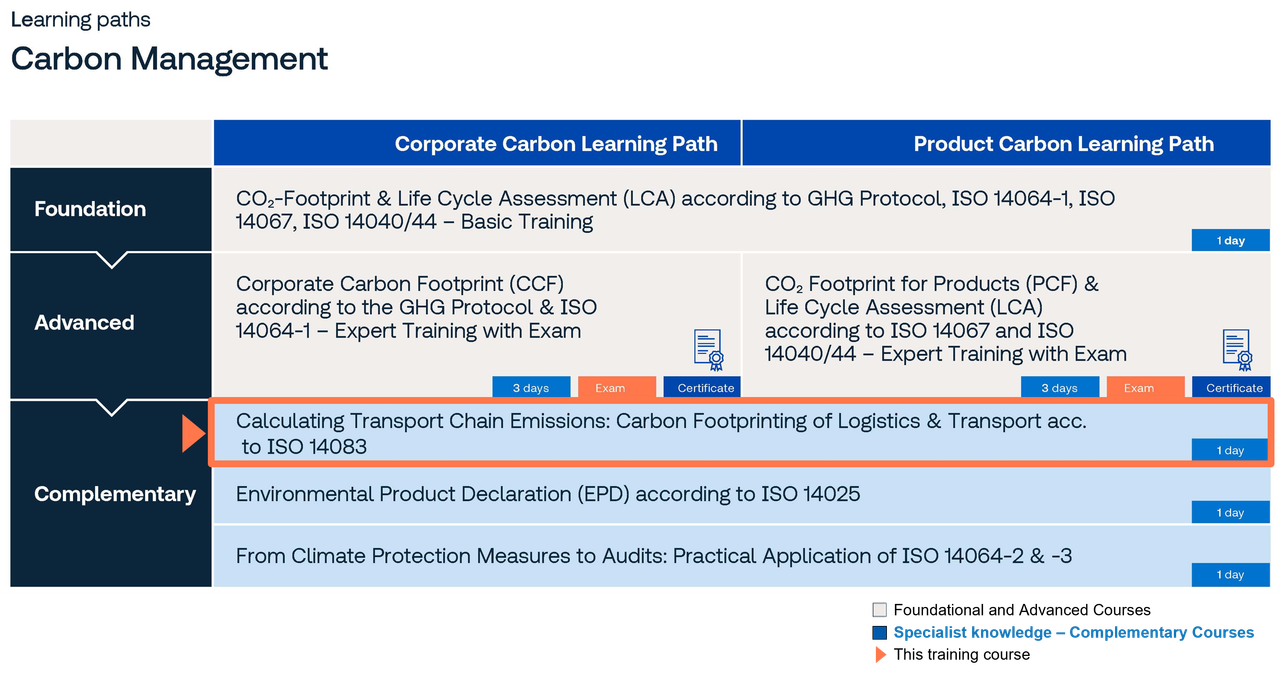
Recommended Learning Path:
- Foundation: Carbon Footprint and Life Cycle Assessment (LCA) – Fundamentals (25-03-26-0012) according to GHG Protocol, ISO 14064-1, ISO 14067, and ISO 14040/44
- Advanced (Optional Specialization):
- Corporate Carbon Footprint (CCF) – Advanced Training (25-03-26-0015), or
- Product Carbon Footprint (PCF) – Advanced Training (25-03-26-0016)
- Complementary Specialization: Calculating Transport Emissions: Carbon Footprint of Logistics & Transport according to ISO 14083
This complementary course enables learners to bridge the gap between general carbon accounting principles and the practical challenges of calculating, reporting, and managing emissions across transport and logistics networks.
General
Q1. What is ISO 14083?
ISO 14083 is an international standard for quantifying and reporting greenhouse gas emissions from transport chains.
Q2. What will I learn in this course?
You will learn how to calculate, analyze, and report transport emissions using ISO 14083 methodology.
Q3. Is this course practical or theoretical?
It is highly practical, with case studies, exercises, and real-world calculation examples.
Technical Content
Q4. Do I need prior knowledge?
Basic knowledge of carbon accounting or sustainability is recommended but not mandatory.
Q5. What is covered in emission calculations?
The course covers transport activity, emission factors, TTW/WTT, emission intensity, and full transport chain calculations.
Q6. Are all transport modes included?
Yes—road, rail, air, maritime, and hub operations are covered.
Business Value
Q7. How does this help with Scope 3 reporting?
It provides a standardized method to quantify transport-related Scope 3 emissions.
Q8. Is ISO 14083 aligned with other frameworks?
Yes, it aligns with GHG Protocol, ISO 14064, and sustainability reporting standards.
Course Format
Q9. Is the course live or self-paced?
It is a live, instructor-led virtual classroom training.
Q10. Will I receive a certificate?
Yes, participants receive a TÜV SÜD Certificate of Attendance.
Q11. What do I need to attend?
A computer with internet access, webcam, microphone, and basic office software.
Advanced / Practical
Q12. Will I learn how to calculate emissions step-by-step?
Yes, the course walks through the full ISO 14083 calculation process.
Q13. Are real case studies included?
Yes, practical case studies are a core part of the training.
Q14. Can I apply this to my company?
Yes, the methodology is directly applicable to real logistics operations.
Train with Industry Experts
Learn from specialist instructors at TÜV SÜD Academy—recognized leaders with deep expertise in their fields. For over 35 years, our global network of 2,500+ trainers has delivered practical, real-world knowledge that you can apply immediately.
Our courses are continuously updated to reflect the latest regulatory changes and industry best practices, ensuring you gain relevant, up-to-date skills with every session.
Organizer / Distributor Information