
GHG Inventory Accounting & Reporting for Organizations (ISO 14064-1)
Master GHG Inventory Accounting and Reporting aligned with ISO 14064‑1 in just one day.
Gain a comprehensive understanding of greenhouse gas (GHG) inventory accounting and reporting with this focused one‑day training based on ISO 14064‑1. This course introduces participants to the principles, methodologies, and requirements needed to quantify and report organizational emissions in a structured and internationally recognized manner.
Through a blend of theory, practical examples, and interactive exercises, learners will explore how to define organizational and reporting boundaries, classify emissions (Scope 1, 2, and 3), and apply appropriate quantification methodologies. The course also covers documentation, data quality management, and reporting expectations aligned with ISO standards.
Designed for professionals involved in sustainability, ESG reporting, and environmental management, this course equips you with the knowledge and tools to develop accurate, auditable, and compliant GHG inventories for your organization.
By the end of this course, participants will be able to:
- Understand the fundamentals of climate change and greenhouse gas emissions
- Interpret key requirements of ISO 14064‑1 for organizational GHG accounting
- Define organizational and reporting boundaries
- Classify emissions into Scope 1, Scope 2, and Scope 3
- Apply GHG accounting and reporting principles (relevance, completeness, consistency, accuracy, transparency)
- Quantify GHG emissions using appropriate methodologies and emission factors
- Establish a baseline year and track emissions over time
- Identify and document significant indirect emissions
- Understand data quality requirements and uncertainty considerations
- Develop GHG inventory reports aligned with ISO 14064‑1
This course is ideal for:
- Sustainability and ESG professionals
- Environmental, Health & Safety (EHS) managers
- Energy managers and climate analysts
- Corporate reporting and compliance professionals
- Consultants involved in carbon footprinting and sustainability reporting
- Organizations preparing for GHG verification or certification
Key topics covered include:
Introduction & Fundamentals
- Climate change and greenhouse gas emissions
- Global frameworks and standards (IPCC, GHG Protocol, ISO 14060 family)
ISO 14064‑1 Overview
- Structure and requirements of the standard
- GHG accounting and reporting principles
Organizational & Reporting Boundaries
- Organizational boundaries (control vs equity share)
- Reporting boundaries and emission identification
- Scope 1, Scope 2, and Scope 3 emissions classification
GHG Quantification
- Identification of emission sources and sinks
- Data collection and activity data
- Emission factor selection and application
- Calculation methods and CO₂e conversion
Baseline & Data Management
- Establishing a base year
- Data quality, completeness, and uncertainty management
Mitigation & Improvement
- GHG reduction initiatives and strategies
- Setting targets and tracking progress
Reporting & Documentation
- GHG inventory structure and reporting requirements
- Documentation, audit readiness, and verification support
Practical Exercises & Case Studies
- Organizational boundary definition
- GHG calculations and reporting scenarios
Final Assessment
- Short exam to evaluate learning
As climate disclosure requirements and sustainability expectations continue to grow, organizations must develop reliable and transparent GHG inventories. This one‑day training course provides a practical introduction to ISO 14064‑1, the internationally recognized standard for organizational-level GHG accounting and reporting.
Participants will begin with a foundational understanding of climate change, greenhouse gases, and key global frameworks such as IPCC guidelines and the Paris Agreement. The course establishes the importance of GHG measurement as the first step toward effective climate action and transparent carbon footprint reporting.
A core focus of the training is on building a robust GHG inventory. You will learn how to define organizational and reporting boundaries, apply control or equity share approaches, and identify emissions sources across Scope 1, Scope 2, and Scope 3 categories.
The course also provides hands-on guidance on quantification methodologies, including activity data collection, selection of emission factors, and calculation techniques. Practical examples and exercises help participants understand how to translate data into accurate emissions results expressed in CO₂ equivalents while minimizing uncertainty.
Finally, the training covers mitigation strategies, documentation requirements, quality management of GHG inventories, and reporting expectations. By the end of the course, participants will be able to develop and communicate a compliant GHG inventory that supports internal decision-making, regulatory compliance, and sustainability reporting initiatives.
- Gain practical knowledge of ISO 14064‑1 requirements
- Build confidence in preparing GHG inventories
- Improve accuracy and transparency of emissions reporting
- Align with global standards and regulatory expectations
- Enhance ESG disclosures and sustainability reporting
- Support corporate climate strategies and reduction targets
- Prepare for third‑party verification processes
This is a live, instructor-led virtual classroom training with a strong practical focus. Participants benefit from:
- Expert-led lectures
- Interactive discussions and Q&A
- Hands-on exercises and case studies
- Real-world calculation examples
- Peer learning and collaboration
Participants engage in a fully interactive online environment using webcam and audio.
At the end of the course, participants are required to complete a final examination.
Final Examination Details
- Duration: 30 minutes
- Passing score: 21 out of 30 points (70%)
- Closed-book examination
- 15 multiple-choice questions
- Maximum score: 30 points
To successfully pass the examination, participants must achieve a minimum score of 21 points (70%). Scores below this threshold will be considered a fail.
Participants who attend at least 90% of the training will receive a TÜV SÜD Certificate of Attendance. Participants who pass the final examination will earn a TÜV SÜD Certificate of Achievement.
There are no formal prerequisites for this course.
GHC Learning Path Overview
This learning path provides a progressive and flexible approach to developing expertise in greenhouse gas (GHG) accounting, reporting, verification, and product carbon footprint assessment. Participants may enroll in individual courses based on their immediate learning needs or follow the complete pathway to build end-to-end competence across the GHG management and assurance lifecycle.
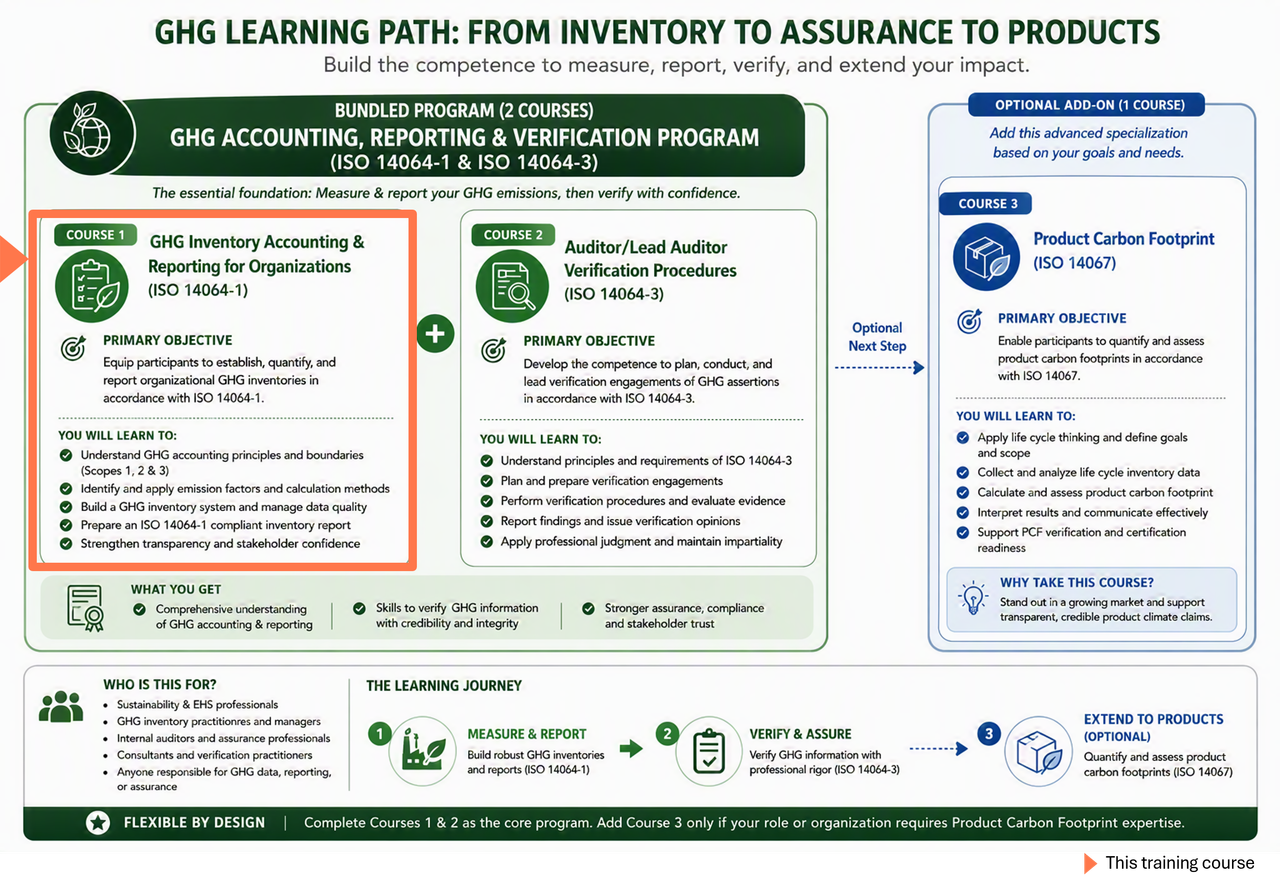
Course 1: GHG Inventory Accounting & Reporting for Organizations (ISO 14064-1) provides the foundation by teaching participants how to establish organizational boundaries, quantify GHG emissions, apply appropriate emission factors, and prepare credible GHG inventories and reports in accordance with ISO 14064-1. This course is ideal for sustainability professionals, EHS managers, consultants, and anyone responsible for organizational GHG reporting.
Course 2: Auditor/Lead Auditor Verification Procedures (ISO 14064-3) focuses on the verification of GHG assertions and emissions reports. Participants learn how to plan, conduct, and lead verification activities, evaluate evidence, document findings, and issue verification conclusions in accordance with ISO 14064-3. While Course 2 can be taken independently, it is highly complementary to Course 1 because it builds on the principles of GHG accounting and reporting by providing the assurance and verification perspective.
For organizations and professionals seeking comprehensive capability, Courses 1 and 2 can be taken together as the GHG Accounting, Reporting & Verification Program (ISO 14064-1 & ISO 14064-3). This bundled program provides a complete understanding of both the development and verification of organizational GHG inventories, creating a strong foundation for credible emissions reporting and assurance.
Participants whose roles require product-level carbon accounting can then extend their expertise with Course 3: Product Carbon Footprint (ISO 14067). This advanced course introduces life cycle-based carbon footprint quantification for products and services, supporting activities related to product carbon footprint verification, certification readiness, sustainability claims, and product-level decarbonization strategies. Because product carbon footprint verification remains a specialized application for many organizations, Course 3 is offered as an optional next step, allowing learners to pursue this expertise only when relevant to their business or professional objectives.
Recommended Learning Journey
Option 1: Individual Courses
- Course 1: GHG Inventory Accounting & Reporting for Organizations (ISO 14064-1)
- Course 2: Auditor/Lead Auditor Verification Procedures (ISO 14064-3)
- Course 3: Product Carbon Footprint (ISO 14067)
Option 2: Recommended Pathway
- Step 1: GHG Accounting, Reporting & Verification Program (Courses 1 + 2)
- Step 2: Product Carbon Footprint (ISO 14067) as an optional advanced specialization
This approach provides maximum flexibility while guiding learners through a logical progression from measuring and reporting emissions, to verifying and assuring results, and finally to assessing carbon footprints at the product level.
1. What is ISO 14064‑1?
ISO 14064‑1 is an international standard that specifies requirements for quantifying and reporting greenhouse gas emissions at the organizational level.
2. Do I need prior knowledge of carbon accounting?
No prior experience is required. The course is designed for beginners and intermediate learners.
3. Is the course practical or theoretical?
The course combines theory with practical exercises and case studies to reinforce learning.
4. Will I learn how to calculate emissions?
Yes, participants will learn how to use activity data and emission factors to calculate GHG emissions.
5. What are Scope 1, 2, and 3 emissions?
These are categories of emissions:
- Scope 1: Direct emissions
- Scope 2: Indirect energy emissions
- Scope 3: Other indirect emissions across the value chain
6. How long is the course?
This is a one‑day training session (typically 8 hours).
7. Is there an exam?
Yes, a short final exam is included to assess knowledge gained.
8. Will I receive a certificate?
Yes, a certificate of completion is typically provided after successful participation.
9. How can this course help my organization?
It enables accurate GHG reporting, supports compliance, and strengthens sustainability strategies.
10. Is this aligned with ESG reporting requirements?
Yes, ISO 14064‑1 supports ESG, carbon disclosure, and sustainability reporting frameworks.
Train with Industry Experts
Learn from specialist instructors at TÜV SÜD Academy—recognized leaders with deep expertise in their fields. For over 35 years, our global network of 2,500+ trainers has delivered practical, real-world knowledge that you can apply immediately.
Our courses are continuously updated to reflect the latest regulatory changes and industry best practices, ensuring you gain relevant, up-to-date skills with every session.