
Auditor/Lead Auditor Verification Procedures (ISO 14064-3)
Develop the Skills to Verify GHG Statements with Confidence using ISO 14064‑3 Best Practices.
Build the expertise required to perform greenhouse gas (GHG) verification engagements with this intensive one‑day training on ISO 14064‑3. This course introduces the principles, methodologies, and best practices used by auditors to assess the accuracy and reliability of GHG statements.
Participants will learn how to plan and execute verification activities, including strategic analysis, risk assessment, sampling, and evidence gathering. The training also covers key verification concepts such as materiality, assurance levels, and independence—critical elements for delivering credible verification outcomes.
Designed for professionals pursuing auditor or lead auditor roles, this course equips learners with practical knowledge to conduct verification engagements in line with international standards and support robust, transparent ESG and carbon reporting.
By the end of this course, participants will be able to:
- Understand ISO 14064‑3 requirements for verification and validation
- Differentiate between verification and validation processes
- Explain key verification principles (impartiality, evidence-based approach, transparency)
- Plan and conduct GHG verification engagements
- Perform contract review and establish verification agreements
- Conduct strategic analysis and risk assessment
- Identify inherent, control, and detection risks in GHG reporting
- Develop verification plans and sampling strategies
- Apply data verification techniques and evidence collection methods
- Assess materiality and evaluate misstatements
- Prepare verification reports and statements of opinion
This course is ideal for:
- Sustainability auditors and verification professionals
- Environmental and ESG consultants
- Internal auditors and compliance professionals
- Carbon accounting specialists seeking verification skills
- Professionals preparing for third‑party auditor / lead auditor roles
- Organizations seeking to build in-house verification capabilitie
Key topics covered include:
Introduction & Framework
- Overview of ISO 14064‑3 and ISO 14064 standards
- Verification vs validation concepts
ISO 14064‑2 Context
- Fundamentals of project-level GHG accounting
- Concepts such as baseline and additionality
Verification Principles
- Impartiality and independence
- Evidence-based approach
- Transparency and documentation
- Conservativeness
Verification Engagement Setup
- Contract review and agreement
- Scope, criteria, and objectives
- Level of assurance (reasonable vs limited)
- Materiality thresholds
Verification Planning
- Strategic analysis
- Understanding operations and data systems
- Risk assessment (inherent, control, detection risks)
Verification Execution
- Development of verification and sampling plans
- Data verification and testing procedures
- Site visits and audit techniques
- Evidence collection and validation
Findings & Reporting
- Identifying nonconformities and errors
- Materiality assessment
- Reporting findings and audit trail
- Drafting verification statements
Opinion & Closure
- Types of verification opinions (unmodified, modified, adverse)
- Independent review process
- Issuance of verification statement
Case Studies & Practical Exercises
- Contract review scenarios
- Strategic analysis exercises
- Risk assessment simulations
Final Assessment
- Short exam to evaluate understanding
As organizations increasingly disclose greenhouse gas emissions, independent verification has become essential to ensure data accuracy, credibility, and compliance. This one‑day training course provides a structured introduction to ISO 14064‑3, the international standard governing verification and validation of GHG statements.
The course begins by explaining the distinction between verification and validation, and introduces the broader ISO 14064 framework, including the role of project-level accounting under ISO 14064‑2. Participants gain a clear understanding of how verification supports assurance over historical emissions data and sustainability disclosures.
A strong emphasis is placed on verification principles such as impartiality, evidence-based decision-making, transparency, and conservativeness. Participants will also explore key concepts such as materiality thresholds and levels of assurance, which define the depth and rigor of verification work and influence final audit conclusions.
The course then takes a hands-on approach to the verification process, guiding learners through contract review, planning, strategic analysis, and risk assessment. Participants will learn how to identify inherent, control, and detection risks, develop verification and sampling plans, and conduct site visits and data testing procedures.
Finally, the training covers reporting, findings management, and issuance of verification opinions, including unmodified, modified, and adverse conclusions. By the end of the course, participants will be equipped with the knowledge and practical tools to perform effective GHG verifications and contribute to high-quality, audit-ready GHG reporting.
- Develop practical audit and verification competencies
- Learn internationally recognized ISO 14064‑3 methodologies
- Improve reliability and credibility of GHG reporting
- Enhance readiness for third‑party verification engagements
- Understand risk-based auditing approaches for ESG data
- Strengthen professional qualifications in sustainability auditing
- Support regulatory and voluntary disclosure requirements
This is a live, instructor-led virtual classroom training with a strong practical focus. Participants benefit from:
- Expert-led lectures
- Interactive discussions and Q&A
- Hands-on exercises and case studies
- Real-world examples
- Peer learning and collaboration
Participants engage in a fully interactive online environment using webcam and audio.
At the end of the course, participants are required to complete a final examination.
Final Examination Details
- Duration: 30 minutes
- Passing score: 21 out of 30 points (70%)
- Closed-book examination
- 15 multiple-choice questions
- Maximum score: 30 points
To successfully pass the examination, participants must achieve a minimum score of 21 points (70%). Scores below this threshold will be considered a fail.
Participants who attend at least 90% of the training will receive a TÜV SÜD Certificate of Attendance. Participants who pass the final examination will earn a TÜV SÜD Certificate of Achievement.
There are no formal prerequisites for this course.
GHC Learning Path Overview
This learning path provides a progressive and flexible approach to developing expertise in greenhouse gas (GHG) accounting, reporting, verification, and product carbon footprint assessment. Participants may enroll in individual courses based on their immediate learning needs or follow the complete pathway to build end-to-end competence across the GHG management and assurance lifecycle.
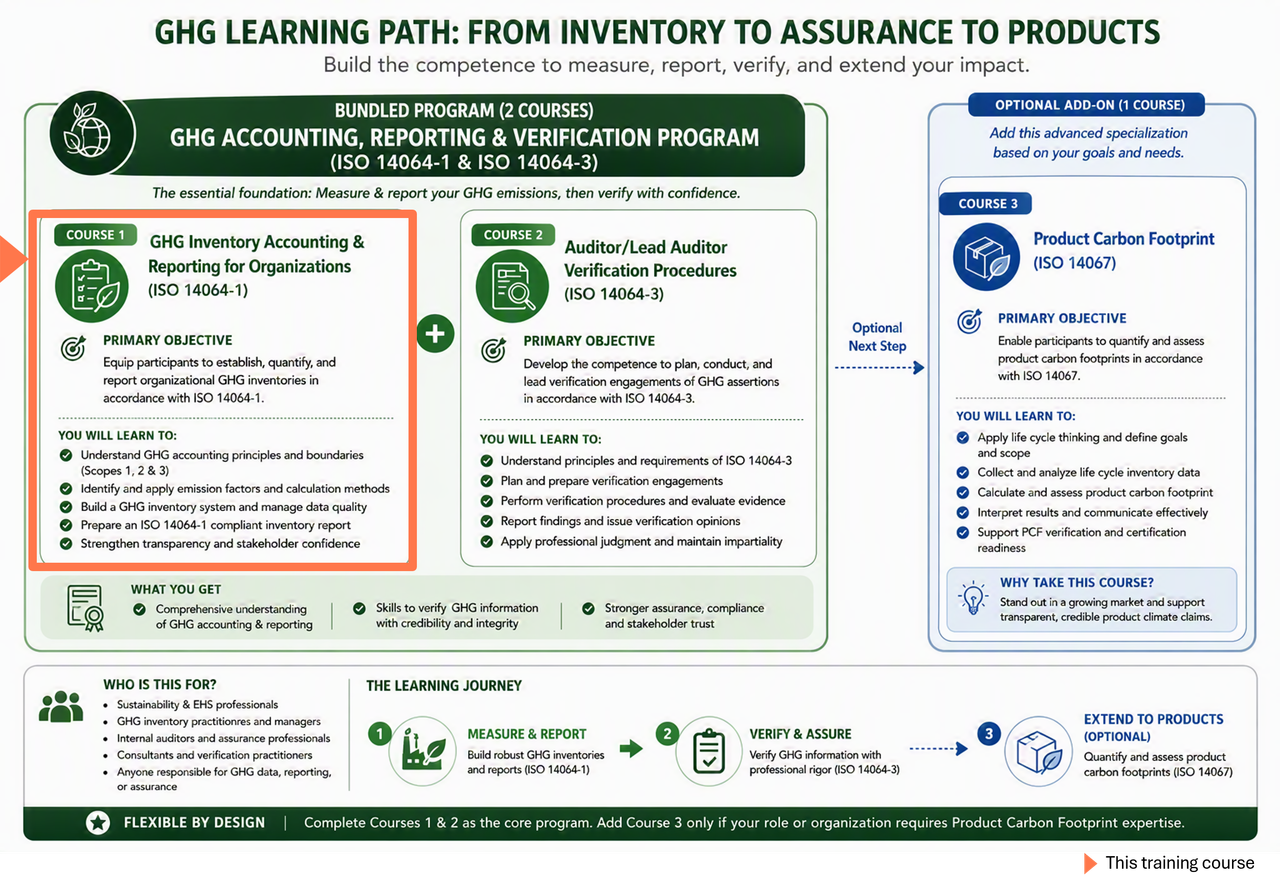
Course 1: GHG Inventory Accounting & Reporting for Organizations (ISO 14064-1) provides the foundation by teaching participants how to establish organizational boundaries, quantify GHG emissions, apply appropriate emission factors, and prepare credible GHG inventories and reports in accordance with ISO 14064-1. This course is ideal for sustainability professionals, EHS managers, consultants, and anyone responsible for organizational GHG reporting.
Course 2: Auditor/Lead Auditor Verification Procedures (ISO 14064-3) focuses on the verification of GHG assertions and emissions reports. Participants learn how to plan, conduct, and lead verification activities, evaluate evidence, document findings, and issue verification conclusions in accordance with ISO 14064-3. While Course 2 can be taken independently, it is highly complementary to Course 1 because it builds on the principles of GHG accounting and reporting by providing the assurance and verification perspective.
For organizations and professionals seeking comprehensive capability, Courses 1 and 2 can be taken together as the GHG Accounting, Reporting & Verification Program (ISO 14064-1 & ISO 14064-3). This bundled program provides a complete understanding of both the development and verification of organizational GHG inventories, creating a strong foundation for credible emissions reporting and assurance.
Participants whose roles require product-level carbon accounting can then extend their expertise with Course 3: Product Carbon Footprint (ISO 14067). This advanced course introduces life cycle-based carbon footprint quantification for products and services, supporting activities related to product carbon footprint verification, certification readiness, sustainability claims, and product-level decarbonization strategies. Because product carbon footprint verification remains a specialized application for many organizations, Course 3 is offered as an optional next step, allowing learners to pursue this expertise only when relevant to their business or professional objectives.
Recommended Learning Journey
Option 1: Individual Courses
- Course 1: GHG Inventory Accounting & Reporting for Organizations (ISO 14064-1)
- Course 2: Auditor/Lead Auditor Verification Procedures (ISO 14064-3)
- Course 3: Product Carbon Footprint (ISO 14067)
Option 2: Recommended Pathway
- Step 1: GHG Accounting, Reporting & Verification Program (Courses 1 + 2)
- Step 2: Product Carbon Footprint (ISO 14067) as an optional advanced specialization
This approach provides maximum flexibility while guiding learners through a logical progression from measuring and reporting emissions, to verifying and assuring results, and finally to assessing carbon footprints at the product level.
1. What is ISO 14064‑3?
ISO 14064‑3 is the international standard that defines requirements for verifying and validating greenhouse gas statements.
2. What is the difference between verification and validation?
Verification assesses historical data accuracy, while validation evaluates assumptions for future outcomes.
3. Do I need auditing experience to take this course?
No, but basic knowledge of GHG accounting or sustainability reporting is helpful.
4. What is a verification statement?
It is the formal opinion issued by the auditor confirming whether a GHG statement is materially correct.
5. What are assurance levels?
- Reasonable assurance: higher confidence
- Limited assurance: lower confidence with less testing
6. What is materiality in verification?
Materiality defines the threshold at which errors or misstatements could influence decision-making.
7. Will I learn practical audit techniques?
Yes, the course includes practical exercises on risk assessment, sampling, and verification planning.
8. How long is the course?
The training is delivered in a single full-day session.
9. Is there an exam?
Yes, a final assessment is included to test learning.
10. How does this course help my career?
It prepares you for auditor or lead auditor roles in sustainability and carbon verification.
Train with Industry Experts
Learn from specialist instructors at TÜV SÜD Academy—recognized leaders with deep expertise in their fields. For over 35 years, our global network of 2,500+ trainers has delivered practical, real-world knowledge that you can apply immediately.
Our courses are continuously updated to reflect the latest regulatory changes and industry best practices, ensuring you gain relevant, up-to-date skills with every session.