
Circular Economy - Basic Training: Fundamentals and Application
Your Compact and Practice-Oriented Entry into the Circular Economy
The circular economy provides a foundation for resource-efficient and economically sustainable business practices. Its applications extend far beyond traditional recycling, offering diverse, industry-specific opportunities to redesign products, processes, and business models.
This training delivers a structured and compact introduction to the principles of the circular economy and their practical application in business contexts. Participants gain a comprehensive overview of key elements of circular systems, including material flows, product design, and process-related challenges across different industries.
A key focus of the course is the regulatory landscape in Europe and Germany, including frameworks such as the KrWG, ESPR, and PPWR. Participants will learn how these regulations drive transformation and how to effectively leverage legal requirements to shape and optimize circular business models.
Through practical examples, case-based discussions, and interactive exercises, participants will explore the relationships between legislation, product design, material management, and technology. Circular processes are analyzed and evaluated using established methods, characteristics, and performance indicators, with particular emphasis on real-world implementation.
The blended learning format combines a short self-paced preparation phase with live online sessions, ensuring both flexibility and interactive engagement. Group work and hands-on exercises enable participants to directly apply concepts to their own organizational context.
After completing this course, participants will be able to:
- Understand the key principles, interrelationships, and business impacts of the circular economy
- Apply methods to analyze and evaluate circular systems
- Identify opportunities and risks in circular business processes
- Assess the interplay between regulation, product design, material flows, and technology
- Transfer circular economy concepts into their own business environment
This training is designed for:
- Specialists and employees involved in the design and implementation of circular systems
- Professionals from development, planning, production control, business administration, controlling, sales, and marketing
- Managers responsible for the strategic alignment and implementation of business processes
- Experts and beginners advising organizations on circular economy, business optimization, and sustainability topics
- Principles and models of the circular economy (linear vs. circular; 3R–12R)
- Advantages, challenges, and success factors of circular systems
- Methods for analyzing circular systems (including indicators)
- Material flow analysis and visualization (e.g., Sankey diagrams)
- Introduction to life-cycle assessment for circular systems
- Regulatory frameworks and their impact on business and industries
- Practical application: case studies, business models, and influencing factors (e.g., product design, material management, technology, customer acceptance)
Training Overview and Objectives
This foundational training is designed as an industry-neutral introduction to the circular economy. Its overall objective is to build a solid understanding of circular economy mechanisms and to develop participants’ ability to analyze, characterize, and evaluate circular measures in a business context.
Participants will gain comprehensive insight into the fundamental principles and characteristics of the circular economy. They will be able to clearly differentiate between linear and circular economic models, understand the associated challenges, and formulate meaningful objectives for circular transformation. In addition, participants will learn to classify different forms of circular economy approaches and relate them to the product life cycle.
Core Competencies Developed
Throughout the training, participants will acquire practical knowledge and analytical skills, including:
-
Implementation of Circular Measures:
Understanding and applying key steps required to implement circular strategies within organizations -
Material Flow Analysis:
Conducting basic material flow analyses and creating flow diagrams to visualize resource use -
Life Cycle Thinking:
Understanding the fundamentals of life cycle assessment (LCA) and applying these principles to simple use cases -
Performance Measurement:
Using relevant indicators to evaluate the efficiency, effectiveness, and economic viability of circular measures, and communicating results transparently within the organization -
Regulatory Awareness:
Gaining an overview of key legal frameworks and understanding their general impact on business activities
Business and Economic Perspective
Participants will become familiar with core circular business models and their associated cost structures. They will develop the ability to:
- Translate business activities into an economic context
- Estimate costs and pricing structures for circular business models
- Assess opportunities and financial implications of circular strategies
Product Design and Circularity
A key focus of the training is the role of product design in enabling circular economy strategies. Participants will:
- Understand how product design influences circularity and economic feasibility
- Identify key factors affecting circular product development
- Evaluate design decisions in terms of their impact on resource efficiency and lifecycle performance
- Gain a clear and concise overview of the key interrelationships within the circular economy, including the opportunities and risks for your business processes
- Learn practical methods and structured approaches to design, analyze, and evaluate circular processes within your organization
- Understand critical influencing factors and system interactions, enabling you to effectively navigate the interplay between regulation, circular product design, material management challenges, and technological possibilities
- Develop the capability to actively shape and implement circular strategies within your business environment
Blended training format with self-learning phase (2 teaching units) between day 1 and day 2:
- Day 1: Live/Virtual classroom: 4 teaching units
- Self-learning phase: approx. 1.5 hours
- Day 2: Live/Virtual classroom: 6 teaching units
Instructor-led training sessions are conducted in a virtual classroom. This means the course is Live Online. Participants will learn through online teaching. Lectures, case studies, group exercises, discussions, problem solving, examples with explanation, assignments and/or quizzes happen in the virtual classroom training. Participants need to connect to the class from any internet accessible location. Each module is delivered live using webinar technology, creating a virtual classroom learning environment. Live sessions provide you with direct access to the trainer so you can ask questions, understand complex concepts and share ideas with peers. Webcam and microphone are REQUIRED to interact with the instructor and/or other participants.
The course content and structure are designed by the domain experts from TÜV SÜD. With immense experience and knowledge in the relevant standards, our team of product specialists and technical experts at TÜV SÜD, developed the course content based on current business landscape and market requirements.
The training includes interactive group work and exercises, enabling participants to directly apply methods and tools to their own business models. By performing exercises and group discussions, attendees will develop a hands-on understanding that will facilitate the understanding and the implementation of knowledge and concepts.
- Interactive group exercises
- Practical case studies
- Risk identification and mitigation workshop
- Knowledge transfer through discussion and applied examples
Successful participants who attend at least 90% of the total training duration will receive a Certificate of Attendance from TÜV SÜD Academy upon completion of the training.
No prerequisites
- The training course is part of a learning path consisting of three compulsory courses and an exam with a certificate Circular Economy Manager - TÜV.
- Please bring your laptop with Excel and Word installed to the training. The documents will be made available in digital form.
Learning Path:
Circular Economy - Basic Training: Fundamentals and Application (1.5 days) serves as the foundation of the Circularity learning path. The course provides participants with a comprehensive introduction to circular economy principles, key concepts, business drivers, implementation approaches, and the practical application of circularity within organizations and value chains. Learners gain an understanding of how circular economy strategies contribute to resource efficiency, sustainability objectives, regulatory compliance, and long-term business value creation.
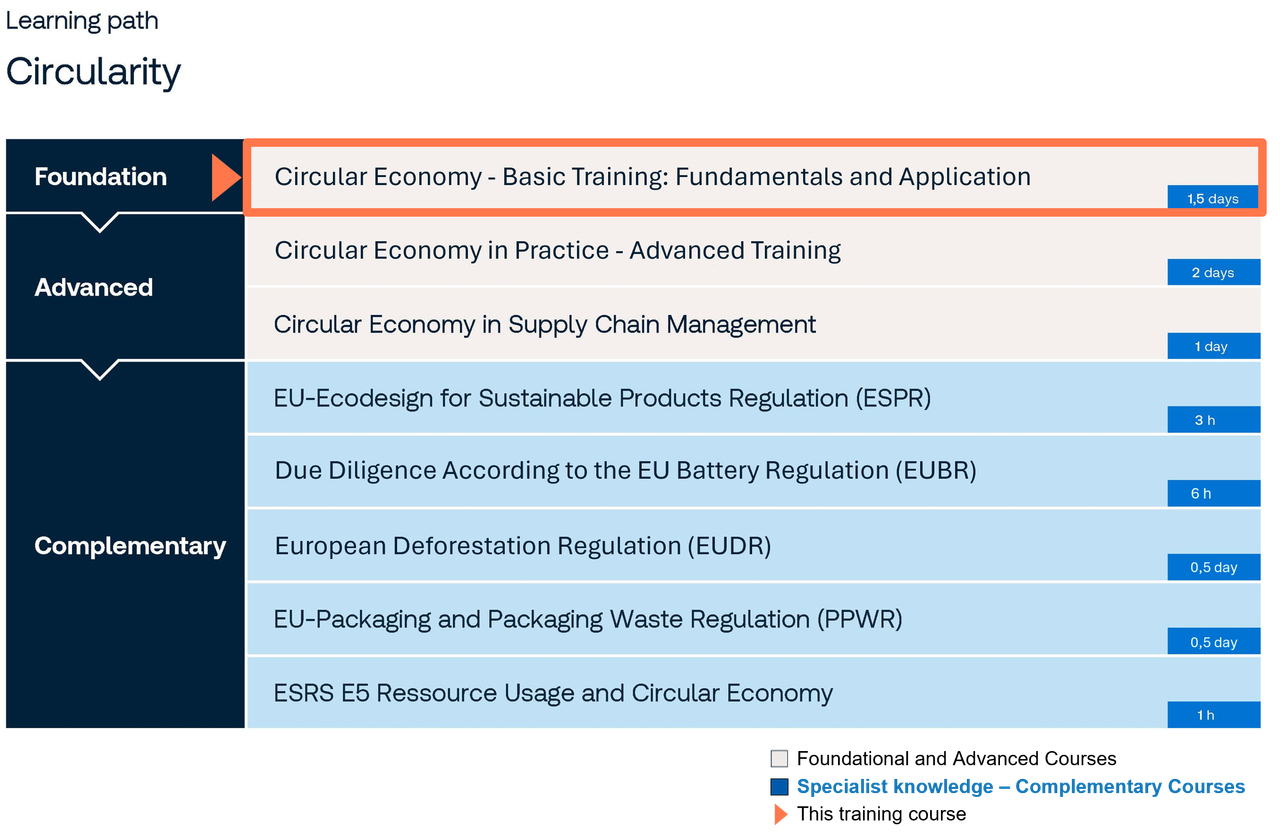
As part of a modular training programme on Circularity, this foundational course is designed to be complemented by a set of other advanced and specialist training courses. Building on the fundamentals established in this training, participants can deepen their expertise through Circular Economy in Practice - Advanced Training (11-28-26-0009), which focuses on the practical implementation of circular economy strategies, and Circular Economy in Supply Chain Management (11-28-26-0007), which explores circularity across supply chains and procurement processes. Together, these three courses form the core learning path and are compulsory components of the Circular Economy Manager – TÜV qualification programme, culminating in an examination and certification. Participants who successfully complete the required courses and pass the examination are awarded the Circular Economy Manager – TÜV certificate, demonstrating their competence in applying circular economy principles in a business context.
The learning path is further enriched by complementary regulatory and reporting modules, including:
- EU-Ecodesign for Sustainable Products Regulation (ESPR) (Not yet available),
- Due Diligence According to the EU Battery Regulation (EUBR) (11-28-25-0005),
- European Deforestation Regulation (EUDR) (11-28-25-0003),
- EU Packaging and Packaging Waste Regulation (PPWR) (Not yet available), and
- ESRS E5 Resource Usage and Circular Economy (Not yet available).
These specialist courses provide additional knowledge on the evolving European regulatory landscape and its relevance to circularity strategies. Together, the foundation, advanced, and complementary modules create a progressive and comprehensive learning journey, enabling participants to develop both strategic and practical expertise in Circularity.
1. What is the main objective of this circular economy training?
The course provides a structured introduction to the principles of the circular economy and equips participants with practical methods to analyze, design, and evaluate circular business processes.
2. Is this training specific to a particular industry?
No, the training is industry-neutral and designed to be applicable across various sectors, making it relevant for a wide range of business functions and roles.
3. Who should attend this course?
The course is ideal for professionals involved in product development, production, business strategy, sustainability, and operations, as well as managers and consultants working on circular economy initiatives.
4. What topics are covered in the course?
Key topics include:
- Circular vs. linear economy principles
- Circular business models (e.g., 3R–12R frameworks)
- Material flow analysis and visualization
- Life cycle assessment (LCA) basics
- Regulatory frameworks (e.g., KrWG, ESPR, PPWR)
- Product design for circularity
- Performance indicators and evaluation methods
5. Will I learn practical tools and methods?
Yes. The course focuses on practical application, including material flow analysis, flow diagrams (e.g., Sankey), basic LCA, and evaluation of circular processes using indicators.
6. How does the course address regulations?
Participants gain an overview of key European and German regulations and learn how these frameworks influence business activities and support circular economy implementation.
7. What learning format is used?
The training follows a blended learning approach:
- Live virtual classroom sessions
- Self-paced learning phase
- Interactive group exercises and case studies
8. How long is the course?
The course consists of 12 training units (45 minutes each), delivered over live sessions and a short self-learning phase.
9. Are there any prerequisites?
No prior knowledge or prerequisites are required to attend this course.
10. What will I be able to do after completing the course?
You will be able to:
- Analyze and evaluate circular systems
- Identify business opportunities and risks
- Apply lifecycle thinking and material flow analysis
- Develop and assess circular business models
- Integrate regulatory and design considerations into decision-making
11. Is there a certification?
Yes, participants receive a Certificate of Attendance from TÜV SÜD Academy upon completion of the training.
12. What skills will I gain related to business impact?
You will learn to assess cost structures, pricing strategies, and financial implications of circular business models, enabling better strategic decisions.
The course is delivered by experts from TÜV SÜD Academy with practical experience in:
- Circular economy
- Supply chain management
- Sustainability and risk management