
Circular Economy in Practice - Advanced Training
Deepen Knowledge and Apply the Circular Economy in a Practical Way
Circular economy systems are inherently complex. They involve diverse stakeholder networks and must comply with stringent regulatory frameworks and standards, including ISO standards (e.g., 14001, 59004) and EU product-specific regulations such as the Packaging Regulation. Managing these interdependencies requires precise coordination, a clear understanding of value chain interactions, and continuous monitoring of value streams, measures, and their effectiveness.
This two-day advanced training equips participants with the tools and methodologies needed to effectively plan and manage circular economy projects. You will learn how to establish the necessary organizational conditions within your company, define clear governance and responsibility structures, and translate regulatory requirements into practical, actionable processes.
From a technical perspective, the course provides a comprehensive overview of proven approaches to material recycling, closed-loop production, and circular use models. It also addresses key challenges in product development, quality assurance, and marketing—enabling you to confidently align these functions with your organization’s circular strategy.
A central focus of the training is value stream transparency and traceability. You will explore the growing importance of digital product passports and standards such as Environmental Product Declarations (EPDs), and gain insight into the processes and technologies required to implement them effectively in your organization.
The training is highly practical: through case studies, group work, and hands-on exercises, you will directly apply concepts to your own business context.
After completing this course, participants will be able to:
- Understand the key prerequisites, framework conditions, and constraints for implementing circular economy projects
- Apply structured tools and methods to monitor progress and manage trade-offs or conflicting objectives
- Evaluate, steer, and optimize circular initiatives using systematic and data-driven approaches
- Integrate regulatory requirements, strategic business goals, and digital solutions into effective project design and execution
This training is designed for:
- Specialists and managers with basic knowledge of circular economy seeking advanced implementation skills
- Project managers and team members involved in circular economy initiatives
- Executives responsible for sustainable business strategies
- Internal and external consultants in circular economy, sustainability, and business optimization
- Regulatory frameworks and circular economy standards
- Organizational structures and responsibility models
- Strategic integration of circular economy
- Material flow transparency and traceability
- Digital product passport and EPD
- Circular production, return systems, and use models
Circular economy systems are inherently complex, involving multiple stakeholders, strict regulatory requirements, and the need for precise coordination. Successful implementation depends on a clear understanding of interactions across the value chain, coupled with consistent monitoring of value streams, implemented measures, and their effectiveness.
In this advanced training, you will gain the practical tools required to effectively plan and manage circular economy projects. You will learn how to establish the necessary organizational conditions within your company, define suitable governance and responsibility models, and implement legal requirements in a pragmatic and actionable way.
On the technical side, the course provides a comprehensive overview of proven solutions for material recycling, closed-loop production, and innovative circular use models. You will also develop a solid understanding of challenges in product development, quality assurance, and marketing—and how to systematically integrate these aspects into your company’s strategy.
A key focus of the training is the traceability of value streams. You will explore the growing importance of digital product passports and standards such as Environmental Product Declarations (EPDs), and learn which processes and technologies are needed to implement them effectively in your organization.
The course emphasizes practical application: through case studies, group work, and hands-on exercises, you will directly transfer the concepts into your own business context.
This advanced training is designed for experienced professionals across industries who are actively working in—or transitioning into—the field of circular economy, regardless of their specific role or sector.
The primary objective of the course is to equip you with a deep understanding of the key prerequisites, framework conditions, and success factors for implementing circular economy initiatives. You will learn how to systematically apply these principles to design and execute impactful projects within your organization.
You will gain confidence in using structured methods to measure and evaluate progress, manage trade-offs, and resolve conflicting objectives—enabling you to steer circular initiatives effectively and make informed decisions throughout the project lifecycle.
By the end of the training, you will be able to independently plan, coordinate, and implement circular economy projects with confidence. You will understand how strategic priorities, governance and responsibility models, regulatory requirements, and digital solutions are interconnected—and how to align them to build resilient, future-proof circular systems.
In addition, you will develop the practical skills needed to manage interfaces across functions and stakeholders, ensuring robust, scalable, and sustainable execution of circular economy projects within your organization.
Instructor-led training sessions are conducted in a virtual classroom. This means the course is Live Online. Participants will learn through online teaching. Lectures, case studies, group exercises, discussions, problem solving, examples with explanation, assignments and/or quizzes happen in the virtual classroom training. Participants need to connect to the class from any internet accessible location. Each module is delivered live using webinar technology, creating a virtual classroom learning environment. Live sessions provide you with direct access to the trainer so you can ask questions, understand complex concepts and share ideas with peers. Webcam and microphone are REQUIRED to interact with the instructor and/or other participants.
The course content and structure are designed by the domain experts from TÜV SÜD. With immense experience and knowledge in the relevant standards, our team of product specialists and technical experts at TÜV SÜD, developed the course content based on current business landscape and market requirements.
The training includesinteractive group work and exercises, enabling participants to directly applymethods and tools to their own business models. By performing exercises and group discussions, attendees will develop a hands-on understanding that will facilitate the understanding and the implementation of knowledge and concepts.
- Interactive group exercises
- Practical case studies
- Risk identification and mitigation workshop
- Knowledge transfer through discussion and applied examples
Successful participants who attend at least 90% of the total training duration will receive a Certificate of Attendance from TÜV SÜD Academy upon completion of the training.
Basic knowledge of circular economy systems recommended
- The training course is part of a learning path consisting of three compulsory courses and an exam with a certificate Circular Economy Manager - TÜV.
- Please bring your laptop with Excel and Word installed to the training. The documents will be made available in digital form.
Learning Path:
Circular Economy in Practice - Advanced Training (11-28-26-0009) builds on the foundational knowledge acquired in the Circular Economy - Basic Training: Fundamentals and Application course and represents the next step in the Circularity learning path. This advanced course focuses on the practical implementation of circular economy principles, providing participants with the tools, methods, case studies, and best practices needed to translate circularity concepts into actionable business strategies. Learners will deepen their understanding of circular business models, product lifecycle approaches, value retention strategies, organizational transformation, and the challenges and opportunities associated with implementing circular economy initiatives across industries.
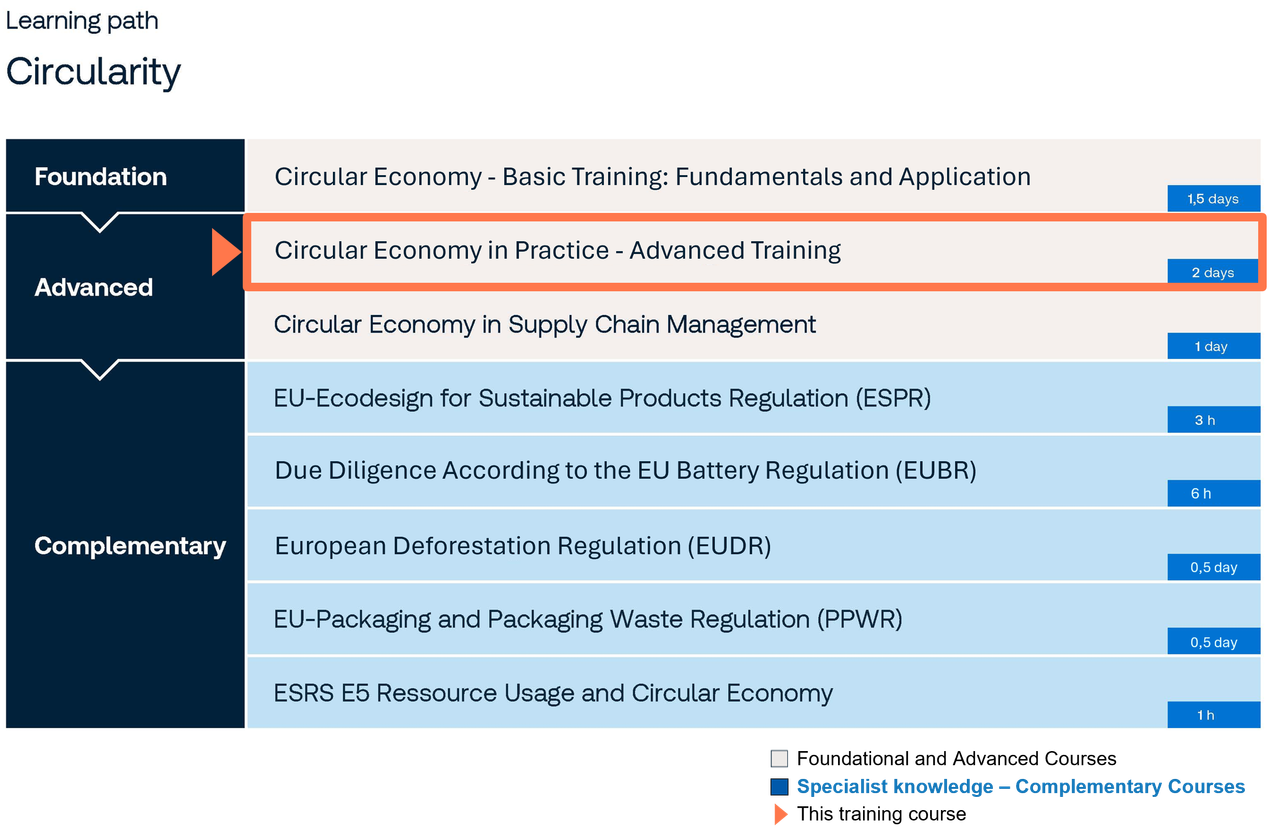
As part of a modular training programme on Circularity, this advanced course complements the foundational course Circular Economy - Basic Training: Fundamentals and Application (11-28-26-0008) and the specialist course Circular Economy in Supply Chain Management (11-28-26-0007), which explores the role of circularity across supply chains, procurement, and supplier networks. Together, these three courses form the core learning path and are compulsory components of the Circular Economy Manager – TÜV qualification programme, culminating in an examination and certification. Participants who successfully complete all three required courses and pass the examination are awarded the Circular Economy Manager – TÜV certificate, demonstrating their capability to apply circular economy principles strategically and operationally within their organizations.
The learning path is further enriched by complementary regulatory and reporting modules, including:
- EU-Ecodesign for Sustainable Products Regulation (ESPR) (Not yet available),
- Due Diligence According to the EU Battery Regulation (EUBR) (11-28-25-0005),
- European Deforestation Regulation (EUDR) (11-28-25-0003),
- EU Packaging and Packaging Waste Regulation (PPWR) (Not yet available), and
- ESRS E5 Resource Usage and Circular Economy (Not yet available).
These specialist courses provide additional knowledge on the evolving European regulatory landscape and its implications for circular economy strategies and business operations. Together, the foundation, advanced, and complementary modules create a comprehensive and progressive learning journey, enabling participants to develop both strategic and practical expertise in Circularity.
1. Who is this training designed for?
This course is intended for experienced professionals across industries who are involved in circular economy, sustainability, or transformation initiatives. It is especially relevant for project managers, specialists, consultants, and executives responsible for implementing circular strategies.
2. What level of knowledge is required to attend?
Participants should have a basic understanding of circular economy concepts. The training builds on foundational knowledge and focuses on advanced implementation, management, and optimization of circular projects.
3. What are the key benefits of attending this course?
You will gain the ability to:
- Plan, manage, and implement circular economy projects independently
- Apply structured methods to measure progress and resolve trade-offs
- Align strategy, regulatory requirements, and digital tools
- Build resilient and scalable circular systems within your organization
4. What practical skills will I develop?
The course emphasizes hands-on learning. You will develop practical skills in:
- Designing governance and responsibility models
- Managing cross-functional and stakeholder interfaces
- Monitoring value streams and performance metrics
- Applying circular solutions such as recycling and closed-loop production
5. How is the training delivered?
The training is conducted live online in a virtual classroom environment. It includes lectures, case studies, group work, interactive discussions, and exercises with direct access to expert instructors.
6. What topics are covered in the course?
Key topics include:
- Regulatory frameworks and standards (e.g., ISO 14001, ISO 59004, EU regulations)
- Organizational structures and governance models
- Circular strategy integration
- Material flow transparency and traceability
- Digital product passports and Environmental Product Declarations (EPDs)
- Circular production systems and use models
7. How does the course address regulatory compliance?
You will learn how to interpret and implement relevant regulations and standards in a practical way, ensuring your projects meet legal requirements while remaining efficient and scalable.
8. What is a digital product passport, and why is it important?
A digital product passport enables transparency across the product lifecycle by providing accessible data on materials, sustainability, and compliance. The course explains its role in future circular systems and how to implement it within your organization.
9. How does the course help with measuring circular economy performance?
You will learn structured methods and tools to track progress, evaluate performance, and manage conflicting objectives—ensuring continuous improvement and effective decision-making.
10. How practical is the training?
The training is highly application-oriented. Through case studies, exercises, and group work, you will directly apply concepts to your own business context, ensuring immediate relevance and impact.
11. What certification will I receive?
Upon completion, you will receive a Certificate of Attendance from TÜV SÜD Academy.
12. Is this course part of a broader certification path?
Yes, it is part of a structured learning path toward becoming a Circular Economy Manager (TÜV), which includes additional courses and an exam.
13. What makes this training different from introductory courses?
Unlike basic courses, this training focuses on advanced implementation topics such as:
- Managing complexity across stakeholders
- Integrating strategy, operations, and compliance
- Using data and digital tools for traceability
- Resolving real-world trade-offs in circular projects
14. How will this training impact my organization?
Participants leave with actionable tools and frameworks that can be immediately applied to improve project planning, execution, and scalability—ultimately accelerating the organization’s transition toward a circular economy.
The course is delivered by experts from TÜV SÜD Academy with practical experience in:
- Circular economy
- Supply chain management
- Sustainability and risk management