
ISO 9001:2026 – Practical Knowledge for Users
Effective Implementation of Standard Requirements in the Company
This course is certified by Exemplar Global.
ISO 9001:2026 – Practical Knowledge for Users is a highly interactive training course designed for professionals who already have a basic understanding of ISO 9001 and want to confidently apply the standard in everyday business operations. Participants learn how to interpret key requirements of the revised ISO 9001:2026 standard and translate them into effective quality management practices.
Through practical examples, group exercises and real-world case studies, participants will explore organizational context, risks and opportunities, quality objectives, process KPIs and nonconformity management. The course provides practical tools and methods that can be immediately applied within an organization's Quality Management System (QMS).
Upon completion of this course, participants will be able to:
- Explain the structure and intent of ISO 9001:2026.
- Interpret key ISO 9001 requirements in a practical business context.
- Analyze organizational context and interested-party requirements.
- Identify, evaluate and address risks and opportunities using recognized methodologies.
- Apply risk-based thinking throughout QMS processes.
- Develop meaningful and measurable quality objectives.
- Plan and monitor actions required to achieve quality objectives.
- Establish suitable process KPIs and evaluate process effectiveness.
- Differentiate between containment actions, corrections and corrective actions.
- Apply structured approaches for nonconformity management and continual improvement.
- Assess organizational situations against ISO 9001 requirements.
- Support ongoing compliance and continual improvement initiatives.
Visit the Prerequisites tab below to discover our new ISO 9001:2026 training portfolio.
Get a comprehensive overview of the full learning journey.
This course is intended for:
- Quality Management System users
- Process owners
- Quality coordinators
- Quality professionals
- Operational managers
- Department managers
- Team leaders
- Process improvement specialists
- Internal auditors seeking practical implementation knowledge
- Employees involved in maintaining or improving a QMS
- Individuals with prior knowledge of ISO 9001 who want deeper practical understanding
Module 1: ISO 9001:2026 Structure and Interpretation
- Overview of ISO 9001:2026
- PDCA model within ISO 9001
- Understanding key standard requirements
- Organizational context and interested parties
Module 2: Risk and Opportunity Management
- Risk-based thinking in ISO 9001
- Risk versus opportunity
- Strategic and operational risks
- Risk identification and assessment
- PESTEL analysis
- SWOT analysis
- FMEA concepts
- Risk matrices
- Risk treatment strategies
Module 3: Quality Objectives and Planning
- ISO 9001 Clause 6.2 requirements
- Developing measurable quality objectives
- Linking objectives to organizational strategy
- Planning actions and responsibilities
- Monitoring and evaluation
- Introduction to OKR methodology
Module 4: Process Performance and Measurement
- Process management fundamentals
- Process effectiveness and efficiency
- Establishing KPIs
- Selecting meaningful indicators
- Monitoring performance trends
- Performance evaluation requirements
Module 5: Nonconformity Management and Improvement
- Nonconformity versus complaint management
- Containment actions
- Corrections
- Corrective actions
- Root cause analysis
- Preventive thinking
- Continual improvement practices
Module 6: Practical ISO 9001 Application Workshops
- Risk and opportunity exercises
- Quality objective workshops
- KPI development exercises
- Nonconformity management case studies
- ISO 9001 compliance assessment exercises
- Clause interpretation activities
The ISO 9001:2026 – Practical Knowledge for Users training course is designed for professionals who need to move beyond understanding the requirements of ISO 9001 and confidently apply them within their Quality Management System (QMS). The course provides a practical interpretation of key ISO 9001:2026 requirements and demonstrates how these requirements can be implemented effectively in real business environments.
Participants will explore how organizational context influences quality management activities and how risks and opportunities should be identified, evaluated and managed in accordance with ISO 9001. Practical management tools such as PESTEL analysis, SWOT analysis, risk matrices and structured risk management approaches are introduced to support effective decision making and continual improvement.
The course also focuses on establishing meaningful quality objectives and developing process performance indicators that support organizational strategy and customer satisfaction. Participants learn how to derive measurable objectives, monitor performance and evaluate the effectiveness of quality-related actions using practical examples and exercises.
A further key topic is the management of nonconformities and improvement activities. Participants will learn the differences between containment actions, corrections and corrective actions, how to identify root causes and how to establish an effective approach to continual improvement. Real-world examples help learners understand how to apply ISO 9001 requirements when dealing with complaints, process failures and quality issues.
Throughout the training, participants engage in moderated group work, practical case studies and discussion-based learning activities that reinforce the application of ISO 9001 requirements. The course also provides insights into the forthcoming ISO 9001:2026 revision, helping organizations prepare for future implementation requirements while strengthening existing quality management practices.
By attending this course, you will:
- Gain practical understanding of ISO 9001:2026 requirements and their business application.
- Learn how to interpret key clauses of ISO 9001 and implement them effectively.
- Understand how to identify and manage risks and opportunities using practical tools.
- Develop measurable quality objectives aligned with organizational goals.
- Learn how to establish and evaluate process performance indicators (KPIs).
- Improve the management of nonconformities, complaints and corrective actions.
- Strengthen continual improvement practices within the QMS.
- Develop confidence in assessing compliance with ISO 9001 requirements.
- Benefit from practical exercises, case studies and group discussions.
- Prepare for the implementation of changes associated with the ISO 9001:2026 revision.
This course uses a highly interactive, instructor-led approach combining theory with practical application.
Learning methods include:
- Expert-led presentations
- Facilitated discussions
- Practical case studies
- Interactive group work
- Guided workshop exercises
- Scenario-based learning
- Real-world examples
- Problem-solving activities
- Knowledge-sharing sessions
- Continuous trainer feedback
The course may be delivered either in a classroom environment or through a live virtual classroom.
Participants who attend at least 90% of the total training duration will receive a Certificate of Attendance from TÜV SÜD Academy upon completion of the training.
From now on, all our QM training courses will always include the latest information on the ISO 9001:2026 standard revision.
To maximize the value of this training, participants are strongly encouraged to obtain a copy of the applicable ISO standard for reference during the course. The standard can be purchased through the American National Standards Institute (ANSI) at www.ansi.org or the American Society for Quality (ASQ) at www.asq.org.
Participants should have:
- Basic knowledge of ISO 9001 requirements.
- General awareness of quality management principles.
- Experience working within a Quality Management System (recommended but not mandatory).
No auditing experience is required.
Our new ISO 9001:2026 training portfolio:
Prepare for the upcoming ISO 9001:2026 revision with TÜV SÜD's comprehensive training portfolio, designed to support every stage of your learning journey, from understanding the fundamentals of quality management to becoming a competent auditor of Quality Management Systems. The portfolio follows a structured learning path that allows individuals and organizations to build knowledge progressively, ensuring that participants gain the right level of competence for their responsibilities within a Quality Management System (QMS).
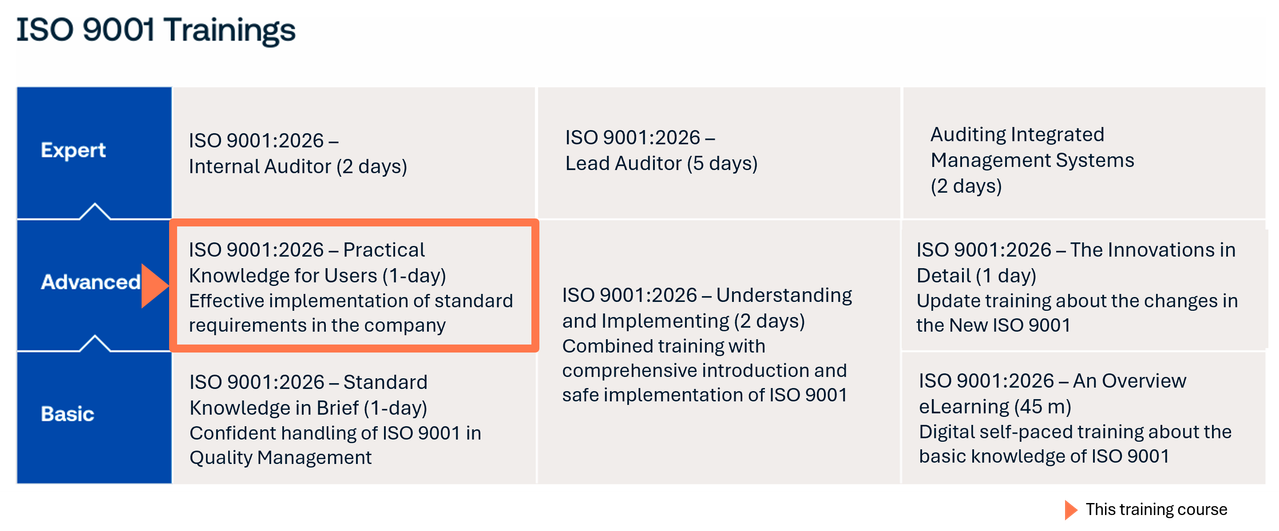
The learning pathway begins with introductory awareness training and progresses through implementation-focused courses before advancing to professional auditing qualifications. Whether you are completely new to ISO 9001, involved in operating a QMS, responsible for implementation and improvement activities, or preparing to conduct internal or external audits, there is a training solution tailored to your needs. The portfolio structure is illustrated below and provides a clear progression from Basic to Advanced and Expert levels. Based on the learning pathway shown in the ISO 9001 training portfolio, learners can select individual courses or combine them to build a complete competence development journey.
Basic Level
ISO 9001:2026 – An Overview (45-minute eLearning)
The journey starts with this self-paced eLearning module, designed for individuals who are new to ISO 9001 or who need a concise introduction to the standard. Participants gain a basic understanding of Quality Management Systems, the purpose and benefits of ISO 9001, and the key concepts and requirements that can be applied to organizations of any size or sector.
ISO 9001:2026 – Standard Knowledge in Brief (1 day)
This classroom or virtual instructor-led course provides a structured introduction to the revised ISO 9001:2026 standard. Participants become familiar with the structure, terminology, principles and requirements of the standard while gaining insight into the latest developments and proposed changes included in the revision.
Advanced Level
ISO 9001:2026 – Practical Knowledge for Users (1 day)
Designed for professionals who already have a basic understanding of ISO 9001, this practice-oriented training focuses on applying the requirements within a real Quality Management System. Participants learn how to analyze organizational context, identify risks and opportunities, develop quality objectives and process KPIs, and effectively manage nonconformities and corrective actions. Through practical exercises, group work and case studies, learners gain confidence in implementing ISO 9001 requirements within their organizations.
ISO 9001:2026 – Understanding and Implementation (2 days)
This comprehensive program combines the content of Standard Knowledge in Brief and Practical Knowledge for Users into a complete learning experience. Participants develop both a solid understanding of the standard and the practical skills required to implement, maintain and continually improve an effective Quality Management System.
ISO 9001:2026 – The Innovations in Detail (1 day)
This specialized update course is ideal for organizations already certified to ISO 9001 or professionals familiar with the current version of the standard. Participants receive a detailed review of the planned changes introduced in the ISO 9001:2026 revision, learn how to interpret the new requirements, and assess the impact on existing Quality Management Systems. Interactive workshops and case studies help participants identify practical implementation actions for their organizations.
Expert Level
ISO 9001:2026 – Internal Auditor (2 days)
This course equips participants with the knowledge and practical skills needed to plan, conduct, report and follow up internal audits of a Quality Management System in accordance with ISO 9001:2026. Participants learn auditing principles, interview techniques, evidence gathering, audit reporting and the evaluation of conformity against standard requirements.
ISO 9001:2026 – Lead Auditor (5 days)
Designed for experienced quality professionals and auditors, this intensive program develops the competencies required to lead first-party, second-party and third-party audits. Participants learn advanced auditing techniques, audit management processes, communication skills and auditor best practices needed to perform and lead effective management system audits.
Auditing Integrated Management Systems (2 days)
Organizations increasingly operate multiple management systems simultaneously. This advanced course focuses on planning and conducting integrated audits across multiple standards and management systems, helping auditors increase efficiency while evaluating processes through a unified business-focused approach.
Recommended Learning Paths
For beginners
- ISO 9001:2026 – An Overview
- ISO 9001:2026 – Standard Knowledge in Brief
For QMS users and process owners
- ISO 9001:2026 – Standard Knowledge in Brief
- ISO 9001:2026 – Practical Knowledge for Users
For implementation and quality professionals
- ISO 9001:2026 – Understanding and Implementation
- ISO 9001:2026 – The Innovations in Detail
For auditors
- ISO 9001:2026 – Understanding and Implementation
- ISO 9001:2026 – Internal Auditor
- ISO 9001:2026 – Lead Auditor
- Auditing Integrated Management Systems
This structured portfolio enables learners to progress from awareness and understanding, through implementation and improvement, to professional auditing competence, ensuring organizations have the skills needed to successfully implement and sustain ISO 9001:2026.
1. What is the main purpose of this course?
The course helps participants apply ISO 9001:2026 requirements in practical business situations rather than simply understanding the standard's clauses.
2. Does the course cover the new ISO 9001:2026 revision?
Yes. Participants receive current information regarding the ISO 9001:2026 revision and its practical implications.
3. Is this course suitable for beginners?
Participants should already have a basic understanding of ISO 9001. The focus is on application rather than introductory awareness.
4. What topics are covered?
Topics include organizational context, risk and opportunity management, quality objectives, process KPIs, nonconformity management, corrective actions and continual improvement.
5. Will I learn practical tools for managing risks?
Yes. The course introduces practical tools such as PESTEL analysis, SWOT analysis, risk matrices and structured risk evaluation approaches.
6. Does the course include exercises?
Yes. The training contains multiple group exercises, workshops and practical case studies covering risks, quality objectives, KPIs and nonconformities.
7. Will I learn how to create quality objectives?
Yes. Participants learn how to establish measurable quality objectives, define actions and monitor achievement.
8. Does the course explain process KPIs?
Yes. The course covers KPI selection, monitoring, effectiveness measurement and alignment with organizational objectives.
9. Will nonconformity management be covered?
Yes. Participants learn the differences between containment actions, corrections and corrective actions, including practical application examples.
10. Is the course relevant for service organizations as well as manufacturing companies?
Yes. Examples and case studies are drawn from both service and manufacturing environments.
11. How is the training delivered?
The course can be delivered either face-to-face or live online through a virtual classroom.
12. What certificate will I receive?
Participants receive a Certificate of Participation from TÜV SÜD Academy upon successful completion of the course.
13. What makes this course different from an ISO 9001 awareness course?
This course emphasizes practical implementation, interpretation and application of ISO 9001 requirements through interactive workshops and real-world business scenarios.
Experienced specialist trainers from the TÜV SÜD Academy with practical knowledge in quality management and in the application of ISO 9001.
This course is certified by Exemplar Global.
TÜV SÜD has achieved Exemplar Global Accreditation as a Recognized Training Provider. This accreditation confirms our commitment to providing the highest quality services and demonstrates our expertise in our industry. As a professional, it's important to have recognition for your skills and knowledge. Exemplar Global Accreditation provides this recognition, giving you a competitive edge in the marketplace. With over 30 years of experience building certification programs, Exemplar Global is the leading authority in accreditation for the conformity community. As a student of an Exemplar Global Recognized Training Provider (RTP) course, you are eligible to receive:
- Access to Exemplar LINK
- 12-months of exclusive benefits including:
- One self-coaching assessment
- Extended learning content
- Complimentary access to online events, online magazine, newsletters, and low-cost professional liability insurance
- Access to an exclusive LinkedIn Community
- The chance to look into alternatives for employment and career advancement
- A TÜV SÜD / Exemplar Global Graduate Certificate
At TÜV SÜD, we believe in maximizing your career and providing you with the tools you need to succeed. Our Exemplar Global Accreditation is a testament to our commitment to excellence and our commitment to helping you succeed.