
Lead Auditor Training Program on Quality Management System based on ISO 9001:2026
Become a Competent ISO 9001:2026 Lead Auditor Through Real-World Audit Simulation and Practical Learning.
 | Disponible en Español | Also available in Spanish |
This course is certified by Exemplar Global.
Our ISO 9001:2026 Lead Auditor Training Course is designed to provide participants with the knowledge and practical auditing skills required to perform first-party, second-party and third-party audits of Quality Management Systems (QMS).
Through interactive learning, case studies, exercises and audit simulations, participants will gain the competence required to evaluate conformity, process effectiveness and management system performance.
Our course will enable you to:
- Gain a comprehensive understanding of ISO 9001:2026 requirements and Quality Management System principles.
- Understand auditing principles, methodologies, and best practices based on ISO 19011.
- Develop practical auditing skills through realistic audit simulations and workshops.
- Learn how to effectively plan, conduct, report, and follow up audits.
- Improve the ability to assess process effectiveness, customer satisfaction, risks, opportunities, and continual improvement initiatives.
- Build confidence in identifying conformity, nonconformity, corrective actions, and opportunities for improvement.
- Develop competence to perform Internal (1st Party), Supplier (2nd Party) and Certification Preparation Audits .
- Strengthen professional credentials through an internationally recognized Exemplar Global Certified training program.
Course Testimonial: "The instructor was thorough and provided the proper techniques to be successful as a Lead Auditor. His knowledge of the material was beneficial to the entire class. He also took the time to answer questions and to clarify when anyone would get disoriented with the material."
The Quality Management System Lead Auditor course is thoughtfully curated for a diverse range of professionals passionate about fostering excellence in quality management. The participants who will benefit from this course are:
- Internal Auditors
- Supplier Auditors
- Prospective Lead Auditors
- Quality Managers
- Quality Engineers
- Management Representatives
- Compliance and Governance Professionals
- Quality Consultants
- Process Owners
- Functional Heads and Business Unit Leaders
- Individuals responsible for establishing, implementing, maintaining, or improving a Quality Management System
- Professionals seeking auditor qualification and certification path
From comprehensive insights into ISO 9001:2026 to advanced auditing techniques, this QMS Lead Auditor course provides insights on the following key topics:
Quality Management System Fundamentals
- QMS concepts and principles
- Benefits of Quality Management Systems
- PDCA methodology
- ISO 9001:2026 requirements
- QMS documentation
Auditing Fundamentals
- Audit objectives and principles
- Types of audits
- Audit methods
- Audit process
Auditor Competence
- Roles and responsibilities of Auditors and Lead Auditors
- Auditor competence and evaluation
- Auditor qualification pathways
Audit Planning and Preparation
- Pre-audit activities
- Document review
- Audit planning
- Working documents and checklists
- Communication planning
Conducting Audits
- Opening meetings
- Interviewing techniques
- Audit evidence collection and verification
- Process auditing
- Site observation techniques
- Audit findings and nonconformities
Reporting and Follow-Up
- Audit reporting
- Corrective action review
- Audit follow-up activities
- Closing meetings
Auditor Development
- Auditor registration pathways
- Examination preparation
Final Examination
The ISO 9001:2026 Lead Auditor Training Program is a comprehensive and highly interactive course designed to develop the knowledge, skills, and practical competence required to perform and lead Quality Management System (QMS) audits.
This Exemplar Global Certified training provides participants with a thorough understanding of ISO 9001:2026 requirements and the auditing principles and practices outlined in ISO 19011. Through a combination of instructor-led sessions, practical workshops, case studies, role plays, and realistic audit simulations, participants will gain the confidence and competence needed to plan, conduct, report, and follow up audits using an evidence-based and process-based auditing approach.
Participants will experience the full audit lifecycle, including audit preparation, audit planning, conducting opening meetings, interviewing auditees, gathering and evaluating objective evidence, identifying nonconformities, preparing audit reports, conducting closing meetings, and verifying corrective actions.
Upon successful completion, participants will have developed the competencies expected of professional auditors and lead auditors performing first-party, second-party, and third-party audits of Quality Management Systems.
By the end of this course, participants will be able to:
- Explain the purpose, principles, and requirements of ISO 9001:2026.
- Apply the process approach, risk-based thinking, opportunity-based thinking, PDCA methodology, and quality culture concepts within a QMS.
- Interpret auditing principles and guidelines based on ISO 19011.
- Understand the roles, responsibilities, and competencies of Auditors and Lead Auditors.
- Plan and prepare management system audits.
- Develop audit plans, checklists, and working documents.
- Conduct opening meetings and audit interviews.
- Collect, verify, and evaluate objective audit evidence.
- Assess conformity and process effectiveness.
- Identify, document, and communicate audit findings and nonconformities.
- Prepare audit reports and audit conclusions.
- Evaluate corrective actions and perform audit follow-up activities.
- Lead audit teams and contribute to organizational improvement initiatives.
Organizations increasingly depend on effective Quality Management Systems to improve performance, enhance customer satisfaction, manage risks, and achieve continual improvement. Effective auditing plays a critical role in evaluating system performance and driving business excellence.
Successful implementation and auditing of a Quality Management System can help organizations:
- Meet customer and stakeholder requirements.
- Improve customer satisfaction.
- Reduce operational and business risks.
- Improve process effectiveness and organizational performance.
- Strengthen quality culture and continual improvement practices.
- Increase confidence in products, services, and business processes.
- Enhance market reputation and competitive advantage.
This course utilizes a highly practical, workshop-based learning methodology designed to maximize participant engagement and develop real-world auditing competence.
Participants learn through:
- Instructor-led training sessions
- Interactive discussions
- Individual and team-based exercises
- Real-world case studies
- Audit simulations
- Role plays
- Audit planning workshops
- Process auditing exercises
- Opening and closing meeting simulations
- Nonconformity writing workshops
- Audit report preparation activities
- Daily knowledge checks
- Continuous assessment activities
A significant portion of the course is dedicated to a comprehensive audit simulation where participants conduct realistic audit activities, evaluate evidence, identify findings, and prepare audit outputs in a structured audit environment.
Participant performance is evaluated through a combination of continuous assessment and a final examination:
Continuous Assessment
Assessment include:
- Participation and engagement
- Practical exercises and workshops
- Audit simulations and role plays
- Group activities and presentations
- Daily quizzes and knowledge checks
- Communication and analytical skills
Final Examination
- Open-book examination conducted at the end of the course
- Designed to evaluate knowledge of ISO 9001 requirements and auditing techniques
- Participants must meet the required passing criteria established for the course
*Study materials and other materials will not be allowed during the exam for reference.
Minimum passing score: 90% (Passing Marks – 63)
Issue of certificate:
Participants completing the course will be presented with certificate of TÜV SÜD along with Exemplar Global mark which is renowned in certification and carries worldwide acceptance. The Lead Auditor course is made in line with international registers and guidelines.
Participants who score 70% and above in both the continuous assessment and examination will be issued a certificate of attendance.
Certification
Participants who successfully meet the assessment requirements and the minimum passing score of 90%, will receive a Certificate of Achievement. Participants who do not meet the passing requirements may receive a Certificate of Attendance.
Participants will receive:
- Course workbook and learner materials
- Audit case studies and practical exercises
- Audit checklists and workshop resources
- Access to instructor-led discussions and activities
Note: Participants should have access to a copy of ISO 9001:2026 during the course.
Learners must obtain a copy of the ISO standard to be referenced during the course. The standard may be purchased through the American National Standards Institute (ANSI) (www.ansi.org) and/or American Society for Quality (ASQ) (www.asq.org).
Participants should possess prior knowledge of Quality Management System concepts and the requirements of ISO 9001:2026.
This course is intended to develop auditing competence and is not designed to provide introductory training or fill knowledge gaps regarding ISO 9001 requirements. A pre-course assessment may be conducted to verify foundational knowledge.
Our new ISO 9001:2026 training portfolio:
Prepare for the ISO 9001:2026 revision with TÜV SÜD's comprehensive training portfolio, designed to support every stage of your learning journey, from understanding the fundamentals of quality management to becoming a competent auditor of Quality Management Systems. The portfolio follows a structured learning path that allows individuals and organizations to build knowledge progressively, ensuring that participants gain the right level of competence for their responsibilities within a Quality Management System (QMS).
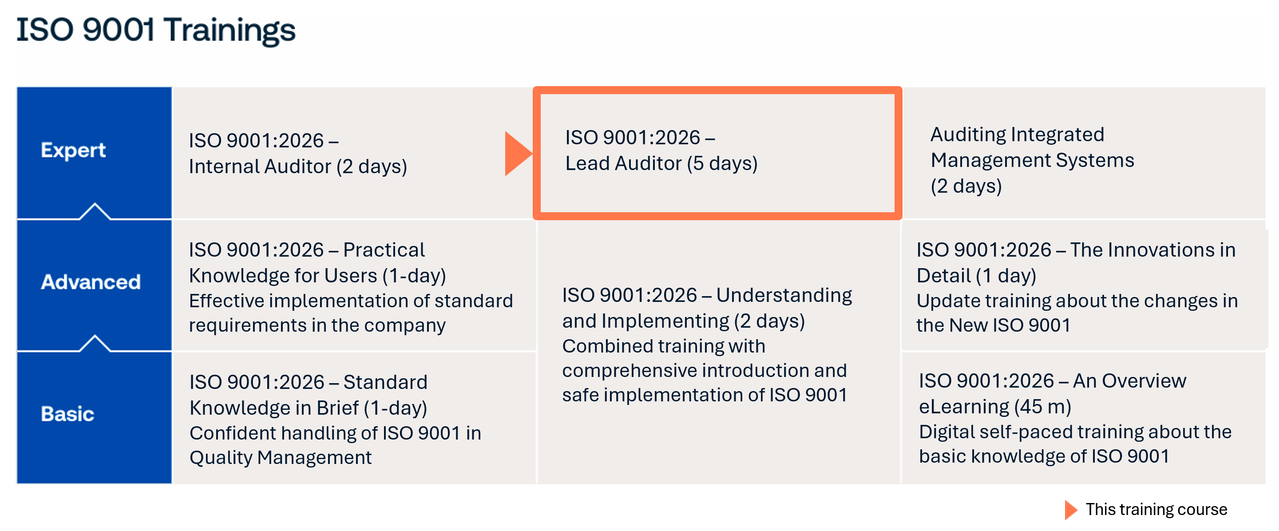
The learning pathway begins with introductory awareness training and progresses through implementation-focused courses before advancing to professional auditing qualifications. Whether you are completely new to ISO 9001, involved in operating a QMS, responsible for implementation and improvement activities, or preparing to conduct internal or external audits, there is a training solution tailored to your needs. The portfolio structure is illustrated below and provides a clear progression from Basic to Advanced and Expert levels. Based on the learning pathway shown in the ISO 9001 training portfolio, learners can select individual courses or combine them to build a complete competence development journey.
Basic Level
ISO 9001:2026 – An Overview (45-minute eLearning)
The journey starts with this self-paced eLearning module, designed for individuals who are new to ISO 9001 or who need a concise introduction to the standard. Participants gain a basic understanding of Quality Management Systems, the purpose and benefits of ISO 9001, and the key concepts and requirements that can be applied to organizations of any size or sector.
ISO 9001:2026 – Standard Knowledge in Brief (1 day)
This classroom or virtual instructor-led course provides a structured introduction to the revised ISO 9001:2026 standard. Participants become familiar with the structure, terminology, principles and requirements of the standard while gaining insight into the latest developments and proposed changes included in the revision.
Advanced Level
ISO 9001:2026 – Practical Knowledge for Users (1 day)
Designed for professionals who already have a basic understanding of ISO 9001, this practice-oriented training focuses on applying the requirements within a real Quality Management System. Participants learn how to analyze organizational context, identify risks and opportunities, develop quality objectives and process KPIs, and effectively manage nonconformities and corrective actions. Through practical exercises, group work and case studies, learners gain confidence in implementing ISO 9001 requirements within their organizations.
ISO 9001:2026 – Understanding and Implementation (2 days)
This comprehensive program combines the content of Standard Knowledge in Brief and Practical Knowledge for Users into a complete learning experience. Participants develop both a solid understanding of the standard and the practical skills required to implement, maintain and continually improve an effective Quality Management System.
ISO 9001:2026 – The Innovations in Detail (1 day)
This specialized update course is ideal for organizations already certified to ISO 9001 or professionals familiar with the current version of the standard. Participants receive a detailed review of the planned changes introduced in the ISO 9001:2026 revision, learn how to interpret the new requirements, and assess the impact on existing Quality Management Systems. Interactive workshops and case studies help participants identify practical implementation actions for their organizations.
Expert Level
ISO 9001:2026 – Internal Auditor (2 days)
This course equips participants with the knowledge and practical skills needed to plan, conduct, report and follow up internal audits of a Quality Management System in accordance with ISO 9001:2026. Participants learn auditing principles, interview techniques, evidence gathering, audit reporting and the evaluation of conformity against standard requirements.
ISO 9001:2026 – Lead Auditor (5 days)
Designed for experienced quality professionals and auditors, this intensive program develops the competencies required to lead first-party, second-party and third-party audits. Participants learn advanced auditing techniques, audit management processes, communication skills and auditor best practices needed to perform and lead effective management system audits.
Auditing Integrated Management Systems (2 days)
Organizations increasingly operate multiple management systems simultaneously. This advanced course focuses on planning and conducting integrated audits across multiple standards and management systems, helping auditors increase efficiency while evaluating processes through a unified business-focused approach.
Recommended Learning Paths
For beginners
For QMS users and process owners
For implementation and quality professionals
For auditors
- ISO 9001:2026 – Understanding and Implementation
- ISO 9001:2026 – Internal Auditor
- ISO 9001:2026 – Lead Auditor
- Auditing Integrated Management Systems
This structured portfolio enables learners to progress from awareness and understanding, through implementation and improvement, to professional auditing competence, ensuring organizations have the skills needed to successfully implement and sustain ISO 9001:2026.
What is the purpose of this course?
This course develops the knowledge and practical auditing skills required to perform Quality Management System audits against ISO 9001:2026 and to lead audit teams effectively.
Is this an ISO 9001 implementation course?
No. This course is designed to develop auditing competence rather than provide implementation consulting or clause-by-clause interpretation of ISO 9001 requirements.
What standards are covered?
The course primarily covers ISO 9001:2026 and auditing principles and practices based on ISO 19011. References may also be made to ISO 9000 and ISO 9004 where relevant.
Will I participate in practical audits?
Yes. Participants engage in extensive audit simulations, workshops, interviews, audit planning exercises, opening meetings, audit reporting activities and closing meeting simulations.
What audit types will I learn?
You will learn auditing techniques applicable to Internal (First-Party), Supplier (Second-Party), and Certification Preparation or Third-Party audit environments.
How is participant performance assessed?
Performance is evaluated through continuous assessment, participation in exercises and workshops, audit simulations, daily tests and a final examination.
Is attendance mandatory?
Yes. Full attendance throughout the five-day program is expected to successfully complete the training requirements.
What skills will I gain?
Participants will develop competencies in:
- Audit planning
- Interviewing techniques
- Audit evidence collection
- Process auditing
- Audit reporting
- Nonconformity writing
- Corrective action review
- Audit team leadership
- Audit follow-up and verification activities
Is prior auditing experience required?
No. Prior auditing experience is beneficial but not mandatory. However, participants should already have a working knowledge of Quality Management Systems and ISO 9001 requirements.
What certificate will I receive?
Participants who successfully satisfy the assessment requirements and examination criteria will receive a Certificate of Achievement. Other participants may receive a Certificate of Attendance according to the applicable certification requirements.
Is the course available virtually?
Yes. The training can be delivered through Virtual Instructor-Led Training (VILT) or face-to-face classroom delivery. Virtual sessions are conducted live with direct trainer interaction.
How much of the course is practical?
The course places significant emphasis on practical application through exercises, workshops, audit simulations, role plays and case studies designed to replicate real audit conditions.
Will I learn how to write audit findings and nonconformities?
Yes. Participants practice identifying audit findings, documenting objective evidence, classifying findings and writing effective nonconformity statements.
Will I learn how to conduct opening and closing meetings?
Yes. Dedicated practical workshops are included to help participants conduct professional opening and closing meetings during audits.
Does the course cover audit reports and corrective actions?
Yes. Participants learn how to prepare audit reports, evaluate corrective action responses and perform audit follow-up activities.
What career opportunities can this course support?
The course supports professional development for Internal Auditors, Supplier Auditors, Lead Auditors, Quality Managers, Management Representatives, Consultants and professionals involved in management system compliance and improvement activities.
Experienced specialist trainers from the TÜV SÜD Academy with practical knowledge in quality management and in the application of ISO 9001.
This course is certified by Exemplar Global.
TÜV SÜD has achieved Exemplar Global Accreditation as a Recognized Training Provider. This accreditation confirms our commitment to providing the highest quality services and demonstrates our expertise in our industry. As a professional, it's important to have recognition for your skills and knowledge. Exemplar Global Accreditation provides this recognition, giving you a competitive edge in the marketplace. With over 30 years of experience building certification programs, Exemplar Global is the leading authority in accreditation for the conformity community. As a student of an Exemplar Global Recognized Training Provider (RTP) course, you are eligible to receive:
- Access to Exemplar LINK
- 12-months of exclusive benefits including:
- One self-coaching assessment
- Extended learning content
- Complimentary access to online events, online magazine, newsletters, and low-cost professional liability insurance
- Access to an exclusive LinkedIn Community
- The chance to look into alternatives for employment and career advancement
- A TÜV SÜD / Exemplar Global Graduate Certificate
At TÜV SÜD, we believe in maximizing your career and providing you with the tools you need to succeed. Our Exemplar Global Accreditation is a testament to our commitment to excellence and our commitment to helping you succeed.