

Navigating the complexities of EU Taxonomy and other international sustainability directives is challenging. Although varied in their specific goals, these regulations generally require advanced sustainability reporting and aim for net-zero carbon emissions by 2050. At RISKWORLD 2024, Global Risk Consultants Principal Consulting Lead Ulf Bruening provided an insightful overview of global directives and the critical need for sustainability assessments from trained professionals.
Here are some key takeaways from the session.
EU Taxonomy: A classification system that defines the criteria for economic activities considered environmentally sustainable and aligned with the goal of net-zero carbon emissions by 2050. It applies to European companies and foreign companies doing business in Europe.
Corporate Sustainability Reporting Directive (CSRD): As part of the EU Green Deal, this directive evaluates the sustainability performance of companies and measures their alignment with 10 out of 17 Sustainable Development Goals (SDGs) adopted by the United Nations in 2015. It aims to increase transparency, comparability, and standardization of sustainability information among EU-based companies.
Corporate Sustainability Due Diligence Directive (CSDDD): This directive requires companies to audit their supply chains to identify human rights violations, environmental issues, and more.
Over the past 20+ years, governments and international organizations have set a wide variety of sustainability milestones. Below is a timeline of the most significant initiatives.
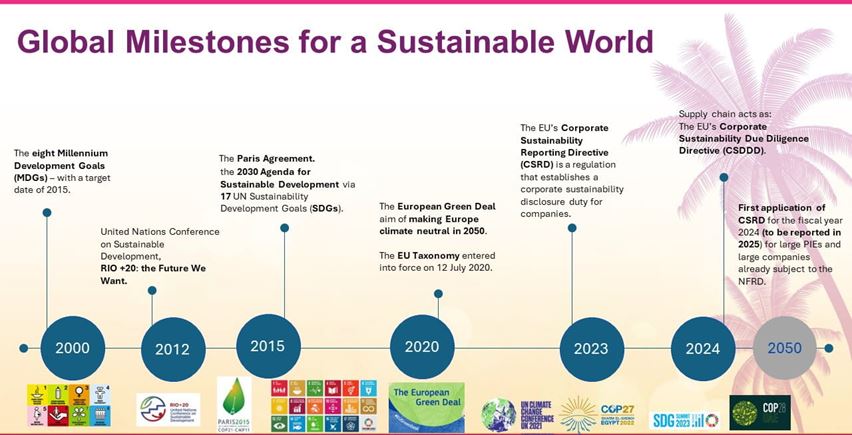
The rules pertaining to sustainability reporting are stringent and mandatory.
“If you fail to report on corporate sustainability or you don’t meet the goal of net zero emissions by 2050, companies can face fines up to 5% of annual revenue,” said Bruening. “Managers responsible for the reporting could face significant consequences, companies might, in the worst cases, even be excluded from the market.”
Governments are not the only entities demanding action on sustainability; consumers are too. They are increasingly supporting businesses that align with their values.
“Younger consumers are gaining more economic power and seeking out sustainable products and companies,” said Bruening. “That behavior will transform the market over the next decade.”
To ensure compliance with sustainability mandates, conduct a sustainability assessment — a comprehensive, evidence-based approach to evaluating an organization’s contribution to sustainable performance. These assessments analyze a company’s adherence to 17 SDGs adopted by the UN (broken down into 126 targets, and 1,533 indicators) and provide clear evidence of how the organization meets these criteria. Methodologies slightly differ between the companies that offer such comprehensive and intensive assessments.
Sustainability assessments consider various types of operations, assigning different weights to reflect a company’s industry sector, region, and business model. For instance, a steam mill in India will have different potential issues compared to an office building in the United States.
These assessments might examine factors such as collective wage agreements, fair pay for employees, and the energy-to-power ratio. Each indicator is rated on a scale of 1-5 (5 being the best), which helps determine an overall score representing the degree of fulfillment of all SDGs.
“Sustainability assessments provide a holistic view of corporate sustainability, helping companies stay on track to complying with the Green New Deal requirements,” said Bruening.
Site Selector
Global
Americas
Asia
Europe
Middle East and Africa
