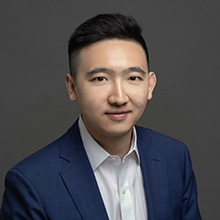
Ian Liu
Client Executive, Global Risk Consultants

Artificial intelligence is already transforming risk engineering—and according to Ian Liu, Client Executive at Global Risk Consultants (GRC), we’re only at the beginning.
Liu brings a rare dual lens to this transformation: a background spanning property risk engineering, underwriting, and a master’s degree in the management of artificial intelligence. As one of the few professionals in the industry fluent in both domains, he’s become a leading voice on how AI can enhance—not replace—human judgment in risk control.
In the picture: Jared Shelly (left) and Ian Liu
In a recent episode of the RIMS podcast and during a live session at RISKWORLD 2025 moderated by GRC’s head of marketing Jared Shelly, Liu shared how AI is reshaping everything from data collection and hazard prediction to insurance submissions and strategic decision-making. His insights reflect the next wave of risk engineering—one where people and machines collaborate to make faster, smarter, and more resilient decisions.
5 TAKEAWAYS
1. Data Ownership Is the Foundation of Strong Risk Management
"The risk data belongs to you. It's your facility, it's your exposure. You should have ownership of that information."
Your ability to negotiate a policy, prepare a submission, or even make internal safety improvements depends on one thing: access to quality data. Liu emphasized that companies shouldn’t rely solely on brokers or insurers to hold that information. Owning your risk data—structurally and strategically—sets the stage for more transparent, confident, and efficient decision-making.
2. AI Is Reshaping Every Step of the Risk Lifecycle
"AI is going to fundamentally transform every step of what we do in this space."
AI thrives on data—and in property loss control, everything starts and ends with it. From risk identification and mitigation to pricing and policy terms, AI is already augmenting decision-making with faster analysis, more precise forecasting, and early issue detection.
Liu cited tools like digital twins and IoT-enabled real-time monitoring as powerful enablers for predicting failures before they escalate. In high-value industries like manufacturing and energy, this could prevent tens of millions in losses through preemptive maintenance.
3. AI Can’t Replace Human Judgment—Especially in the Field
"AI can analyze a lot of data, but it can’t walk through a facility and see if a fire pump is leaking. You still need someone to connect the dots."
AI can surface anomalies, simulate scenarios, and summarize reports—but it lacks context, nuance, and on-the-ground visibility. Liu made it clear: the best decisions happen when AI is paired with experienced engineers who understand the business, the facility, and the stakes.
4. AI-Ready Submissions Will Win the Underwriter’s Attention
"When I was an underwriter, the most organized, complete, and accurate submissions got the most of my time and attention."
Liu predicts that in the near future, insurance submissions rich with high-quality, structured data will become the gold standard. As more carriers adopt AI-driven underwriting tools, the ability to feed clean, contextualized data into those models will separate good submissions from great ones.
On the client side, AI can also help identify gaps in risk reports and enrich portfolios with external data. But garbage in, garbage out—poor or incomplete data will be penalized more sharply as AI adoption grows.
5. There Are Real Risks in AI—and Risk Managers Must Stay Vigilant
"There is always the risk of trusting AI recommendations blindly. Our best engineering judgment and underwriting discretion will still be our best model."
Liu’s view of AI is optimistic—but not naïve. He outlined real-world concerns that risk professionals should consider when implementing AI:
- Bias and variance in models (underfitting vs. overfitting)
- Data residency, security, and governance risks
- Lack of historical data for emerging risks or technologies
Risk managers and brokers must ensure AI tools comply with data regulations, avoid over-reliance on black-box predictions, and integrate AI responsibly into broader strategies.
White paper: Property Risk Engineering in the Age of AI
Artificial intelligence is reshaping how insurers triage submissions—and how risk teams prioritize mitigation. See what to modernize now to stay ahead.
The Future Is Hybrid—People + AI
AI isn’t a silver bullet. It’s a tool—one that, when used wisely, can unlock better decisions, faster responses, and stronger submissions. But as Liu reminds us, nothing replaces a seasoned engineer who knows what to look for and how to act.
"The success of our clients’ risk programs still relies on a robust property risk engineering foundation. AI helps us make better, data-driven decisions—but human judgment makes us who we are," he said.
To learn more about the intersection of AI and property risk engineering, listen to Ian’s recent podcast with the Risk Insurance Management Society.
If you’d like to discuss your specific risk management and loss control strategies, please contact us today.