
Responsible Battery Production Specialist
Drive Battery Reliability Through Smarter Production, Quality, and Sustainability Practices.
This 2-day Responsible Battery Production Specialist program delivers a practical and strategic understanding of battery failures, thermal runaway, sustainability, and production quality. Delivered by TÜV SÜD Americas, the training connects real-world field data, north american environmental conditions, and manufacturing realities to battery reliability and lifetime.
Objective:
- Build awareness of battery failure mechanisms and thermal propagation
- Understand sustainability and lifecycle considerations
- Develop knowledge of battery production and quality control
- Prepare professionals to manage battery reliability in real conditions
This course is suitable for:
- NPD and Design & Development Engineers
- R&D Professionals
- Production Engineers
- Reliability & Safety Engineers
- Testing & Validation Engineers
- EV and battery system professionals
Day 1 – Failures, Environment & Sustainability
- Failure modes in battery usage (thermal runaway, imbalance, aging)
- Thermal runaway and propagation mechanisms
- Statistics and field insights
- Case studies (EVs, warehouses, incidents)
- North American-specific environmental challenges
- Sustainability concepts
- Learning from failures and operational quality
Day 2 – Production & Quality
- Cell, module, and pack production overview
- Manufacturing quality principles
- Standards and their influence on battery quality
- Q&A session
You will gain a practical understanding of how batteries behave in real operating conditions, why failures occur, and how production and quality influence battery life. The course explains thermal runaway, aging, imbalance, and environmental stress factors common in North America such as heat, humidity, dust, extreme colds, and logistics challenges.You will also learn how sustainability considerations and production quality affect long-term battery reliability. Through case studies and field data interpretation, you will build the ability to connect design, production, and operational quality to overall battery performance.
By the end of theprogram, participants will be able to:
- Understand common battery failure modes and root causes
- Explain thermal runaway mechanisms and propagation risks
- Assess environmental impacts on battery performance
- Interpret field failure data and case studies
- Understand sustainability and lifecycle factors
- Recognize quality drivers in battery production and operation
- Strong awareness of real-world battery failures
- Improved understanding of battery lifetime drivers
- Knowledge of sustainability and responsible production
- Better quality control awareness in manufacturing
- Industry-relevant insights for North America conditions
Examination
- Online exam (30 minutes)
- Objective-type questions
- Maximum marks: 30
- Passing marks: 21 (70%)
Certification
- ≥70% score: Certificate of Successful Completion (Responsible Battery Production Specialist
- <70% score: Certificate of Attendance
- Completion of all three modules (Safety + Design + Production) leads to Expert in Battery Technology (Safety, Design & Sustainable Production) certification
Participants are expected to have prior knowledge of:
- Basic electrical fundamentals
- Product/system monitoring knowledge
- Product application knowledge
- Completion of Battery Safety Specialist Certification
Learning Path:
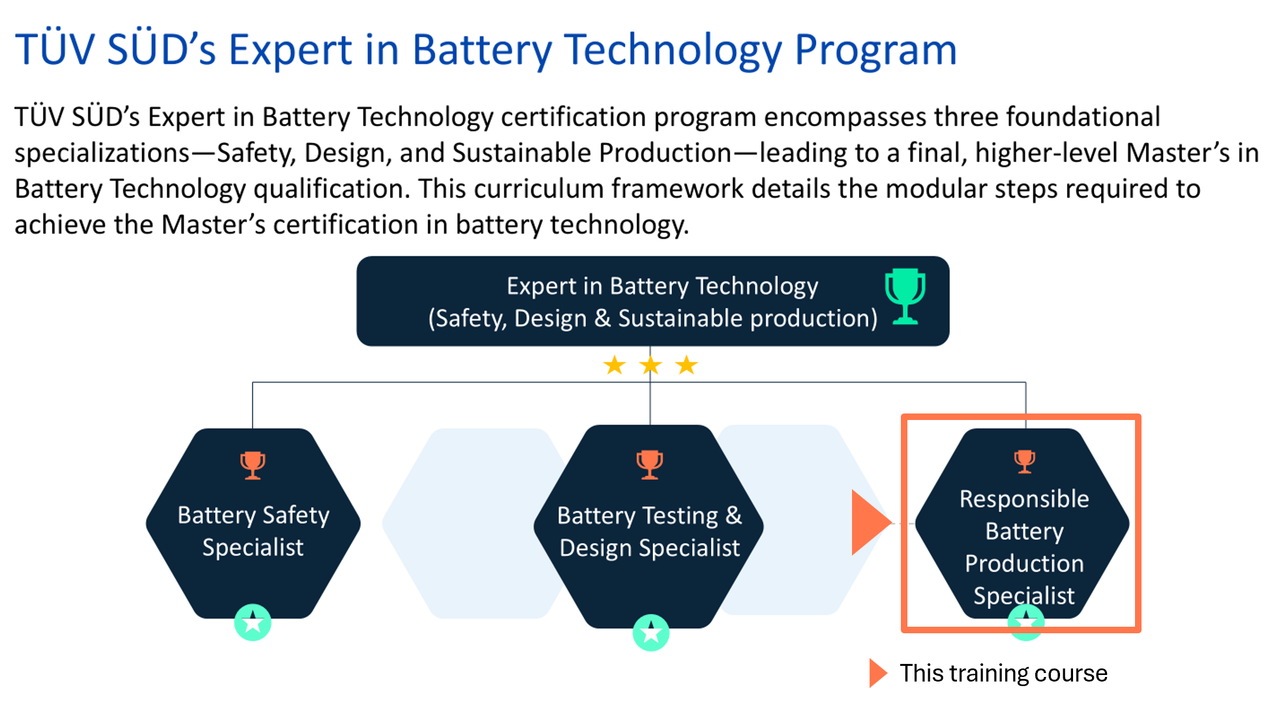
This course is one of three specialist programs within TÜV SÜD’s Expert in Battery Technology Learning Path. The pathway comprises of:
- Battery Safety Specialist Program (3 days)
- Battery Testing & Design Specialist Program (4 days), and
- Responsible Battery Production Specialist Program (2 days),
providing professionals with a holistic understanding of battery safety, performance, design, testing, and sustainable production practices.
1. Does this course cover real failure case studies?
Yes, real industry cases and North America context incidents are discussed.
2. Is thermal runaway explained technically?
Yes, mechanisms and propagation behavior are explained in engineering terms.
3. Are sustainability topics included?
Yes, lifecycle thinking and sustainability impacts are covered.
4. Does it address climate challenges in North America?
Yes, heat, humidity, extreme cold, dust, and logistics impacts are specifically discussed.
5. Is production quality covered in detail?
Core manufacturing quality principles and standards are introduced.
6. Is this course practical or theoretical?
It is primarily theory-based with applied case discussions.
7. How can I pay the training and examination fees?
Fees can be paid through online payment modes.
TÜV SÜD America, Inc. is a recognized leader in high-voltage safety training and certification for electric vehicles. Its training programs are well-regarded both in the United States and internationally. The experts at TÜV SÜD Academy possess deep technical knowledge and hands-on experience, ensuring that the training is both practical and comprehensive.
Professionals responsible for high-voltage safety in electric vehicles play a critical role, as their expertise directly impacts the safe and efficient operation of the entire system.