
ISO 13485:2016 Lead Auditor Training Program for Medical Devices with FDA QMSR & MDSAP Regulatory Requirements (USA/Canada) — 2026 Update
Lead audits. Ensure compliance. Drive quality excellence in the medical device industry.
This Exemplar Global–certified 5‑day Lead Auditor Training Program provides participants with the competence to perform first‑, second‑, and third‑party audits of Medical Device Quality Management Systems (MD‑QMS) according to ISO 13485:2016 and applicable global regulatory requirements in alignment with ISO 19011 and ISO/IEC 17021.
The training now includes a dedicated regulatory module on the 2026 North America update — ISO 13485 with FDA QMSR (USA/Canada) — covering the modernization of 21 CFR Part 820 into the FDA Quality Management System Regulation (QMSR) effective February 2, 2026, and its alignment with ISO 13485:2016. Participants also learn how the Canadian CMDR and MDSAP requirements integrate with ISO 13485 and how these impact audit planning, execution, and reporting. This new module provides essential insights for auditors working with manufacturers operating in the U.S. and Canadian markets.
Learners gain an in‑depth understanding of MD‑QMS regulatory expectations, including risk‑based QMS processes, lifecycle documentation via the Medical Device File (MDF), UDI, complaint handling, PMS obligations, vigilance, labeling requirements, and unique retained U.S. regulatory elements (MDR 803, Corrections & Removals 806, Tracking 821).
Important: TÜV SÜD tests and certifies through its Notified Bodies medical devices and their manufacturers. TÜV SÜD Akademie GmbH offers trainings in the field of medical devices.
The neutrality and independence of the conformity assessment procedures carried out by TÜV SÜD must be maintained. In the interest of our customers, hence the seminars of TÜV SÜD Akademie do not contain any product-specific, process-related or company-specific content or solutions that could fulfill the function of individual consulting.
In case of any questions or uncertainties, please do not hesitate to contact us at [email protected].
The ISO 13485 Lead Auditor certification training course can be attended by medical device quality testing professionals interested in conducting first-party, second-party, and third-party audits.
- Management representatives.
- Quality directors, managers, and engineers.
- Consultants.
1) MD-QMS Introduction and Process Approach
- Purpose and benefits of MD-QMS-Requirements for Regulatory Purposes including understanding of the basic MD-QMS principles
- Terms, Fundamentals and Principles
- Process Approach with PDCA
- Mandatory documents for regulatory purposes
- Difference between compliance and conformance
- Relationship between IMDRF and GHTF
- Principles of IMDRF
- MDR European Union Regulations
- MD-QMS Requirements (Clause 1 to 8)
1.5) ISO 13485 with FDA QMSR (USA/Canada) 2026 Update — NEW MODULE
- FDA modernization of 21 CFR 820 into QMSR (effective Feb 2, 2026)
- ISO 13485 incorporation and remaining FDA‑specific requirements (UDI 830, MDR 803, C&R 806, Tracking 821)
- Transition to the Medical Device File (MDF) replacing DMR/DHF/DHR
- North America regulatory comparison: FDA QMSR vs CMDR/MDSAP — audit implications
- Canadian licensing (MDL / MDEL), bilingual labeling, PMS/incident reporting, and MDSAP audit expectations
- Internal audit considerations under QMSR & MDSAP
- Traceability expectations under design (7.3) and production (7.5.8/7.5.9) controls
2) Auditing Principle
- Auditing objectives
- Types of audits
- Audit life cycle
- Terms and Definition
- Principle of Auditing
- Annex A – Guidance of Auditors
3) Role and Responsibilities of Auditor
- Audit Programme objectives
- The auditees responsibilities
- The lead auditors’ responsibilities
- Auditors qualification and certifications
4) Role Planning an Audit
- Pre-Audit planning
- Reviewing documentation
- Developing an audit plan
- Preparing checklists or working documents
- Communication factors
5) Conducting an Audit
- Opening meeting
- Collecting objective/audit evidence
- Effective interviewing techniques
- Identifying and recording nonconformities
- Preparing for the closing meeting
6) Reporting Audit Results
- Conducting the closing meeting
- Preparing the audit report
- Distributing the audit report
7) Corrective Actions
- Corrective action responsibilities
- Follow up scheduling
- Monitoring corrective action
8) ISO 13485: 2016 Registration
- The registration processes
- Surveillance audits
9) Exercises/ Role play (50 % of course Time)
10) Written Examination
Upon successful completion of this course and its examination, delegates will be able to:
Knowledge Outcomes
- Explain the purpose of a Medical Device Quality Management System and its relationship to global regulatory authorities.
- Describe ISO 13485:2016 requirements and their alignment with FDA QMSR and CMDR/MDSAP expectations.
- Understand the role of an auditor in planning, conducting, reporting, and following up on MD‑QMS audits in accordance with ISO 19011 and ISO/IEC 17021.
Skills Outcomes
- Plan, conduct, report, and follow up an audit of an MD‑QMS to establish conformity with ISO 13485:2016 and applicable regulatory requirements (FDA QMSR, CMDR/MDSAP).
- Apply risk‑based auditing, evaluate lifecycle documentation (including MDF), and assess regulatory compliance evidence for North American markets.
This intensive and participative Lead Auditor program uses case studies, workshops, role‑plays, and group activities to build practical auditing capability and ensure learners can confidently perform and lead MD‑QMS audits globally.
This training equips professionals with the knowledge, practical auditing techniques, and regulatory expertise required to lead and perform ISO 13485 audits confidently while addressing the latest FDA QMSR and MDSAP requirements. Participants will leave prepared to assess the effectiveness of medical device quality management systems, support regulatory compliance, and drive continuous improvement across their organizations.
By attending this advanced 5-day Lead Auditor training, you will:
-
Develop the competence to plan, conduct, report, and follow up on first-, second-, and third-party audits of Medical Device Quality Management Systems (MD-QMS) in accordance with ISO 13485:2016 and internationally recognized auditing principles.
-
Gain a thorough understanding of ISO 13485:2016 requirements and their practical application, enabling effective assessment of quality management systems across the medical device lifecycle.
-
Strengthen auditing skills using ISO 19011 and ISO/IEC 17021 guidelines, improving the ability to evaluate conformity, identify nonconformities, and drive continual improvement.
-
Understand the latest FDA Quality Management System Regulation (QMSR) requirements and how FDA's alignment with ISO 13485:2016 impacts audit planning, execution, documentation, and reporting.
-
Gain valuable insight into Canadian CMDR and MDSAP requirements, allowing auditors to assess compliance for organizations operating in both the U.S. and Canadian medical device markets.
-
Learn how to audit risk-based quality management processes, including design and development controls, supplier management, production controls, complaint handling, post-market surveillance, and vigilance activities.
-
Enhance knowledge of regulatory documentation and traceability requirements, including Medical Device Files (MDF), UDI requirements, lifecycle records, and post-market compliance obligations.
-
Build confidence in evaluating regulatory compliance and audit readiness, helping organizations prepare for certification, regulatory inspections, and customer audits.
-
Improve the ability to identify risks, gaps, and opportunities for improvement, contributing to stronger quality systems, product safety, and regulatory compliance.
-
Benefit from expert instruction and an Exemplar Global-certified training program, providing industry-recognized auditor training and professional development.
-
Enhance professional credibility and career growth opportunities by acquiring advanced lead auditor competencies that are highly valued within quality assurance, regulatory affairs, supplier quality, and compliance functions.
This is an instructor-led training in a virtual classroom. There is a balance between knowledge-based presentation, discussions, exercises and case studies. 50% of the time is spent on activity-based learning.
- Course delivered by one of TÜV SÜD's leading industry experts
- Small class sizes enhance trainer-delegate relationship
- Receive globally recognised TÜV SÜD certificate upon completion
Instructor-led training in a virtual classroom. This means the course is Live Online. Participants will learn through online teaching. Lectures, case studies, group exercises, discussions, problem solving, examples with explanation, assignments and/or quizzes happen in the virtual classroom training. Participants need to connect to the class from any internet accessible location. Each module is delivered live using webinar technology, creating a virtual classroom learning environment. Live sessions provide you with direct access to the trainer so you can ask questions, understand complex concepts and share ideas with peers. Webcam and microphone are REQUIRED to interact with the instructor and/or other participants.
The course content and structure are designed by the domain experts from TÜV SÜD.
With immense experience and knowledge in the relevant standards, our team of product specialists and technical experts at TÜV SÜD, developed the course content based on current business landscape and market requirements.
In order to satisfactorily complete the course each trainee must:
1. Complete/attend all elements of the course.
2. Pass the continuous assessment.
3. Pass the written examination.
Evaluation parameters
1) Continuous Assessment: Punctuality, presentation skills, interactive approach, involvement, role-play, daily tests etc.
2) Written examination: (Closed book) at the end of the course.
- Participants who score 70% and above in both the continuous assessment and written examination will be issued a certificate of successful completion of the course. The Lead Auditor course is made in line with international registers and guidelines.
- Unsuccessful candidates will be issued a certificate of attendance.
Learners must obtain a copy of the ISO standard to be referenced during the course. The standard may be purchased through the American National Standards Institute (ANSI) (www.ansi.org) and/or American Society for Quality (ASQ) (www.asq.org).
As the ISO 13485 Lead Auditor training covers auditing concepts utilizing ISO 13485, a prior understanding of ISO 13485 and its implementation within a Medical Device business and internal audit experience is recommended.
MD -QMS
- MD -QMS Terms and definitions
- MD -QMS Requirements
- ISO 9000 – Terms and Definitions
Other related standards
- IEC 62304
- PD ISO/TR 80002-2-2017
- IEC/ISO60601
- ISO14937
- ISO14644
- 14698-1
Relationship With
- GHTF
- IMDRF
- MDSAP
Learning Path:
Medical Device Quality Management Learning Pathway
Not sure which ISO 13485 training course you need?
Progress from ISO 13485 fundamentals to advanced auditing expertise through this comprehensive medical device quality management learning pathway.
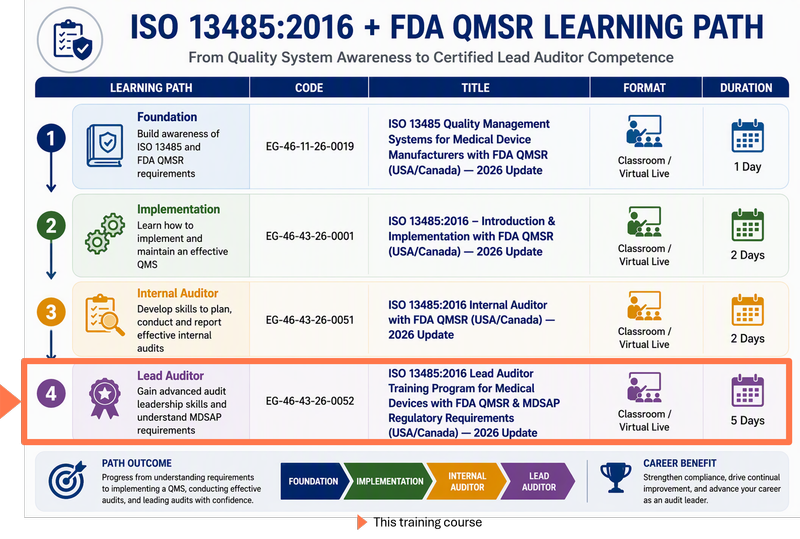
Participants begin with an introduction to ISO 13485 and FDA QMSR requirements in the ISO 13485 Quality Management Systems for Medical Device Manufacturers with FDA QMSR (USA/Canada) — 2026 Update [eg-46-11-26-0019] training course, gaining a clear understanding of the regulatory and quality management expectations for medical device manufacturers.
They then advance to implementation techniques with the ISO 13485:2016 – Introduction & Implementation with FDA QMSR (USA/Canada) — 2026 Update [eg-46-43-26-0001] training course, learning how to establish, maintain, and improve a compliant Quality Management System that supports product quality, patient safety, and regulatory readiness.
Once a strong implementation foundation has been established, learners develop practical auditing competencies through the ISO 13485:2016 Internal Auditor [eg-46-43-26-0051] course, where they learn to assess QMS effectiveness and drive continual improvement.
This pathway culminates with the ISO 13485:2016 Lead Auditor Training Program for Medical Devices with FDA QMSR & MDSAP Regulatory Requirements (USA/Canada) — 2026 Update [eg-46-43-26-0052], providing the advanced audit leadership skills needed to conduct and lead audits against ISO 13485, FDA QMSR, and MDSAP requirements. This structured progression is ideal for quality professionals, regulatory specialists, implementation teams, internal auditors, and future lead auditors seeking a complete development path from compliance awareness to auditing excellence.
1. What is the main objective of this course?
This course is designed to develop the knowledge and practical skills required to perform, lead, and manage first-party, second-party, and third-party audits of Medical Device Quality Management Systems (MD-QMS) based on ISO 13485:2016 and applicable regulatory requirements. Participants learn how to evaluate compliance, identify nonconformities, and assess the effectiveness of quality management systems.
2. Who should attend this training?
This course is ideal for Quality Managers, Quality Engineers, Regulatory Affairs professionals, Internal Auditors, Supplier Quality Auditors, Compliance Specialists, Consultants, and professionals seeking to become Lead Auditors in the medical device industry.
3. Is prior knowledge of ISO 13485 required?
Yes. As this is an advanced Lead Auditor course, participants will benefit from having a working knowledge of ISO 13485:2016 and medical device quality management systems before attending.
4. What auditing standards are covered during the training?
The course covers auditing principles and practices based on ISO 19011 and ISO/IEC 17021, in addition to ISO 13485:2016 requirements and applicable regulatory expectations.
5. Does the course cover FDA QMSR requirements?
Yes. The course includes a dedicated module covering the FDA Quality Management System Regulation (QMSR), including its alignment with ISO 13485:2016 and the regulatory changes effective February 2, 2026.
6. Will I learn about MDSAP requirements?
Yes. Participants will learn how Canadian CMDR and MDSAP requirements integrate with ISO 13485 and how these requirements impact audit preparation, execution, and reporting.
7. What medical device regulatory topics are included?
The training addresses FDA QMSR, MDSAP, Medical Device Files (MDF), UDI requirements, complaint handling, post-market surveillance (PMS), vigilance, labeling requirements, and U.S.-specific regulatory obligations such as MDR reporting, Corrections & Removals, and Device Tracking.
8. Will the course explain how to audit risk management processes?
Yes. Participants learn how to audit risk-based quality management processes and evaluate whether risk management principles are effectively integrated within the organization's QMS.
9. Are audit planning and audit reporting covered?
Yes. The course teaches how to prepare audit plans, conduct audits, gather objective evidence, write audit findings, document nonconformities, and prepare professional audit reports.
10. Does the training include practical exercises?
Yes. Participants are expected to engage in practical auditing activities, case studies, and audit scenarios designed to strengthen their auditing and evaluation skills.
11. Will I learn how to identify and classify nonconformities?
Yes. The course provides guidance on identifying audit findings, evaluating objective evidence, and appropriately classifying nonconformities against ISO 13485 requirements and regulatory expectations.
12. Does the course address supplier and outsourced process audits?
Yes. Auditing supplier controls and outsourced processes is an important element of ISO 13485 compliance and is incorporated into the auditing methodology covered in the program.
13. How does the course address post-market activities?
Participants learn how to assess processes related to complaints, vigilance reporting, post-market surveillance, and other activities that ensure ongoing compliance and product safety after market launch.
14. Will I learn how FDA inspections relate to ISO 13485 audits?
Yes. The course explains the impact of FDA's QMSR framework and how FDA expectations align with ISO 13485 requirements, helping auditors understand key inspection and compliance considerations.
15. How long is the training?
The training is a comprehensive five-day instructor-led program designed to provide both theoretical knowledge and practical auditing experience.
16. What skills will I gain upon completion?
Upon completion, participants will be able to:
- Plan and conduct ISO 13485 audits.
- Evaluate compliance with FDA QMSR and MDSAP requirements.
- Assess the effectiveness of medical device quality management systems.
- Identify risks, gaps, and improvement opportunities.
- Report audit findings professionally and objectively.
- Support organizations during certification and regulatory readiness activities.
17. Is the course recognized internationally?
Yes. The training is Exemplar Global-certified and is delivered by TÜV SÜD, a globally recognized organization in quality, regulatory compliance, and auditing training.
18. What professional benefits can participants expect after completing the course?
Successful participants can enhance their qualifications for roles such as Lead Auditor, Internal Auditor, Supplier Quality Auditor, Quality Manager, Regulatory Affairs Specialist, and Compliance Professional within the medical device industry.
19. How is the course delivered?
The program is delivered as an instructor-led training course, allowing participants to interact directly with experienced medical device quality and regulatory experts.
20. What makes this course different from a standard ISO 13485 implementation course?
Unlike implementation-focused training, this course concentrates on advanced auditing competencies, audit leadership, regulatory assessment techniques, audit evidence evaluation, and compliance verification against ISO 13485, FDA QMSR, and MDSAP requirements.
Train with Industry Experts
Learn from specialist instructors at TÜV SÜD Academy—recognized leaders with deep expertise in their fields. For over 35 years, our global network of 2,500+ trainers has delivered practical, real-world knowledge that you can apply immediately. Our courses are continuously updated to reflect the latest regulatory changes and industry best practices, ensuring you gain relevant, up-to-date skills with every session.
This course is certified by Exemplar Global.
TÜV SÜD has achieved Exemplar Global Accreditation as a Recognized Training Provider. This accreditation confirms our commitment to providing the highest quality services and demonstrates our expertise in our industry. As a professional, it's important to have recognition for your skills and knowledge. Exemplar Global Accreditation provides this recognition, giving you a competitive edge in the marketplace. With over 30 years of experience building certification programs, Exemplar Global is the leading authority in accreditation for the conformity community. As a student of an Exemplar Global Recognized Training Provider (RTP) course, you are eligible to receive:
- Access to Exemplar LINK
- 12-months of exclusive benefits including:
- One self-coaching assessment
- Extended learning content
- Complimentary access to online events, online magazine, newsletters, and low-cost professional liability insurance
- Access to an exclusive LinkedIn Community
- The chance to look into alternatives for employment and career advancement
- A TÜV SÜD / Exemplar Global Graduate Certificate
At TÜV SÜD, we believe in maximizing your career and providing you with the tools you need to succeed. Our Exemplar Global Accreditation is a testament to our commitment to excellence and our commitment to helping you succeed.