
Corporate Carbon Footprint (CCF) – Advanced Training
Calculate and Report on CO₂-Footprint for Companies (CCF) according to GHG Protocol and ISO 14064-1 – Expert Training with Exam
This advanced training provides a comprehensive understanding of Corporate Carbon Footprint (CCF) accounting in accordance with ISO 14064-1 and the GHG Protocol. Participants learn how to define organizational and reporting boundaries, collect and validate greenhouse gas data, quantify Scope 1, Scope 2 and Scope 3 emissions, and prepare audit-ready GHG inventories and reports.
The course also covers verification requirements, climate reporting obligations, CSRD and ESRS disclosures, decarbonization strategies, greenhouse gas neutrality, and climate communication. Through practical examples and exercises, participants gain the knowledge needed to manage corporate GHG inventories with confidence and support their organization’s sustainability and reporting objectives.
After completing the training, participants will be able to:
- Explain the principles of greenhouse gas accounting according to ISO 14064-1.
- Distinguish between Corporate Carbon Footprints (CCF) and Product Carbon Footprints (PCF).
- Establish organizational and reporting boundaries for a GHG inventory.
- Evaluate significance criteria and determine relevant indirect emissions.
- Assign emission sources to the appropriate ISO 14064-1 categories and GHG Protocol scopes.
- Apply greenhouse gas quantification methods using activity data and emission factors.
- Define base years and understand recalculation requirements.
- Implement quality management processes and assess uncertainty.
- Prepare GHG reports that comply with ISO 14064-1 requirements.
- Understand the verification process and audit expectations under ISO 14064-3.
- Interpret climate-related reporting obligations under CSRD and ESRS E1.
- Compare major reporting standards and sustainability frameworks.
- Identify reduction opportunities and develop decarbonization strategies.
- Evaluate internal carbon pricing approaches and carbon neutrality concepts.
- Assess climate claims and communication practices for regulatory compliance.
This training is intended for:
- Sustainability Managers
- Environmental Managers
- Climate and Carbon Managers
- ESG Reporting Professionals
- Energy Managers
- Corporate Sustainability Officers
- Compliance and Risk Management Professionals
- Supply Chain Sustainability Specialists
- Product and Project Managers involved in climate-related initiatives
- Consultants supporting GHG accounting and sustainability reporting
- Professionals responsible for collecting, managing or reporting GHG data
Days 1-2: Corporate Carbon Footprint Development
Introduction and GHG Accounting Principles
- Carbon footprint fundamentals
- CCF and PCF overview
- ISO 14064 series
- GHG Protocol overview
- Principles of GHG accounting
Defining Inventory Boundaries
- Organizational boundaries
- Reporting boundaries
- Consolidation approaches
- Significance and materiality assessments
Categorization of GHG Emissions
- Scope 1, Scope 2 and Scope 3 emissions
- ISO 14064-1 categories 1-6
- Identification of emission sources and sinks
- Common classification challenges
Quantification of Emissions
- Activity data and emission factors
- Primary and secondary data
- Standard calculation methods
- Mass balance approaches
- Estimation approaches
- Measurement approaches
Reduction Activities and Targets
- Reduction initiatives
- Base-year selection
- Target setting
- Mitigation planning
Quality Management
- Data governance
- Data quality assurance
- Information management
- Uncertainty assessment
Reporting and Verification
- ISO 14064-1 reporting requirements
- GHG reporting content
- Verification principles
- ISO 14064-3 overview
Day 3: From Carbon Footprint to Integrated Sustainability Reporting
Review of GHG Accounting
Sustainability Reporting and Verification
- GHG reporting requirements
- Verification processes
- Assurance concepts
Climate-Related Regulatory Frameworks
- Paris Agreement
- EU Climate Law
- European Green Deal
- Fit for 55
CSRD and ESRS
- ESRS E1 Climate Change
- Disclosure requirements
- Relationship to Corporate Carbon Footprints
Global Standards and Frameworks
- CDP
- SBTi
- EcoVadis
- B Corp
- Industry-specific frameworks
Decarbonization and GHG Neutrality
- Decarbonization strategies
- Marginal Abatement Cost Curves (MACC)
- Internal carbon pricing
- ISO 14068-1
Climate Communication and Green Claims
- Climate-related disclosures
- Greenwashing risks
- Green Claims Directive
- Empowering Consumers Directive
Final Examination
Organizations are increasingly required to quantify, manage and report greenhouse gas (GHG) emissions to meet stakeholder expectations, comply with reporting requirements and support climate strategies. This advanced training provides the knowledge and practical tools needed to create a Corporate Carbon Footprint (CCF) in accordance with ISO 14064-1 and the GHG Protocol.
Participants learn the complete process of developing an organizational GHG inventory, from defining organizational and reporting boundaries to identifying emission sources, conducting significance assessments and quantifying emissions across Scope 1, Scope 2 and Scope 3 categories. The course introduces key principles of greenhouse gas accounting and explains how to select appropriate data sources, emission factors and calculation methodologies.
Building on this foundation, participants gain practical insight into quality management, uncertainty assessment, data governance and reporting requirements. The training explains how to prepare transparent, traceable and verification-ready GHG reports and introduces the principles of verification according to ISO 14064-3.
The program further explores the evolving sustainability reporting landscape, including CSRD, ESRS E1, the EU Climate Law, the European Green Deal, Fit for 55 and other climate-related regulatory frameworks. Participants will understand how Corporate Carbon Footprint data supports broader ESG and sustainability reporting requirements.
Finally, participants learn how organizations use carbon footprints to develop decarbonization pathways, establish reduction targets, apply internal carbon pricing mechanisms, pursue greenhouse gas neutrality in accordance with ISO 14068-1, and communicate climate-related information credibly while avoiding greenwashing and non-compliant environmental claims. Successful participants are prepared to support strategic climate management and auditable sustainability reporting within their organizations.
Upon completion of this training, you will be able to:
- Develop Corporate Carbon Footprints in accordance with ISO 14064-1 and the GHG Protocol.
- Define organizational and reporting boundaries using appropriate consolidation approaches.
- Conduct materiality and significance assessments for indirect emissions.
- Identify and categorize emission sources across Scope 1, Scope 2 and Scope 3.
- Apply different GHG quantification methodologies, including standard, estimation, measurement and mass-balance approaches.
- Select and apply appropriate activity data and emission factors.
- Improve data quality and perform uncertainty assessments.
- Prepare transparent and verification-ready GHG reports.
- Understand verification requirements according to ISO 14064-3.
- Navigate CSRD and ESRS climate disclosure requirements.
- Understand the role of CDP, SBTi, EcoVadis and other reporting frameworks.
- Develop effective decarbonization strategies and reduction roadmaps.
- Understand greenhouse gas neutrality concepts and ISO 14068-1 requirements.
- Communicate climate performance credibly while reducing greenwashing risks.
This instructor-led training combines expert-led presentations with practical application and participant engagement through:
- Interactive lectures
- Real-world examples and case studies
- Practical exercises and workshops
- Group discussions
- Knowledge reviews and recap sessions
- Q&A sessions with experts
- Exam preparation activities
Participants gain both methodological understanding and practical implementation skills.
Participants who attend at least 90% of the training will receive a TÜV SÜD Certificate of Attendance.
The training concludes with a final examination. Upon successful completion of the exam, participants will earn the prestigious “Corporate Carbon Emissions Accounting Expert – TÜV” certification issued by TÜV SÜD Academy.
To obtain the certification, participants must complete an online proctored examination independently. Exam access is activated on the final day of the training at 5:00 p.m., and candidates may schedule and complete the exam at a time convenient to them within six days of course completion. Examination access details and instructions will be provided via email.
Participants should have access to a laptop with Microsoft Word and Microsoft Excel installed inorder to take part in practical exercises.
- Basic understanding of sustainability, climate change or environmental management concepts.
- Prior knowledge of life cycle assessment (LCA), carbon accounting or carbon standards is strongly recommended.
- Participants should have access to a laptop with Microsoft Excel and Microsoft Word installed for practical exercises.
Learning Paths:
The Carbon Management curriculum offers two specialized learning paths that allow learners to build expertise based on their professional focus: the Corporate Carbon Learning Path and the Product Carbon Learning Path:
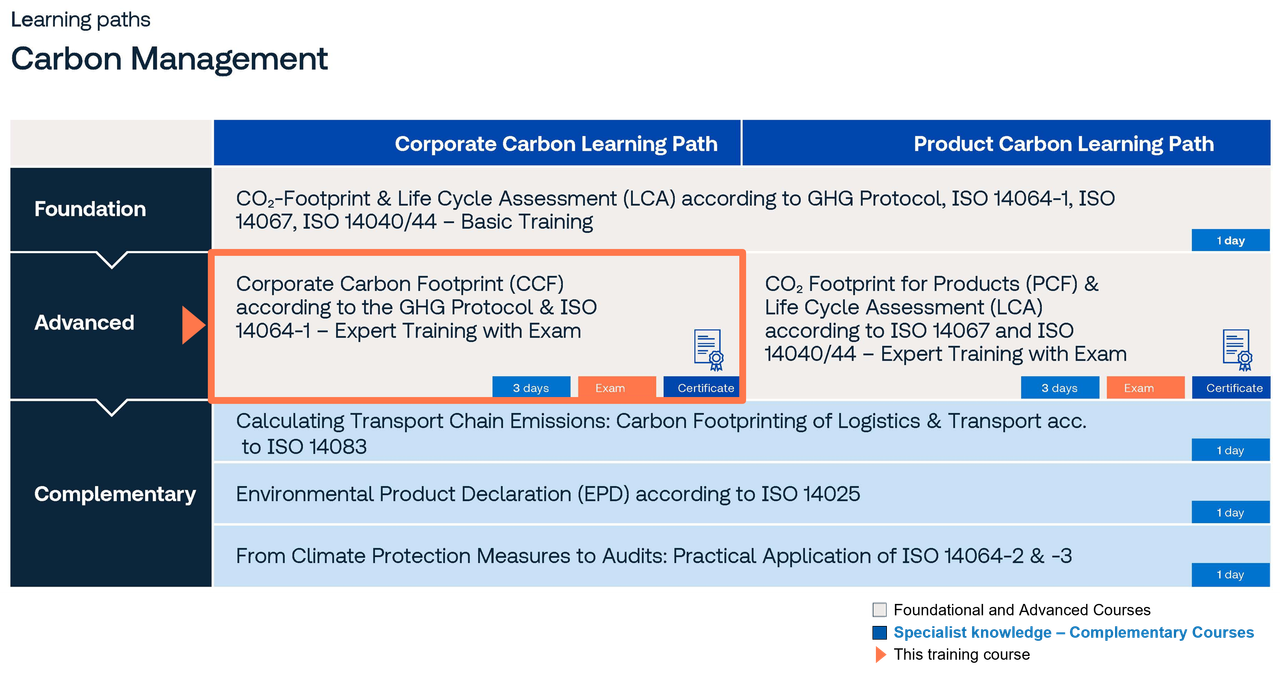
As illustrated in the learning path overview, both pathways begin with the same foundational course, Carbon Footprint and Life Cycle Assessment (LCA) – Fundamentals (25-03-26-0012), which introduces the core principles of carbon footprinting, life cycle assessment methodologies, and the relevant international standards and frameworks. This foundation ensures that all participants develop a consistent understanding of carbon accounting before progressing to more advanced topics.
After completing the foundation course, learners can select the path that best aligns with their role and objectives:
- Those interested in organizational greenhouse gas accounting and reporting can follow the Corporate Carbon Learning Path by attending Corporate Carbon Footprint (CCF) – Advanced Training (25-03-26-0015), or
- Alternatively, learners focused on evaluating and reducing product-related emissions can pursue the Product Carbon Learning Path through Product Carbon Footprint (PCF) – Advanced Training (25-03-26-0016).
Both learning paths are further supported by complementary courses that expand practical carbon management knowledge, including Calculating Transport Emissions: Carbon Footprint of Logistics and Transport according to ISO 14083 (25-03-26-0008).
Additional courses planned for future release include Environmental Product Declaration (EPD) according to ISO 14025 and From Climate Protection Measures to Audits: Practical Application of ISO 14064-2 & -3, providing learners with broader expertise in sustainability reporting, verification, and climate action implementation.
What is a Corporate Carbon Footprint (CCF)?
A Corporate Carbon Footprint measures the greenhouse gas emissions associated with an organization's activities over a defined reporting period.
Which standards are covered in the course?
The training focuses primarily on ISO 14064-1 and the GHG Protocol and also introduces ISO 14064-3, ISO 14068-1, CSRD, ESRS, CDP and SBTi.
Does the course cover Scope 3 emissions?
Yes. Participants learn how to identify, assess and quantify relevant Scope 3 emissions and perform significance assessments.
Will I learn how to prepare a GHG report?
Yes. The course covers the content, structure and documentation requirements of ISO 14064-1-compliant GHG reports.
Does the training include verification requirements?
Yes. Participants learn the fundamentals of verification according to ISO 14064-3 and how to prepare for audits and third-party verification.
Will CSRD and ESRS be covered?
Yes. The course explains the relationship between Corporate Carbon Footprints and ESRS E1 climate disclosures.
Are emissions calculation methods included?
Yes. The course covers standard calculation approaches, measurement methods, mass-balance approaches and estimation methods.
Is the course suitable for beginners?
This is an advanced-level course. Prior exposure to carbon accounting, sustainability management or life cycle assessment is recommended.
How does the course address decarbonization?
Participants learn how to identify reduction opportunities, develop climate targets, use MACC analyses and understand internal carbon pricing approaches.
Will greenhouse gas neutrality be discussed?
Yes. The course introduces ISO 14068-1 requirements and explains the relationship between carbon footprints, reductions, removals and carbon neutrality.
Does the course address greenwashing risks?
Yes. The training covers climate communication, environmental claims, greenwashing risks and relevant European legislation.
Is there an examination?
Yes. The course concludes with an examination leading to the “Corporate Carbon Emissions Accounting Expert - TÜV” certification upon successful completion.
What certificate will I receive?
Participants who meet attendance requirements receive a TÜV SÜD Certificate of Attendance. Successful examination candidates receive the “Corporate Carbon Emissions Accounting Expert - TÜV” certification.
How long is the course?
The course is delivered over three training days and combines theory, practical exercises and exam preparation.
What practical skills will I gain?
You will learn how to define boundaries, collect and validate data, quantify emissions, assess uncertainty, prepare reports, support verification activities and use CCF results for strategic climate management.
Train with Industry Experts
Learn from specialist instructors at TÜV SÜD Academy—recognized leaders with deep expertise in their fields. For over 35 years, our global network of 2,500+ trainers has delivered practical, real-world knowledge that you can apply immediately.
Our courses are continuously updated to reflect the latest regulatory changes and industry best practices, ensuring you gain relevant, up-to-date skills with every session.