
Circular Economy in Supply Chain Management
How to Implement Resilient Circular Supply Chains in Times of Global Challenges
Future‑proof supply chains are a cornerstone of the circular economy. In this one‑day training, participants learn how to turn supply chain management into a key enabler of circular value creation—despite global disruptions, regulatory pressure, and resource scarcity.
The course provides practical insights into circular procurement, supplier collaboration, reverse logistics, and the use of secondary raw materials. Participants gain hands‑on methods to manage risks, resolve conflicting objectives, and measure circularity using relevant KPIs and sustainability metrics.
After completing this course, participants will be able to:
- Understand the role of supply chains in enabling the circular economy
- Develop circular supply chain and procurement strategies
- Select, evaluate, and collaborate with circular suppliers
- Design and optimize reverse logistics and return systems
- Manage risks and conflicting objectives in circular supply chains
- Define and use KPIs, LCA, PCF, and circularity metrics for performance control
This training is designed for:
- Professionals and managers in procurement, inbound logistics, and supply chain management
- Sustainability, ESG, CSR, and risk managers
- Product, service, and supply chain strategy professionals
- Quality, compliance, and operations managers
- Consultants and professionals supporting companies in circular economy implementation
- Beginners and experienced practitioners seeking to future‑proof supply chains
Introduction to Circular Economy in Supply Chain Management
- Role of supply chains in circular economies
- Circular supply chain strategies
- Coordination across procurement, production, distribution, and return flows
Supplier Integration and Partnerships
- Circular procurement criteria and processes
- Supplier selection, evaluation, and contract design
- Collaboration models and industry use cases
Reverse Supply Chains and Reverse Logistics
- Principles of reverse logistics
- Take‑back systems, reusable packaging, pooling, recycling
- Closed‑loop and circular supply chain case studies
- Group exercise: Implementation scenarios and matching with existing processes
Material Cycles and Secondary Raw Materials
- Procurement and quality assurance of secondary materials
- Standards, certification, and supplier development
- Practical challenges and best practices in quality assurance
Risk and Conflict Management
- Availability, quality, cost, and regulatory risks
- Managing trade‑offs between sustainability, cost, and efficiency
- Tools for risk identification and assessment
- Group exercise: Identification and evaluation of specific risks in one's own supply chain
KPIs and Performance Management
- Developing KPIs for circular supply chains
- Integrating LCA, PCF, and circularity metrics
- Practical examples for controlling circular performance
Q&A and Closing
Circular economy principles are fundamentally changing how supply chains are designed, managed, and evaluated. Companies across all industries face increasing pressure—from regulation, customers, and investors—to reduce emissions, keep materials in use longer, and ensure ethical and transparent supply networks. This course addresses these challenges by showing how circular economy strategies can be successfully embedded into supply chain management.
Participants will explore the role of supply chains as enablers of circular economies and understand how circular material flows support business resilience, regulatory compliance, and sustainability goals such as reduced Scope 3 emissions and responsible resource use. The training explains how procurement, production, distribution, and return flows must be aligned to enable closed loops and circular value creation.
A strong focus is placed on supplier integration and partnerships. Participants learn how to define circular procurement criteria, select and develop suppliers, and design contracts that support reuse, take‑back systems, recycling, and the use of secondary raw materials. Practical examples and industry use cases illustrate successful collaboration models.
Reverse logistics and reverse supply chains are another key element of the course. Participants gain an understanding of return systems, closed‑loop supply chains, and logistics models that enable repair, reuse, refurbishment, and recycling—while remaining economically viable.
The course also addresses real‑world challenges such as data transparency, regulatory uncertainty, quality assurance of secondary materials, and internal resistance to circular business models. Risk management and conflict‑of‑goal management tools help participants balance sustainability, cost efficiency, and operational performance.
Finally, participants learn how to measure and control circular supply chains using meaningful KPIs, circularity metrics, life cycle assessments (LCA), and product or carbon footprint indicators. Group exercises and practical examples ensure direct applicability to participants’ own organizations.
- Turn your supply chain into a central lever for circular value creation
- Learn how to integrate secondary raw materials and reverse supply chains
- Strengthen supplier relationships through circular procurement strategies
- Identify and manage risks and goal conflicts in circular supply chains
- Gain practical KPIs and metrics to control and improve circularity
- Support compliance with sustainability regulations and reporting requirements
This is a standalone training course and includes:
- Expert‑led presentations
- Practical examples and industry use cases
- Group exercises and discussion rounds
- Hands‑on application of tools and methods
Instructor-led training sessions are conducted in a virtual classroom. This means the course is Live Online. Participants will learn through online teaching. Lectures, case studies, group exercises, discussions, problem solving, examples with explanation, assignments and/or quizzes happen in the virtual classroom training. Participants need to connect to the class from any internet accessible location. Each module is delivered live using webinar technology, creating a virtual classroom learning environment. Live sessions provide you with direct access to the trainer so you can ask questions, understand complex concepts and share ideas with peers. Webcam and microphone are REQUIRED to interact with the instructor and/or other participants.
The course content and structure are designed by the domain experts from TÜV SÜD. With immense experience and knowledge in the relevant standards, our team of product specialists and technical experts at TÜV SÜD, developed the course content based on current business landscape and market requirements.
By performing exercises and group discussions, attendees will develop a hands-on understanding that will facilitate the understanding and the implementation of knowledge and concepts.
- Interactive group exercises
- Practical case studies
- Risk identification and mitigation workshop
- Knowledge transfer through discussion and applied examples
Participants will receive a Certificate of Attendance from TÜV SÜD Academy upon completion of the training.
- No prior knowledge required
- Participants should have a laptop available with Excel and Word installed during the virtual classroom sessions
- Training documents are provided digitally
Learning Path:
Circular Economy in Supply Chain Management (11-28-26-0007) is a key component of the Circularity learning path and focuses on the integration of circular economy principles into supply chain and procurement activities. The course provides participants with an understanding of how organizations can create value by transitioning from linear to circular supply chains, improving resource efficiency, reducing waste, extending product lifecycles, and fostering collaboration across supplier networks. Learners gain practical insights into the role of procurement, supplier engagement, material flows, reverse logistics, and value chain partnerships in supporting circular business models and sustainability objectives.
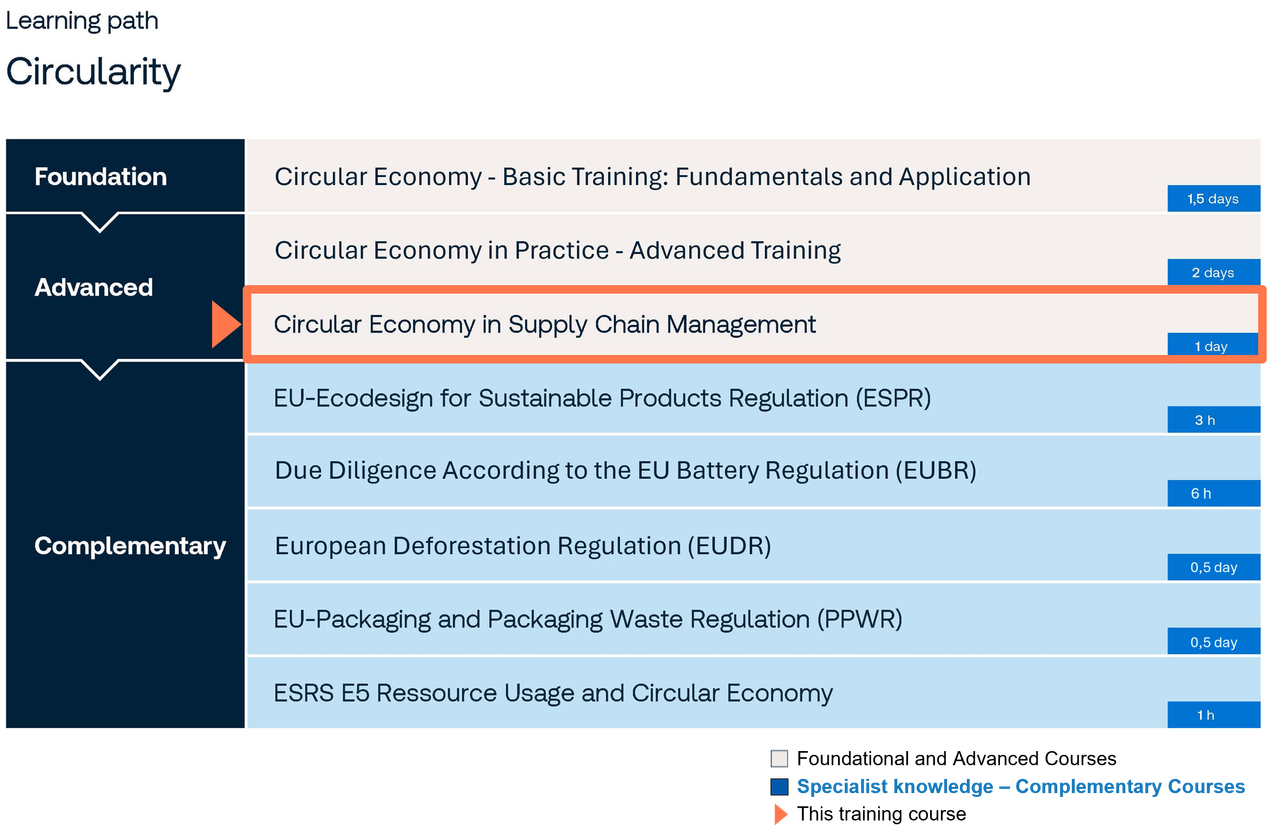
As part of a modular training programme on Circularity, this specialist course builds upon the knowledge acquired in Circular Economy - Basic Training: Fundamentals and Application (11-28-26-0008) and complements Circular Economy in Practice - Advanced Training (11-28-26-0009), which focuses on the implementation of circular economy strategies across organizations. Together, these three courses form the core learning path and are compulsory components of the Circular Economy Manager – TÜV qualification programme, culminating in an examination and certification. Participants who successfully complete all three required courses and pass the examination are awarded the Circular Economy Manager – TÜV certificate, demonstrating their competence in applying circular economy principles across business functions, operations, and supply chains.
The learning path is further enriched by complementary regulatory and reporting modules, including:
- EU-Ecodesign for Sustainable Products Regulation (ESPR) (Not yet available),
- Due Diligence According to the EU Battery Regulation (EUBR) (11-28-25-0005),
- European Deforestation Regulation (EUDR) (11-28-25-0003),
- EU Packaging and Packaging Waste Regulation (PPWR) (Not yet available), and
- ESRS E5 Resource Usage and Circular Economy (Not yet available).
These specialist courses provide additional knowledge on the evolving European regulatory landscape and its implications for circular supply chains, product stewardship, resource management, and sustainability reporting. Together, the foundation, advanced, and complementary modules create a comprehensive and progressive learning journey, enabling participants to develop both strategic and operational expertise in Circularity.
1. How long is the training and what is the time commitment?
The training is designed as a one‑day course consisting of 8 training units. It is structured to balance expert input, practical examples, and interactive exercises within a single working day.
2. Is this course suitable for companies in the USA and Canada?
Yes. While the training strongly considers EU market requirements and regulations, it is also relevant for non‑EU companies that:
- Operate global supply chains
- Supply products or services to the EU market
- Are influenced by customer, stakeholder, or investor sustainability expectations
The course addresses both directly obligated and indirectly (“voluntarily”) affected organizations.
3. Which industries benefit most from this training?
The course is industry‑agnostic and applicable to companies of all sizes across major industries, especially those with complex, globalized supply chains.
It is particularly relevant for:
- Multinational companies
- Manufacturing‑intensive sectors
- Organizations sourcing raw materials, components, or secondary materials internationally
4. Does the course address sustainability regulations and reporting requirements?
Yes. The course supports understanding and implementation of circular supply chain practices that help organizations:
- Reduce Scope 3 emissions
- Improve data transparency
- Prepare for regulatory and sustainability reporting requirements
- Align supply chain strategies with SDGs (e.g. SDG 8, 9, 12, 13)
5. Will digital tools and data topics be covered?
Yes. The training highlights the importance of data transparency and tracking in circular supply chains, including:
- Circularity KPIs
- Life Cycle Assessment (LCA)
- Product and Carbon Footprint metrics (PCF)
- Interoperable data standards and tracking challenges (e.g. Digital Product Passports)
6. Is the training practical or mostly conceptual?
The course combines conceptual foundations with practical application, including:
- Real‑world industry use cases
- Group exercises on implementation scenarios
- Risk identification and evaluation workshops
- KPI development examples for supply chain controlling
Participants are encouraged to relate content directly to their own supply chains.
7. Who delivers the training?
The course is delivered by experts from TÜV SÜD Academy with practical experience in:
- Circular economy
- Supply chain management
- Sustainability and risk management
8. Do participants need to prepare anything in advance?
No prior preparation or subject‑matter expertise is required. However, participants are asked to:
- Bring a laptop
- Ensure Excel and Word are installed
All training materials are provided in digital format.
9. Does the course address internal organizational challenges?
Yes. Beyond technical aspects, the course addresses common organizational barriers such as:
- Resistance to linear business models
- Lack of circular economy skills
- Conflicting objectives between sustainability, cost, and efficiency
- Cross‑functional coordination challenges
These topics are addressed through risk and conflict‑of‑goal management tools.
10. Is this course suitable for both beginners and experienced professionals?
Yes. The course is explicitly designed for both beginners and experienced professionals, combining:
- Foundational concepts
- Advanced topics such as KPIs, risk management, and circular procurement
- Practical discussions that allow experienced participants to deepen and update their knowledge
The course is delivered by experts from TÜV SÜD Academy with practical experience in:
- Circular economy
- Supply chain management
- Sustainability and risk management