
Webinar
Webinar
In the dynamic world of industrial flow measurement, precision is crucial. This is especially true when dealing with complex fluids under varying service conditions. In this webinar, Dr Chris Mills, a senior consultant at TÜV SÜD with over 15 years’ experience, shared his insights on calibrating and operating Coriolis meters under service conditions. Sponsored by the UK Government's Department for Science, Innovation, and Technology (DSIT), this session offered a deep dive into maintaining accuracy when calibrating Coriolis meters.
Coriolis meters are essential tools for measuring the mass flow and density of fluids. Known for their high accuracy and reliability, they are widely used in industries such as oil and gas, chemicals, and food and beverage. The primary functions of Coriolis meters include mass flow measurement, density measurement, and temperature compensation.
Coriolis meters are unique due to their ability to measure mass flow and density simultaneously. This dual capability, combined with onboard temperature compensation, ensures that they maintain high accuracy even under varying temperature conditions. They also offer onboard temperature compensation, maintaining accuracy under fluctuating temperature conditions. This capability is particularly beneficial in environments where temperatures can vary significantly, as it ensures the meter continues to provide accurate readings without the need for manual adjustments.
Calibration is a critical process that ensures Coriolis meters provide accurate measurements regardless of the operating conditions. It involves adjusting the meter to match known standards and verifying its performance under different pressures, temperatures, and viscosities. Without proper calibration, the accuracy of these meters can be significantly compromised.
Pressure can significantly impact the accuracy of Coriolis meters. Increased pressure may deform the measurement tubes, leading to errors. Research undertaken by TÜV SÜD National Engineering Laboratory [1][2] has shown a linear relationship between pressure and measurement error, allowing for correction factors to be calculated to improve accuracy. An example shared in the webinar describes a Coriolis meter operating at a process pressure of 40 bar. The meter is under-reading by 0.4%, which is four times its 0.1% specification. This underscores the importance of calibrating meters at the specific pressures they will encounter in service to ensure accurate measurements.
Temperature changes affect fluid density and viscosity, impacting measurement accuracy. Fortunately, Coriolis meters come with onboard temperature compensation, reducing the effect of temperature variations. This rapid stabilisation allows for efficient and precise calibrations, ensuring that the meters are ready to provide accurate measurements in a short amount of time. The Elevated Pressure and Temperature (EPAT) calibration facility at TÜV SÜD achieves temperature stability within about two hours, operating from 20 to 80 degrees Celsius.
High viscosity fluids pose a challenge for Coriolis meters, especially at low Reynolds numbers, leading to significant under-reading. The under-reading can be considerable at low Reynolds number with deviations greater than 1% evident. TÜV SÜD National Engineering Laboratory research [1] indicates that calibrating the meter against Reynolds numbers is crucial for maintaining accuracy with high-viscosity fluids.
Elevated Pressure and Temperature (EPAT) Facility
TÜV SÜD’s Elevated Pressure and Temperature calibration loop in the UK can operate under a wide range of conditions, making it one of the leading services for precision calibration. This facility is designed to simulate various industrial environments, ensuring that Coriolis meters can be accurately calibrated in as close to real-world conditions as possible.
This facility can achieve stability within 15 minutes when changing from low to high pressures, such as from 4 bar to 100 bar. The ability to quickly adjust and stabilise pressure is crucial for our calibration processes. We ensure that each meter is tested thoroughly under varying conditions to provide reliable and accurate measurements.
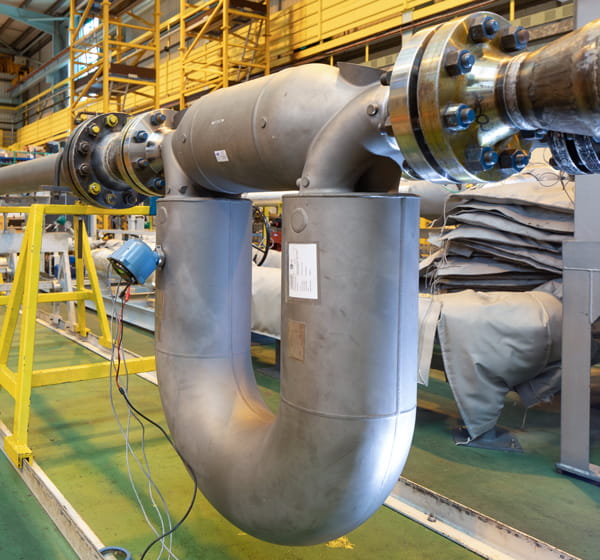
The National Standard Oil Flow Facility [[[link to https://www.tuvsud.com/en-gb/industries/chemical-and-process/flow-measurement/flow-meter-calibration-and-testing/oil-flow-testing-laboratory]]] uses a gravimetric reference system which allows for the precise measurement of flow rates; crucial for industries that require high-accuracy calibration.
Using a gravimetric reference system provides a lower measurement uncertainty, enhancing the reliability of the calibration. This is particularly important for applications involving high-viscosity fluids or other challenging conditions. The gravimetric system's precision ensures that calibrations meet the highest standards, providing clients with the confidence they need in their flow measurements.
Not all Coriolis meters perform the same, so it’s crucial to calibrate them at a traceable flow laboratory to ascertain their performance. Our experts have seen firsthand the variation in performance among different Coriolis meters. Using advanced calibration facilities, ensures that each meter is tested under rigorous conditions, providing the most accurate data possible.
This level of precision is vital for industries that depend on accurate flow measurements. Deriving pressure compensation factors and ensuring Coriolis meter performance is validated against international standards provides clients with confidence in the accuracy, reliability and traceability of their measurements.
Chris provides further details and useful info in his popular webinar. Enter your details in the form to access the recording.
[1] Chris Mills, Calibrating and operating Coriolis flow meters with respect to process effects, Flow Measurement and Instrumentation, Volume 71, 2020.
[2] Chris Mills, The consistency of pressure effects between three identical Coriolis flow meters, Flow Measurement and Instrumentation, Volume 80, 2021.
TÜV SÜD National Engineering Laboratory is the UK’s Designated Institute for Flow Measurement, under contract from DSIT, and part of the UK’s National Measurement System. The state-of-the-art facilities coupled with a team of flow measurement experts with direct involvement in writing measurement standards, provide the necessary environment for precise calibrations, offering invaluable support to the industry.
View more of our past webinars and sign up to our email list to be kept informed of research and developments in flow measurement.
 DR CHRIS MILLS
Chris is a senior consultant based at TÜV SÜD in Glasgow, Scotland and specialises in flow metrology. He has an Engineering Doctorate from Coventry University, an Honours degree in Chemical and Process Engineering from the University of Strathclyde and is also a chartered engineer.
Chris has 15 years’ experience at TÜV SÜD and has theoretical and practical experience of flow measurement technologies, including Coriolis, turbine, differential pressure, and ultrasonic meters. This includes calibration methodologies, traceability, and measurement uncertainty.
Site Selector
Global
Americas
Asia
Europe
Middle East and Africa
