
Clinical Evaluation of Medical Devices under EU MDR – Advanced Course
Additional Requirements through MDCG and MDR: Deepening the Clinical Evaluation of Medical Devices
The Medical Device Regulation (EU MDR 2017/745) has significantly increased requirements for clinical evidence, clinical evaluation, and lifecycle management of medical devices. This advanced course provides participants with practical guidance on implementing MDR clinical evaluation requirements, current MDCG guidance documents, and industry best practices for demonstrating safety, clinical performance, and benefit-risk acceptability.
Building upon foundational clinical evaluation knowledge, participants will explore advanced topics including equivalence, clinical evidence strategies, legacy devices, software as a medical device (SaMD), orphan devices, breakthrough devices, PMCF, PMS, PSUR, and Notified Body expectations. The course also includes a global regulatory perspective, providing a high-level comparison of EU MDR clinical evaluation requirements and FDA clinical evidence expectations, as well as strategies for leveraging global clinical data across regulatory jurisdictions.
After completing this course, participants will be able to:
- Explain advanced MDR requirements for clinical evaluation and clinical evidence.
- Apply MEDDEV 2.7/1 Rev. 4 and relevant MDCG guidance documents.
- Develop and maintain MDR-compliant Clinical Evaluation Plans (CEP) and Clinical Evaluation Reports (CER).
- Determine appropriate clinical evidence strategies based on device classification, intended purpose, and risk profile.
- Apply equivalence principles according to MDCG 2020-5, MDCG 2023-6, and MDCG 2023-7.
- Evaluate exemptions from clinical investigation requirements under MDR Article 61.
- Assess clinical evaluation requirements for software as a medical device.
- Understand clinical evidence pathways for orphan devices and breakthrough devices.
- Integrate PMS, PMCF, PSUR, risk management, and clinical evaluation activities.
- Prepare and maintain complete Clinical Evaluation Files.
- Perform benefit-risk assessments using clinical and risk management data.
- Understand Article 54 Clinical Evaluation Consultation Procedures (CECP) and Article 55 Scrutiny Procedures.
- Identify common submission deficiencies and improve regulatory readiness.
- Compare high-level MDR and FDA clinical evidence expectations.
- Identify opportunities for leveraging global clinical evidence across multiple markets.
Note: This course focuses primarily on clinical evaluation requirements under the European Medical Device Regulation (EU MDR 2017/745). It also includes a high-level overview of how MDR clinical evidence expectations compare with FDA approaches and how clinical data may be leveraged across global regulatory jurisdictions.
Important: TÜV SÜD tests and certifies through its Notified Bodies medical devices and their manufacturers. TÜV SÜD Akademie GmbH offers trainings in the field of medical devices.
The neutrality and independence of the conformity assessment procedures carried out by TÜV SÜD must be maintained. In the interest of our customers, hence the seminars of TÜV SÜD Akademie do not contain any product-specific, process-related or company-specific content or solutions that could fulfill the function of individual consulting.
In case of any questions or uncertainties, please do not hesitate to contact us at [email protected].
This course is intended for professionals involved in medical device development, regulatory compliance, clinical evidence generation, and lifecycle management, including:
- Regulatory Affairs Professionals
- Clinical Affairs Professionals
- Medical Affairs Professionals
- Scientific Affairs Professionals
- Quality Management Professionals
- Product Development and R&D Personnel
- Post-Market Surveillance Specialists
- Risk Management Professionals
- Medical Device Software Teams
- Clinical Investigation Managers
- Investigating Physicians
- Regulatory Strategy Leaders
- Technical Documentation Authors
- Notified Body Liaison Personnel
- Persons Responsible for Regulatory Compliance (PRRC)
- Global Regulatory Affairs Professionals
- Clinical Evidence Strategy Leaders
- Medical device manufacturers seeking access to European markets
- Introduction and Regulatory Framework
- Clinical Evaluation Fundamentals Refresher
- Clinical Evaluation Procedures
- Clinical Investigation Requirements
- Equivalence
- Legacy Devices
- Orphan Medical Devices
- Breakthrough Devices
- Medical Device Software (SaMD)
- Global Regulatory Perspective
- Clinical Evaluation Documentation
- Clinical Evaluation Consultation and Scrutiny Procedures
- Clinical Evaluation Interfaces
- Future Regulatory Developments
- Workshops and Interactive Sessions
The Medical Device Regulation (EU MDR 2017/745) has fundamentally transformed clinical evaluation requirements for medical device manufacturers. Organizations are expected to establish and maintain robust clinical evidence throughout the entire product lifecycle and demonstrate continued compliance through proactive post-market activities. This advanced course provides practical guidance for understanding and implementing these expectations in accordance with MDR Annex XIV, MEDDEV 2.7/1 Rev. 4, and the latest MDCG guidance documents.
Participants will deepen their understanding of clinical evaluation planning, clinical evidence generation, literature reviews, State-of-the-Art evaluations, benefit-risk assessments, equivalence strategies, and clinical investigation requirements. The course examines current regulatory expectations for both new and legacy devices and provides practical approaches for establishing sufficient clinical evidence across different device classifications and technologies.
Special attention is given to advanced and emerging regulatory topics, including clinical evaluation of medical device software, orphan medical devices, breakthrough devices, exemptions from clinical investigation requirements, and evolving expectations from Notified Bodies. Participants will learn how manufacturers can effectively address evidence gaps, justify clinical evaluation strategies, and maintain compliance under increasingly complex regulatory requirements.
The course further explores the critical interfaces between clinical evaluation, risk management, product development, post-market surveillance (PMS), post-market clinical follow-up (PMCF), periodic safety update reporting (PSUR), and technical documentation. Practical workshops and interactive discussions help participants understand how these processes work together to support successful conformity assessment and ongoing regulatory compliance.
Recognizing the needs of global manufacturers, the course also provides a high-level comparison between EU MDR clinical evaluation expectations and U.S. FDA clinical evidence principles. Participants will gain insight into opportunities for leveraging global clinical data, real-world evidence, and international evidence-generation strategies to support multiple regulatory markets efficiently.
Upon completion of this course, participants will be able to:
- Gain advanced knowledge of clinical evaluation requirements under EU MDR 2017/745.
- Understand how to implement current MDCG guidance documents in clinical evaluation activities.
- Learn practical strategies for generating and maintaining sufficient clinical evidence throughout the device lifecycle.
- Apply equivalence requirements and clinical investigation exemptions appropriately.
- Understand clinical evaluation requirements for software as a medical device (SaMD).
- Gain insight into the regulatory pathways for orphan devices and breakthrough devices.
- Improve readiness for Notified Body reviews, conformity assessments, and technical documentation audits.
- Learn common deficiencies and expectations identified by Team-NB and Notified Bodies.
- Understand how clinical evaluation interfaces with PMS, PMCF, PSUR, risk management, and product development processes.
- Stay informed about anticipated MDR/IVDR 2.0 changes and their potential impact on clinical evaluation processes.
- Understand key similarities and differences between MDR clinical evaluation and FDA clinical evidence expectations.
- Learn how global clinical data and real-world evidence can be leveraged across multiple regulatory jurisdictions.
This instructor-led live training combines regulatory expertise with practical implementation guidance and interactive learning activities. Participants are encouraged to actively engage with instructors and peers through workshops, discussions, and case-based exercises.
Training methods include:
- Expert presentations
- Interactive lectures
- Guided regulatory discussions
- Practical workshops
- Real-world examples
- Group exercises
- Case study reviews
- Participant Q&A sessions
The course emphasizes practical application of MDR clinical evaluation requirements and current industry expectations. Participants will receive guidance they can immediately apply within their organizations.
Participants who attend at least 90% of the total training duration will receive an official Certificate of Attendance from TÜV SÜD Academy.
Included in the training course price is the eBook "Medical Device Regulation (MDR)".
Participants should have:
- Basic knowledge of medical device regulations.
- Foundational understanding of clinical evaluation principles.
- Familiarity with MDR Article 61 and Annex XIV concepts.
- Experience in Regulatory Affairs, Clinical Affairs, Quality Management, Product Development, Medical Affairs, or related functions.
Recommended Preparation:
Participation in the Clinical Evaluation of Medical Devices – Basic Course or equivalent knowledge of clinical evaluation fundamentals.
Learning Paths:
This learning path is designed to build comprehensive knowledge of clinical evaluation requirements for medical devices under the European Medical Device Regulation (EU MDR 2017/745).
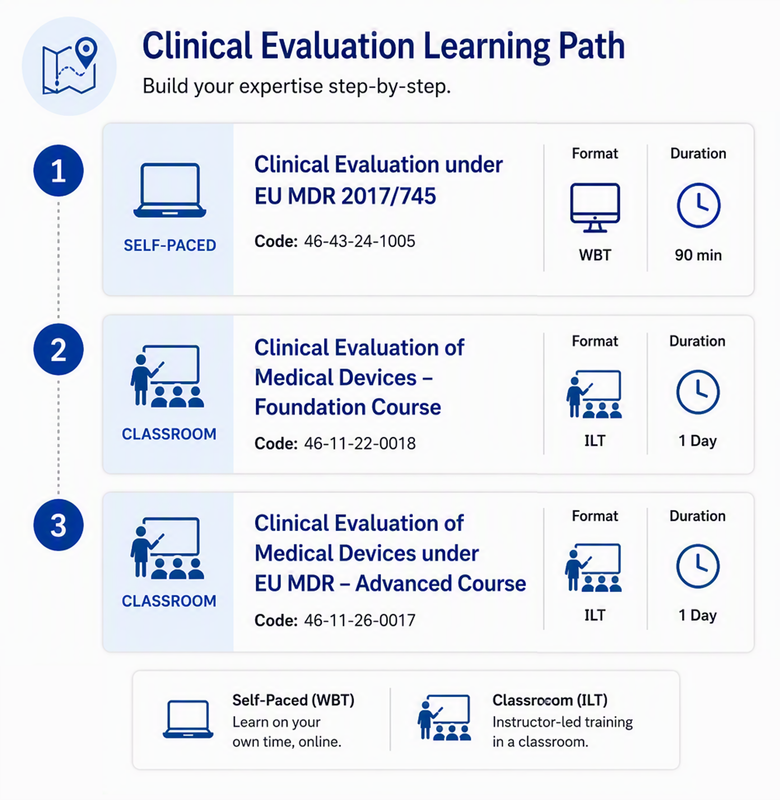
Participants begin with a self-paced web-based training course, Clinical Evaluation under EU MDR 2017/745, that introduces the fundamental concepts, regulatory expectations, and key principles of clinical evaluation. This flexible online module provides a solid foundation and prepares learners for more in-depth study.
The next step is the Clinical Evaluation of Medical Devices – Foundation Course, an instructor-led classroom training that expands on the core concepts and practical application of clinical evaluation processes. Learners gain a deeper understanding of regulatory requirements, clinical evidence, and documentation expectations while benefiting from expert guidance and interactive discussions.
The learning journey culminates with the Clinical Evaluation of Medical Devices under EU MDR – Advanced Course. This classroom-based course is intended for professionals who already understand the fundamentals and want to develop advanced expertise in planning, preparing, reviewing, and maintaining clinical evaluations under EU MDR. Together, these three courses provide a structured progression from foundational knowledge to advanced competency, helping professionals confidently navigate clinical evaluation requirements throughout the medical device lifecycle.
- This course is also part of a modular training programme. After successful participation in the advanced modules, you can acquire this recognized qualification:
- Manager Clinical Affairs – TÜV
- To prepare, we recommend participating in our basic course.
Is this a beginner-level course?
No. This is an advanced course intended for professionals who already have a foundational understanding of clinical evaluation principles and MDR requirements.
Do I need prior knowledge of clinical evaluation?
Yes. Participants should possess basic knowledge of clinical evaluation concepts, MDR requirements, and medical device regulatory processes. Participation in a basic clinical evaluation course is recommended.
Which regulations and guidance documents are covered?
The course covers MDR 2017/745, MEDDEV 2.7/1 Rev. 4, and key MDCG guidance documents relating to clinical evaluation, equivalence, legacy devices, software, PMCF, PSUR, orphan devices, breakthrough devices, CEAR, and SSCP.
Does the course cover Clinical Evaluation Reports (CERs)?
Yes. Participants learn how to prepare, maintain, and update MDR-compliant Clinical Evaluation Reports and their relationship to other technical documentation.
Does the course cover Clinical Evaluation Plans (CEPs)?
Yes. The course reviews CEP requirements, content expectations, clinical development planning, and common deficiencies identified by Notified Bodies.
Will equivalence strategies be discussed?
Yes. Equivalence requirements, data access expectations, equivalence assessments, MDCG 2020-5, MDCG 2023-6, and MDCG 2023-7 are covered in detail.
Does the course cover PMCF requirements?
Yes. PMCF planning, PMCF activities, PMCF evaluation reports, PMCF studies, and integration with clinical evaluation and PMS are extensively discussed.
Does the course cover PMS and PSUR requirements?
Yes. Participants learn how PMS and PSUR activities support clinical evaluation throughout the product lifecycle and how these processes are interconnected.
Is software as a medical device included?
Yes. The course covers MDCG 2020-1 and specific clinical evidence expectations for software as a medical device (SaMD).
Are orphan devices covered?
Yes. The course addresses MDCG 2024-10 and discusses clinical evidence considerations, PMCF strategies, and regulatory expectations for orphan medical devices.
Are breakthrough devices covered?
Yes. The course covers MDCG 2025-09 and associated clinical evaluation, PMCF, and conformity assessment considerations for breakthrough devices.
Does the course address clinical investigation exemptions?
Yes. Participants will learn when clinical investigations may be required and how exemptions under MDR Article 61, MDCG 2023-7, and related guidance may apply.
Will I learn how Notified Bodies assess clinical evaluations?
Yes. The course covers MDCG 2020-13, Team-NB Best Practice Guidance, common findings, and Notified Body expectations for technical documentation reviews.
Does the course discuss risk management interfaces?
Yes. The relationship between clinical evaluation, ISO 14971 risk management, benefit-risk determination, PMS, and PMCF is a key component of the course.
Does the course cover MDR Article 54 and Article 55 procedures?
Yes. Participants will learn about Clinical Evaluation Consultation Procedures (CECP), Scrutiny Procedures, and associated regulatory expectations.
Does this course cover FDA requirements?
The course primarily focuses on EU MDR clinical evaluation requirements. However, it includes a dedicated section providing a high-level comparison between MDR clinical evaluation expectations and FDA clinical evidence principles to support organizations operating in multiple markets.
Can clinical data be leveraged across multiple regulatory jurisdictions?
Yes. The course discusses strategies for leveraging clinical investigations, clinical literature, real-world evidence, PMS activities, PMCF activities, and other clinical evidence across multiple regulatory jurisdictions where scientifically and regulatorily appropriate.
Is this course suitable for North American medical device professionals?
Yes. While the course is primarily focused on EU MDR requirements, it includes a global regulatory perspective and is highly relevant for North American manufacturers seeking access to European markets or managing global clinical evidence strategies.
Does the course include practical exercises?
Yes. Participants engage in workshops covering equivalence assessments, Clinical Evaluation Files, clinical evidence strategies, benefit-risk assessments, and practical implementation activities.
Does the course discuss future regulatory developments?
Yes. The course reviews proposed MDR/IVDR 2.0 changes and discusses their potential impact on clinical evaluation and post-market activities.
Will participants receive a certificate?
Participants who meet the attendance requirements established by TÜV SÜD Academy will receive a Certificate of Attendance.
What course materials are included?
Course materials include the training presentation and supporting learning materials. The course fee also includes the eBook Medical Device Regulation (MDR).
Specialist lecturers from the TÜV SÜD Academy