
Battery Testing & Design Specialist Program
Master EV Battery Design, Testing & Validation for Safer, Higher-Performance Battery Systems.
This 4-day Battery Testing & Design Specialist Program provides a strong technical foundation in how EV batteries are designed, integrated, operated, and validated. Delivered by TÜV SÜD Americas, the course connects battery theory with practical engineering considerations across design, production, and testing.
Objective:
- Build core understanding of EV battery architecture and chemistries
- Explain design principles for safety, performance, and durability
- Develop knowledge of operation strategies and failure mechanisms
- Introduce structured battery testing and validation methods
This course is suitable for:
- NPD and Design & Development Engineers
- R&D Professionals
- Production Engineers
- Reliability & Safety Engineers
- Testing & Validation Engineers
- EV and battery system professionals
Day 1 – Battery Fundamentals
- EV battery cells, modules, and packs
- Battery chemistry and applications
- Thermal management principles
- Pack architecture and integration examples
Day 2 – Operation & Reliability
- Operation strategies and maintenance
- Risks in operational strategies
- Typical failures during usage
- Overview of battery production from cell to pack
Day 3 – Testing & Validation
- Test planning and DVP&R basics
- Component-level testing
- Electrical, thermal, mechanical, and safety tests
- Battery forensics, weight, and cost analysis
- Key EV battery standards
- Q&A session
Day 4 – Practical
- Hands-on battery evaluation
- Component replacement exercises
- Battery data evaluation
- Root Cause Mapping
- Q&A session
You will develop a clear understanding of how EV batteries are built, how they function in real applications, and how they are validated for safety and performance. The course explains battery hierarchy, chemistry, pack architecture, and cooling strategies, while also covering operational behavior, preventive maintenance, and common failure modes. You will learn how battery tests are planned and executed, how DVP&Rs support validation, and how test results guide better design decisions. Practical exposure to battery evaluation, assembly, and root-cause analysis strengthens your ability to work with real EV battery systems.
By the end of the program, participants will be able to:
- Understand interactions between cells, modules, and packs
- Evaluate chemistry choices for safety and performance
- Apply principles of thermal management and voltage isolation
- Recognize operational risks and preventive maintenance needs
- Plan and understand battery testing and validation processes
- Interpret test data for design improvements
- Strong foundation in EV battery design principles
- Better understanding of performance vs safety trade-offs
- Ability to interpret battery test results
- Improved design validation skills
- Practical exposure to real battery systems
- Career advancement in EV and battery engineering
Examination
- Online exam (30 minutes)
- Objective-type questions
- Maximum marks: 30
- Passing marks: 21 (70%)
Certification
- ≥70% score: Certificate of Successful Completion (Battery Design Specialist)
- <70% score: Certificate of Attendance
- Mandatory certification for achieving “Expert in Battery Technology” track
Participants are expected to have prior knowledge of:
- Basic electrical fundamentals
- Product/system monitoring knowledge
- Product application knowledge
- Completion of Battery Safety Specialist Certification
Learning Path:
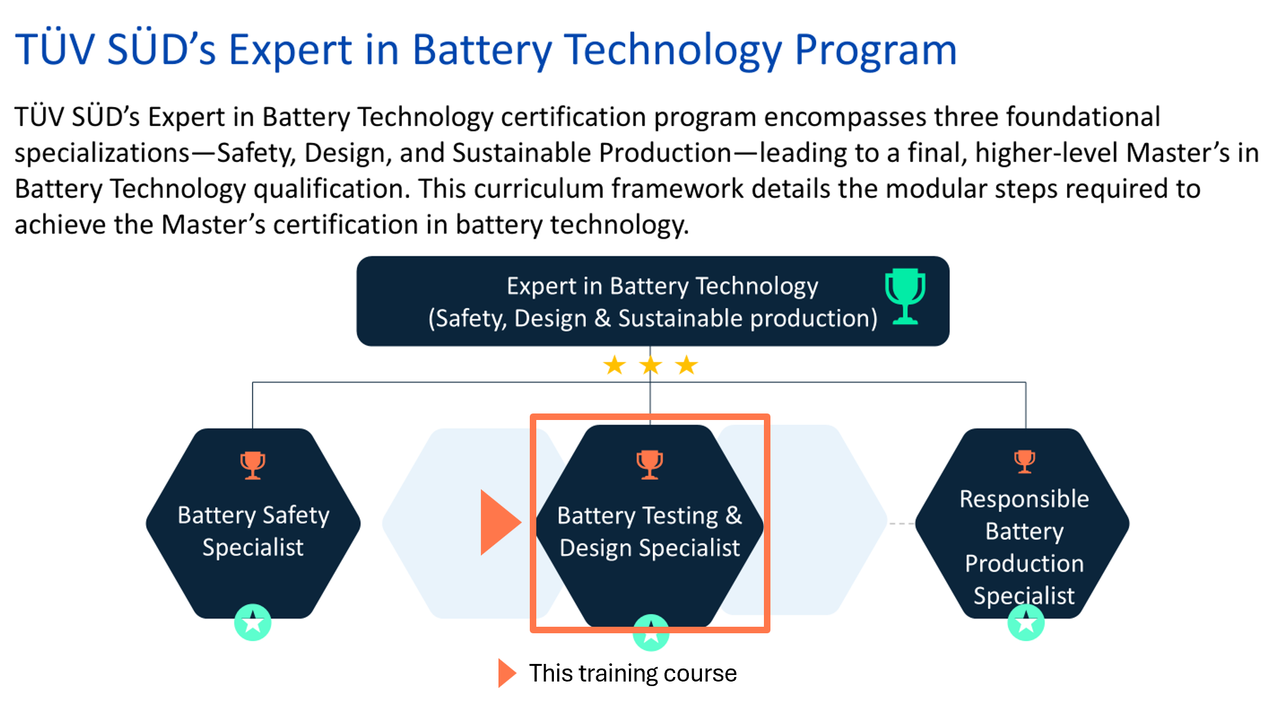
This course is one of three specialist programs within TÜV SÜD’s Expert in Battery Technology Learning Path. The pathway comprises of:
- Battery Safety Specialist Program (3 days)
- Battery Testing & Design Specialist Program (4 days), and
- Responsible Battery Production Specialist Program (2 days),
providing professionals with a holistic understanding of battery safety, performance, design, testing, and sustainable production practices.
1. Does the course cover real battery pack teardown?
Yes, practical sessions include supervised assembly and disassembly exercises to a certain extent. Module disassembly is not possible.
2. Are testing standards discussed?
Yes, important EV battery standards and validation approaches are introduced.
3. Is thermal management covered in depth?
Core principles, cooling strategies, and design considerations are covered.
4. Will DVP&R creation be taught?
Participants learn how DVP&Rs are structured and used in validation planning.
5. Does it include data analysis?
Yes, battery data evaluation and interpretation are part of the practical.
6. Is this suitable for beginners?
It is best suited for engineers with basic electrical knowledge and prior safety training.
7. How can I pay the training and examination fees?
Fees can be paid through online payment modes.
TÜV SÜD America, Inc. is a recognized leader in high-voltage safety training and certification for electric vehicles. Its training programs are well-regarded both in the United States and internationally. The experts at TÜV SÜD Academy possess deep technical knowledge and hands-on experience, ensuring that the training is both practical and comprehensive.
Professionals responsible for high-voltage safety in electric vehicles play a critical role, as their expertise directly impacts the safe and efficient operation of the entire system.