
Article 13 of the February 10, 2020 law, known as the AGEC law, requires informing consumers about a product's environmental attributes.
Article 13 of the February 10, 2020 law, known as the AGEC law, requires informing consumers about a product's environmental attributes.
19 September 2023
Article 13 of the law of February 10, 2020 on the fight against waste and for a circular economy, known as the AGEC law corresponds to the obligation to inform the consumer about the environmental qualities and characteristics of products placed on the French market. Producers must communicate on all products covered by an extended producer responsibility chain. Decree No. 2022-748 of April 29, 2022 taken pursuant to Article 13 provides the framework for the information to be communicated to the consumer by specifying which types of products are concerned and by specifying which characteristics must be shared.
The information obligation relates to:
• Repairability
• The rate of recycled material incorporated
• Recyclability
• The presence of rare earths and precious metals
• Supply chain traceability
• The presence of microplastics
• The presence of dangerous substances
Following the publication of the Order of August 30, 2023 relating to the identification of dangerous substances in products generating waste, TÜV SÜD suggests clarifying this point.
According to Decree No. 2021-1285 relating to the identification of dangerous substances in waste-generating products, these substances are:
- substances of very high concern included in the list referred to in Article 59(1) of Regulation (EC) No 1907/2006 and published in accordance with Article 59(10) of Regulation (EC) No 1907/2006 ;
- substances presenting a level of suffering comparable to substances of very high concern which are not on the list mentioned in Article 59(1) of Regulation (EC) No 1907/2006. The list of these substances and its update are established by order of the Minister responsible for the environment after consulting the National Agency for Food, Environmental and Occupational Health Safety.
The order, published a few days ago, identifies two dangerous substances to be communicated:
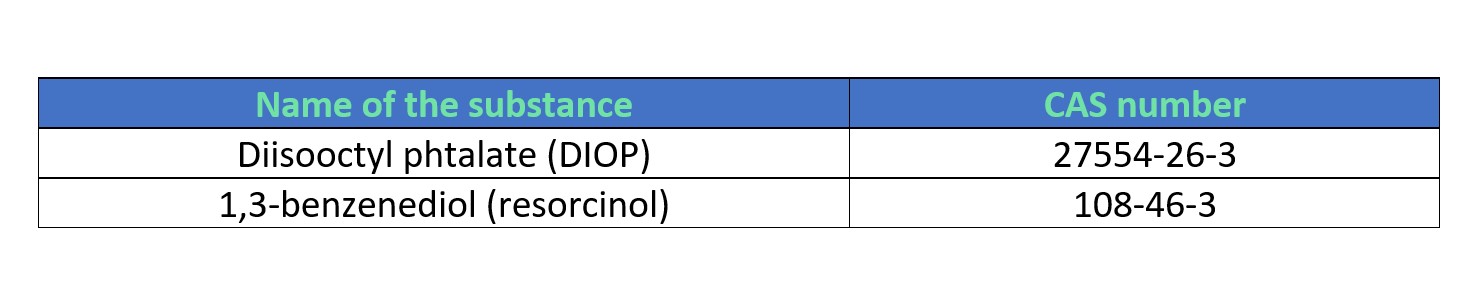
DIOP is part of the phthalate family which is widely used as plasticizers in plastics, coatings and adhesives.
Resorcinol is used in the manufacture of tires, rubber products, glues and industrial resins. It can also be found in cosmetic products such as hair dyes or mascara.
In order to communicate on the presence of these substances, it is first necessary to obtain this information precisely and reliably.
To do this, you can question your supply chain and/or launch tests on the products you market on the French market.
TÜV SÜD can support you in your substance compliance process thanks to its global expertise in chemical analysis tests for industry. For more information, you can go to our dedicated page.
TÜV SÜD can also support you more generally in your understanding and compliance with the AGEC law. For any questions regarding article 13 and its requirements, you can consult our page dedicated to the services offered.
About the author
Anne-Sophie Quinquis
Chemical and environmental engineer
TÜV SÜD France
Site Selector
Global
Americas
Asia
Europe
Middle East and Africa
