
Updates from Switzerland
Updates from Switzerland
During development in the chemical and pharmaceutical industry a wide range of chemical substances can be manufactured and processed. These substances can be very energetic and may confer explosive properties but are not formally classified and listed within the United Nations Dangerous Goods List [1].
March 2019

Experience shows that explosive properties (UN class1 explosive) can be associated with energetic groups in the molecule, the self- oxidising potential of the molecule expressed in the so- called oxygen balance, and the thermal potential of the substance, i.e. heat of decomposition. This is reflected in the example screening procedures outlined in appendix 6 of [2].
The example screening procedures for new organic material allows omitting the Class 1 acceptance procedure (i.e. are not Class 1 explosives):
Unfortunately, the above screening criteria are prone to generate a large number of false positive results still indicating potential explosive properties. The next step in an assessment requires additional testing:
or the official UN series 2 tests (identifying materials which are too insensitive for Class1), e.g.:
Unfortunately, these tests often require sending the potential explosive material to a lab for further testing. Prudently, the potential explosive material needs to be regarded as explosive until experimentally proven otherwise and be shipped appropriately. Shipment of “explosive” materials is heavily restricted and can prove to be a challenge. This results in a “chicken or egg” problem: for any shipment one need to show that the material does not confer explosive properties, but to show that the material does not confer explosive it needs to be shipped for further testing… This is a reoccurring problem and this is why the European Chemical Industry Council (CEFIC) proposed a shipping and packaging concept for transport of energetic samples for further testing [4]. The scope of the proposal
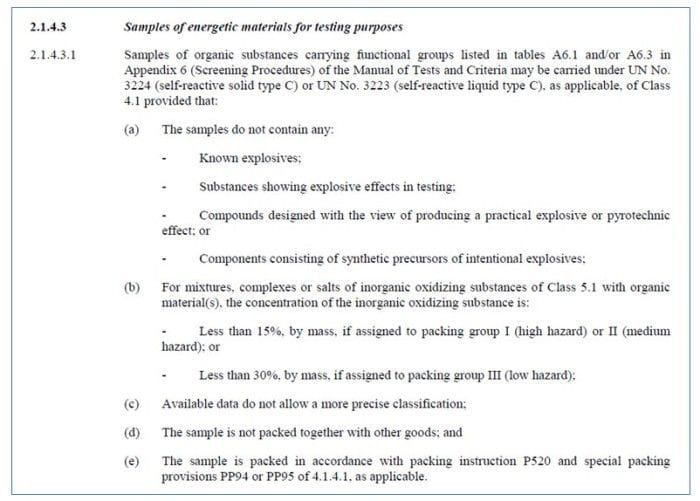
The 2019 ADR regulation (transport by road) [6] adapted this proposal and included “Samples of energetic materials for testing purposes” in section 2.1.4.3 in [6] vol1.:
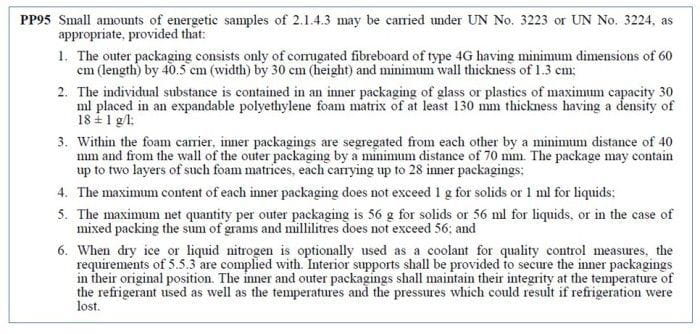
The packaging provisions for typical amounts required for testing are described in instruction P520 with the provision PP95 as described in [6] vol.2.:
References:
[1]http://www.unece.org/trans/danger/publi/unrec/rev20/20files_e.html
[4] United Nations: ST/SG/AC.10/C.3/2016/61, Sept. 2nd, 2016
[5] United Nations: ST/SG/AC.10/C.3/100, Dec 27th, 2016
[6]https://www.unece.org/fileadmin/DAM/trans/publications/ADR_2019_vol1_1818953_E.pdf and https://www.unece.org/fileadmin/DAM/trans/publications/ADR_2019_vol2_1818956_E.pdf
Author:
Dr. Thomas Gmeinwieser
Site Selector
Global
Americas
Asia
Europe
Middle East and Africa
