
Due Diligence According to the EU Battery Regulation (EUBR)
Practical implementation of the due diligence obligations applicable to batteries
With the introduction of the EU Battery Regulation (Regulation (EU) 2023/1542), manufacturers, importers, and distributors face comprehensive new due diligence obligations across the battery supply chain. For the first time, economic operators must establish robust strategies and risk management systems to meet these requirements—ensuring thorough risk analysis and the implementation of effective prevention and mitigation measures.
This regulation mandates the collection and documentation of detailed information on battery-specific raw materials—such as lithium, natural graphite, nickel, and cobalt—including their origin, extraction methods, suppliers, and quantities used. To comply, organizations must build transparent and traceable supply chain systems.
In this training, our expert instructors will demystify the complex due diligence requirements outlined in Articles 47–53 and Annex X of the EUBR. Through practical guidance and real-world examples, you’ll learn how to:
- Interpret and apply the EUBR’s due diligence obligations
- Design and implement a compliant due diligence system
- Identify and assess risks throughout the battery supply chain
- Integrate risk mitigation and transparency measures into your operations
- Strengthen sustainability efforts and maintain market access under the new regulatory framework
This course is ideal for compliance officers, sustainability managers, supply chain professionals, and legal advisors working in battery manufacturing, importation, or distribution:
- Economic operators who place or use batteries on the market
- Sustainability and ESG managers
- Auditors and compliance officers
- Professionals from purchasing, supply chain management and quality assurance
Main content:
- Overview of the EU Battery Regulation (EUBR):
Scope, stakeholder, and specific requirements for manufacturers, importers, and distributors and notified bodies - Due Diligence obligations and Battery Due Diligence policy:
Overview of due diligence obligations under EUBR, policy building blocks, raw material and associated risks - Risk management and supply chain transparency:
Identification, Assessment and mitigation of individual risks, mechanisms for monitoring and disclosure - Practical implementation and compliance:
Integration of due diligence policies into management systems, best practices and case studies
The topics covered in the training are:
- Overview of the EU Battery Regulation (EUBR)
- International standards: OECD, UNGPs, ILO
- Set up a due diligence system
- Risk management and supply chain analysis
- Case studies and practical exercises
The EU Battery Regulation (Regulation (EU) 2023/1542) introduces a transformative shift in how manufacturers, importers, and distributors of batteries must manage their supply chains. For the first time, economic operators are legally required to implement extensive due diligence systems that ensure transparency, accountability, and sustainability across the entire battery lifecycle. This training provides a deep dive into the practical implementation of these obligations, equipping participants with the tools and knowledge needed to comply with the regulation and future-proof their operations.
Participants will explore the core due diligence requirements outlined in Articles 47–53 and Annex X of the EUBR, including the collection and verification of data related to battery-specific raw materials such as lithium, natural graphite, nickel, and cobalt. The course emphasizes the importance of tracing the origin, extraction methods, suppliers, and quantities of these materials to build a transparent and responsible supply chain. Through expert-led sessions, attendees will learn how to design and integrate due diligence systems into existing management processes, ensuring both regulatory compliance and operational efficiency.
The training combines regulatory insights with practical application. Participants will engage with international standards such as the OECD Due Diligence Guidance, UN Guiding Principles on Business and Human Rights, and ILO conventions, learning how to align their internal policies with global best practices. Real-world case studies and interactive exercises will help attendees identify and assess risks, implement mitigation strategies, and establish mechanisms for monitoring and disclosure. These hands-on components are designed to foster a deeper understanding of the regulation’s impact and how to respond effectively.
Delivered in a live online format, the course offers instructor-led sessions, group discussions, and knowledge checks to ensure an engaging and interactive learning experience. Participants will benefit from direct access to TÜV SÜD’s technical experts, who bring extensive experience in regulatory compliance and sustainability. The training is ideal for professionals in compliance, ESG, supply chain management, and legal advisory roles—particularly those involved in placing batteries on the market or managing battery-related operations.
By the end of the 6-hour training, participants will be able to confidently interpret and apply the EUBR’s due diligence obligations, develop and implement compliant systems, and contribute to a more sustainable and transparent battery value chain. A certificate of attendance will be awarded upon completion, validating the participant’s readiness to navigate the evolving regulatory landscape.
- Gain a solid understanding of the regulation’s core due diligence requirements to avoid legal risks and position your business securely for the future
- Learn how to map responsibilities, identify key risk areas, and take effective action to protect your value chain and reputation
- Develop strategies that align with your business and integrate them smoothly into existing processes for long-term impact and efficiency
- Outcome:
By the end of the training, participants will be equipped to confidently navigate the EUBR’s due diligence landscape and implement systems that ensure compliance and resilience.
This is a standalone training module and includes:
- Instructor-led sessions
- Interactive case studies / practical examples
- Group discussions
- Knowledge checks
Instructor-led training sessions are conducted in a virtual classroom. This means the course is Live Online. Participants will learn through online teaching. Lectures, case studies, group exercises, discussions, problem solving, examples with explanation, assignments and/or quizzes happen in the virtual classroom training. Participants need to connect to the class from any internet accessible location. Each module is delivered live using webinar technology, creating a virtual classroom learning environment. Live sessions provide you with direct access to the trainer so you can ask questions, understand complex concepts and share ideas with peers. Webcam and microphone are REQUIRED to interact with the instructor and/or other participants.
The course content and structure are designed by the domain experts from TÜV SÜD. With immense experience and knowledge in the relevant standards, our team of product specialists and technical experts at TÜV SÜD, developed the course content based on current business landscape and market requirements.
By performing exercises and group discussions, attendees will develop a hands-on understanding that will facilitate the understanding and the implementation of knowledge and concepts.
- Participants receive a certificate of attendance
Basic knowledge of sustainability or supply chain management is helpful, but not essential.
Learning Path:
Due Diligence According to the EU Battery Regulation (EUBR) (11-28-25-0005) is a complementary course within the Circularity learning path, providing participants with a focused understanding of the due diligence requirements introduced by the European Union Battery Regulation. The training explores the regulatory expectations for economic operators, including risk identification and assessment, supply chain due diligence obligations, responsible sourcing of battery raw materials, compliance management, reporting requirements, and the practical measures organizations must implement to meet the regulation's requirements. Participants will gain valuable insights into how battery-related due diligence supports sustainable supply chains, resource stewardship, transparency, and broader circular economy objectives.
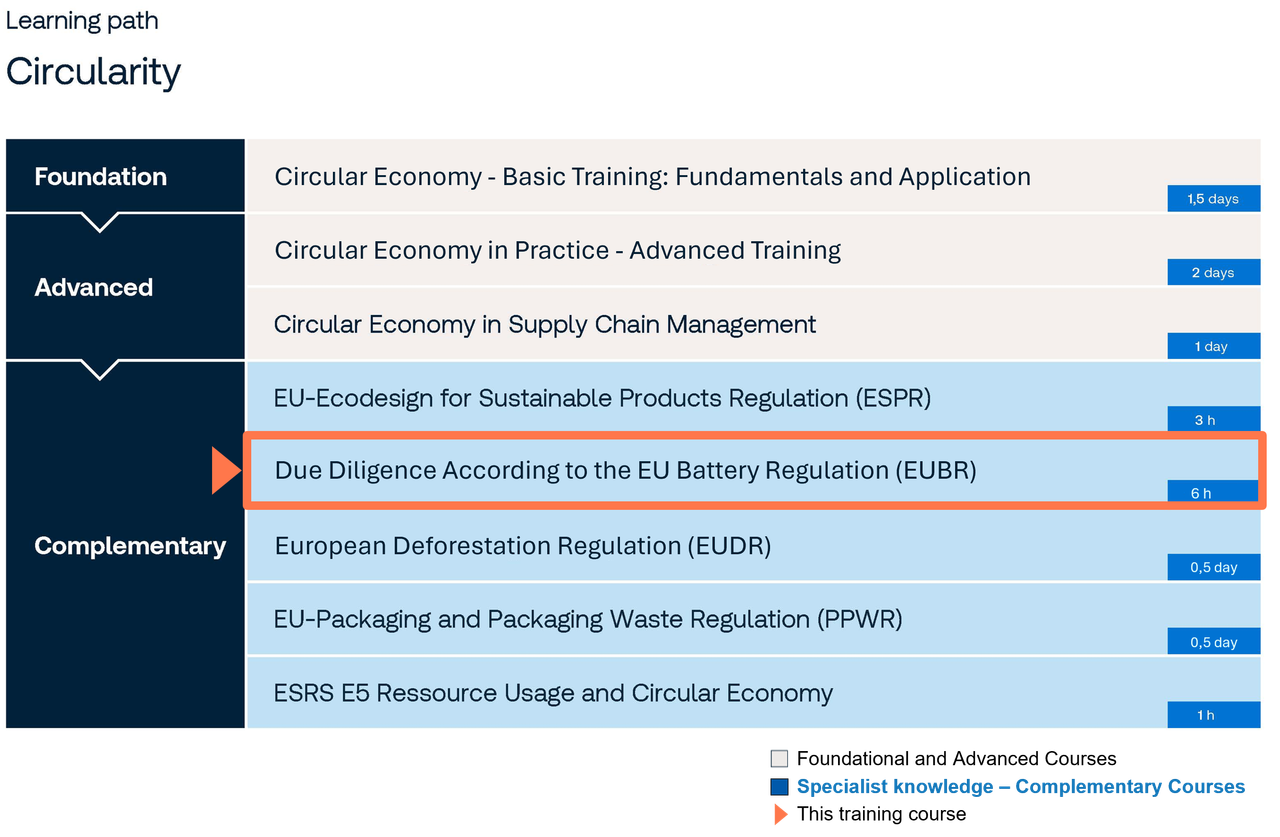
As part of a modular training programme on Circularity, this course complements the core learning path consisting of:
- Circular Economy - Basic Training: Fundamentals and Application (11-28-26-0008),
- Circular Economy in Practice - Advanced Training (11-28-26-0009), and
- Circular Economy in Supply Chain Management (11-28-26-0007).
These three courses form the core learning path and are compulsory components of the Circular Economy Manager – TÜV qualification programme, culminating in an examination and certification. Participants who successfully complete the required courses and pass the examination are awarded the Circular Economy Manager – TÜV certificate, demonstrating their competence in applying circular economy principles across business operations, value chains, and sustainability initiatives.
The Due Diligence According to the EU Battery Regulation (EUBR) course expands this foundation by addressing one of the most significant regulatory developments affecting circularity, sustainable sourcing, and supply chain management within the battery value chain. It is accompanied by other complementary modules within the Circularity learning path, including:
- EU-Ecodesign for Sustainable Products Regulation (ESPR) (Not yet available),
- European Deforestation Regulation (EUDR) (11-28-25-0003),
- EU Packaging and Packaging Waste Regulation (PPWR) (Not yet available), and
- ESRS E5 Resource Usage and Circular Economy (Not yet available).
Together, the foundation, advanced, and complementary courses provide a comprehensive learning journey that combines circular economy principles, practical implementation strategies, supply chain management, and regulatory expertise, enabling participants to develop a holistic understanding of Circularity and its business implications.