
Clinical Evaluation of Medical Devices - Foundation Course
Clinical Evaluation Fundamentals: Proving the Safety and Performance of Medical Devices
Clinical evidence is a fundamental requirement for demonstrating the safety, clinical performance, and clinical benefit of medical devices under the European Medical Device Regulation (MDR). This foundation course provides an essential introduction to clinical evaluation requirements, methodologies, documentation, and regulatory expectations throughout the device lifecycle.
Participants will learn how to plan, conduct, document, and maintain clinical evaluations in accordance with MDR, MEDDEV 2.7/1 Rev. 4, and relevant MDCG guidance documents. The course also addresses Clinical Evaluation Plans (CEP), Clinical Evaluation Reports (CER), literature reviews, benefit-risk assessment, equivalence, post-market clinical follow-up (PMCF), and interfaces with risk management and post-market surveillance.
At the end of this training,
- You will acquire know-how for the targeted identification and provision of required clinical data for medical devices.
- You will be able to successfully clinically evaluate your medical device.
- You will implement regulatory requirements and comply with official guidelines regarding the clinical evaluation of medical devices.
Important: TÜV SÜD tests and certifies through its Notified Bodies medical devices and their manufacturers. TÜV SÜD Akademie GmbH offers trainings in the field of medical devices.
The neutrality and independence of the conformity assessment procedures carried out by TÜV SÜD must be maintained. In the interest of our customers, hence the seminars of TÜV SÜD Akademie do not contain any product-specific, process-related or company-specific content or solutions that could fulfill the function of individual consulting.
In case of any questions or uncertainties, please do not hesitate to contact us at [email protected].
This course is intended for:
- Clinical Affairs professionals
- Clinical Evaluation specialists
- Regulatory Affairs professionals
- Quality Assurance and Quality Management personnel
- Product Development and R&D professionals
- Post-Market Surveillance professionals
- Medical Device Project Managers
- Product Managers and Marketing personnel involved in clinical claims
- Persons Responsible for Regulatory Compliance (PRRC)
- Medical Device Consultants
- Technical Documentation Authors and Reviewers
- Medical Device Manufacturers and Economic Operators
- Competent Authority personnel
- Medical Device Sponsors
Module 1: Introduction and Regulatory Framework
- Importance of clinical evidence and clinical data
- Clinical evaluation within the medical device lifecycle
- MDR requirements and legal framework
- MDR Article 61 and Annex XIV
- Clinical data, clinical evidence, clinical benefit, and clinical performance
- Relevant MEDDEV, MDCG, and IMDRF guidance documents
Module 2: Clinical Evaluation Process and Documentation
- Clinical Evaluation Plan (CEP)
- Clinical Evaluation Report (CER)
- Clinical evaluation process:
- Planning
- Data identification
- Data appraisal
- Data analysis
- Reporting
- Clinical evaluation file documentation
Module 3: Literature Review and Clinical Data Assessment
- Literature search methodologies
- Search strategies and protocols
- Database selection and justification
- Inclusion and exclusion criteria
- Appraisal and weighting of evidence
- Analysis of clinical data
- Determining sufficient clinical evidence
Module 4: Clinical Evaluation Focus Topics
- Clinical evaluation routes and decision criteria
- Clinical investigations versus existing clinical data
- Equivalence assessment
- Qualification of authors and reviewers
- Benefit-risk assessment
- State-of-the-Art (SOTA) evaluation
- Summary of Safety and Clinical Performance (SSCP)
Module 5: Interfaces and Lifecycle Management
- Clinical evaluation and risk management
- Clinical evaluation in product development
- Clinical investigations and ISO 14155 overview
- Post-Market Surveillance (PMS)
- Post-Market Clinical Follow-Up (PMCF)
- Clinical evaluation updates throughout the product lifecycle
- Clinical evaluation within the Quality Management System (QMS)
Clinical evaluation is one of the most critical activities in demonstrating conformity of a medical device under the European Medical Device Regulation (EU) 2017/745 (MDR). Manufacturers must generate and maintain sufficient clinical evidence to demonstrate that their devices are safe, achieve their intended clinical performance, and provide clinical benefits that outweigh any residual risks. Understanding these requirements is essential for successful CE marking and lifecycle compliance.
This foundation course provides a comprehensive introduction to clinical evaluation requirements under MDR, Annex XIV, MEDDEV 2.7/1 Rev. 4, and applicable MDCG guidance documents. Participants will gain an understanding of the regulatory framework governing clinical evidence, clinical evaluations, clinical investigations, post-market clinical follow-up (PMCF), and related conformity assessment activities.
The course explains the complete clinical evaluation process, including planning, clinical data identification, appraisal, analysis, and reporting. Participants will learn how to create and maintain Clinical Evaluation Plans (CEP) and Clinical Evaluation Reports (CER), conduct systematic literature reviews, assess the quality and relevance of clinical data, and evaluate clinical evidence throughout the product lifecycle.
Special attention is given to practical focus areas such as equivalence assessments, benefit-risk evaluation, state-of-the-art assessments, qualification requirements for clinical evaluation personnel, Summary of Safety and Clinical Performance (SSCP), and determining when clinical investigations may be required. The course also explores decision criteria used to establish the appropriate clinical evaluation route for different device types and classifications.
In addition, participants will understand the relationships between clinical evaluation, risk management, product development, quality management systems, post-market surveillance (PMS), and PMCF. Through practical examples, discussions, and workshops, learners will gain the foundational knowledge required to effectively support clinical evaluation activities and regulatory compliance throughout the medical device lifecycle.
Upon completion of this course, participants will be able to:
- Explain key MDR definitions related to clinical evaluation, clinical evidence, clinical benefit, and clinical performance.
- Describe the regulatory requirements governing clinical evaluations under MDR.
- Explain the stages of the clinical evaluation process.
- Plan and document clinical evaluations using CEPs and CERs.
- Identify relevant clinical data sources and assess their suitability.
- Conduct systematic and reproducible literature review activities.
- Evaluate the quality, relevance, and weighting of clinical data.
- Assess equivalence of medical devices in accordance with MDCG guidance.
- Perform benefit-risk and state-of-the-art assessments.
- Determine appropriate clinical evaluation pathways based on device characteristics.
- Describe PMCF planning and reporting requirements.
- Explain how clinical evaluation interfaces with PMS, risk management, product development, and QMS processes.
- Understand documentation requirements supporting conformity assessment and post-market compliance.
By attending this course, participants will be able to:
- Understand MDR requirements for clinical evaluation and clinical evidence.
- Interpret applicable regulations, standards, MEDDEV guidance, MDCG documents, and international guidance.
- Understand the role of clinical evaluation within the medical device lifecycle.
- Develop Clinical Evaluation Plans (CEP) and Clinical Evaluation Reports (CER).
- Conduct and evaluate systematic literature reviews.
- Identify, appraise, and analyze clinical data from various sources.
- Determine appropriate clinical evaluation routes and evidence strategies.
- Apply equivalence concepts in accordance with current MDCG guidance.
- Perform benefit-risk and state-of-the-art assessments.
- Understand SSCP requirements for applicable devices.
- Integrate clinical evaluation activities into quality management and risk management processes.
- Understand PMCF and PMS requirements and their relationship to clinical evaluation.
- Recognize situations where clinical investigations may be required.
- Support MDR conformity assessment activities and CE marking preparations.
This instructor-led live online course combines expert presentations with practical learning activities to reinforce understanding of clinical evaluation requirements and implementation approaches.
Training methods include:
- Interactive lectures
- Guided review of MDR, MEDDEV, and MDCG requirements
- Practical examples and regulatory case discussions
- Individual and group exercises
- Workshops on CEP/CER structure and content
- Literature review exercises
- Interactive discussions and Q&A sessions
- Knowledge checks and learning activities
Participants engage directly with the instructor and peers throughout the virtual classroom environment.
Participants who attend at least 90% of the total training duration will receive an official Certificate of Attendance from TÜV SÜD Academy.
Included in the training course price is the ebook "Medical Device Regulation (MDR)".
No previous experience in clinical evaluation is required.
However, participants will benefit from:
- Basic understanding of medical devices and their lifecycle
- Familiarity with quality management systems in regulated industries
- General awareness of medical device regulatory requirements
- Basic knowledge of MDR concepts is helpful but not mandatory
Learning Paths:
The Clinical Evaluation learning path is designed to build comprehensive knowledge of clinical evaluation requirements for medical devices under the European Medical Device Regulation (EU MDR 2017/745).
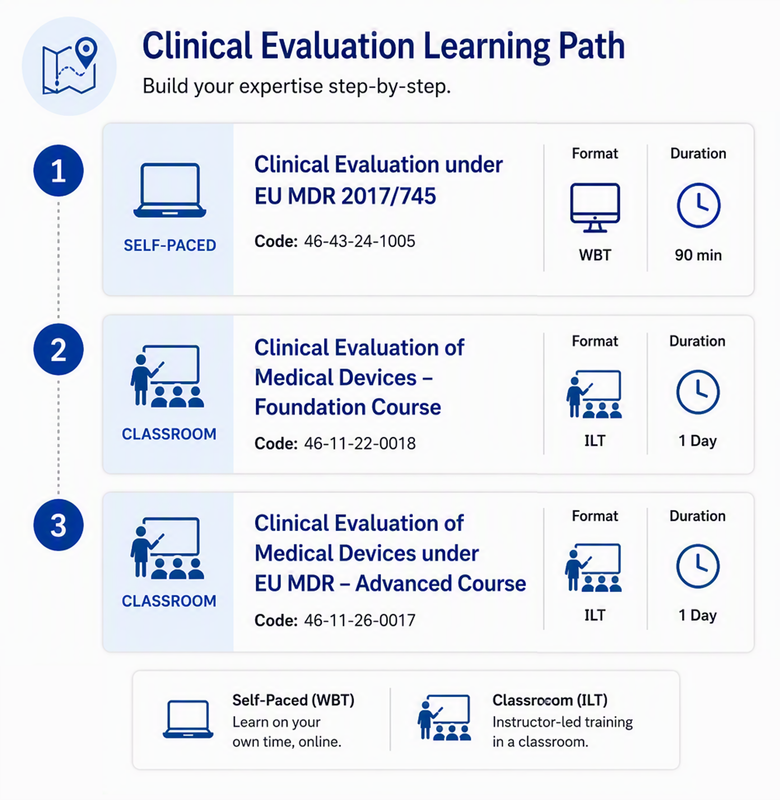
Participants begin with a self-paced web-based training course, Clinical Evaluation under EU MDR 2017/745, that introduces the fundamental concepts, regulatory expectations, and key principles of clinical evaluation. This flexible online module provides a solid foundation and prepares learners for more in-depth study.
The next step is the Clinical Evaluation of Medical Devices – Foundation Course, an instructor-led classroom training that expands on the core concepts and practical application of clinical evaluation processes. Learners gain a deeper understanding of regulatory requirements, clinical evidence, and documentation expectations while benefiting from expert guidance and interactive discussions.
The learning journey culminates with the Clinical Evaluation of Medical Devices under EU MDR – Advanced Course. This classroom-based course is intended for professionals who already understand the fundamentals and want to develop advanced expertise in planning, preparing, reviewing, and maintaining clinical evaluations under EU MDR. Together, these three courses provide a structured progression from foundational knowledge to advanced competency, helping professionals confidently navigate clinical evaluation requirements throughout the medical device lifecycle.
Manager Regulatory Affairs International - TÜV Learning Path:
The 46-11-22-0018 – Clinical Evaluation of Medical Devices – Foundation Course is an essential component of the Manager Regulatory Affairs International – TÜV Learning Path:
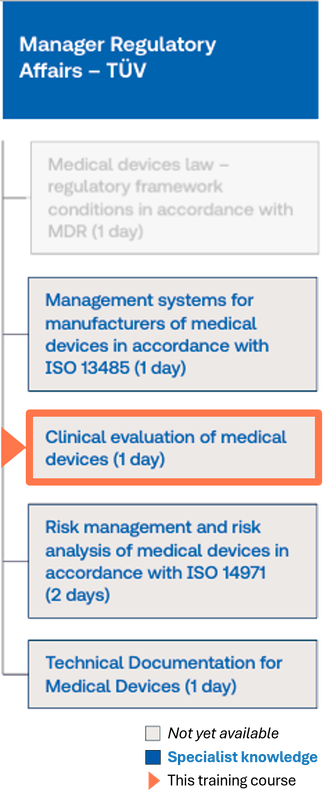
This one-day training provides participants with the fundamental knowledge required to understand and conduct clinical evaluations in accordance with current medical device regulatory requirements. Participants gain insight into the role of clinical evidence in demonstrating the safety, performance, and clinical benefit of medical devices, making this course a critical building block for regulatory affairs professionals involved in product approval and lifecycle compliance.
As part of the broader learning pathway, this course complements the related modules:
- Medical Devices Law – Regulatory Framework Conditions in Accordance with MDR (Not yet available),
- ISO 13485 Quality Management Systems for Medical Device Manufacturers with FDA QMSR (USA/Canada) — 2026 Update (eg-46-11-26-0019)
- Risk Management and Risk Analysis for Medical Devices as per ISO 14971:2019 (eg-46-11-22-0011), and
- Technical Documentation for Medical Devices (46-43-22-1003),
Together, these trainings provide a comprehensive understanding of the key regulatory disciplines required for successful market access and compliance of medical devices. While the clinical evaluation course focuses on generating and assessing clinical evidence, the other modules address regulatory frameworks, quality management systems, risk management processes, and technical documentation requirements, creating a well-rounded competence profile for international regulatory affairs professionals.
This course is part of a modular training programme that enables participants to systematically build specialist knowledge in medical device regulation. Upon successful completion of all required modules within the learning path, participants can acquire the recognized qualification “Manager Regulatory Affairs International – TÜV.” This certification demonstrates comprehensive expertise in the regulatory, clinical, quality, and technical requirements governing medical devices and serves as a valuable credential for professionals responsible for global regulatory compliance and market access activities.
What is clinical evaluation and why is it important?
Clinical evaluation is the systematic assessment of clinical data to demonstrate that a medical device is safe, performs as intended, and provides a positive benefit-risk profile. It is a mandatory requirement under MDR.
Does this course cover MDR requirements for clinical evaluation?
Yes. The course focuses extensively on MDR Article 61, Annex XIV, and related guidance documents relevant to clinical evaluation activities.
Will I learn how to create a Clinical Evaluation Plan (CEP)?
Yes. The course explains CEP objectives, structure, required content, and practical considerations for developing compliant plans.
Will the course explain Clinical Evaluation Reports (CER)?
Yes. Participants learn the purpose, structure, content, and documentation expectations for Clinical Evaluation Reports.
Does the course cover literature reviews?
Yes. A significant portion of the course is dedicated to literature search planning, database selection, appraisal methodologies, and analysis of clinical literature.
Will equivalence evaluations be discussed?
Yes. The course covers equivalence requirements and MDCG guidance, including technical, biological, and clinical equivalence considerations.
Is benefit-risk assessment included?
Yes. Participants learn how benefit-risk assessments support clinical evaluation conclusions and conformity assessment activities.
Does the training address State-of-the-Art (SOTA) evaluations?
Yes. The course explains the purpose of SOTA evaluations, how they are conducted, and how they support clinical evaluation activities.
Will PMCF requirements be covered?
Yes. PMCF planning, reporting, lifecycle updates, and relationships with PMS and clinical evaluation are discussed in detail.
Are clinical investigations included in the course?
Yes. The course explains when clinical investigations may be required, MDR requirements, and how clinical investigations support clinical evidence generation.
Does the course explain interfaces with risk management?
Yes. Participants learn how clinical evaluation supports and interacts with risk management processes and benefit-risk determinations.
Is this course suitable for beginners?
Yes. This is a foundation-level course designed for professionals who are new to clinical evaluation as well as those seeking a structured overview of MDR requirements.
Does the course cover SSCP requirements?
Yes. The course introduces Summary of Safety and Clinical Performance (SSCP) requirements, content, and applicability under MDR.
Are workshops and practical exercises included?
Yes. The course incorporates workshops, exercises, discussions, and practical examples to reinforce learning.
What certificate will I receive?
Participants who attend at least 90% of the training duration will receive a TÜV SÜD Academy Certificate of Attendance.
What is the next step after completing this foundation course?
Participants seeking more advanced knowledge may continue with advanced clinical evaluation training modules and related Clinical Affairs qualification pathways.
Specialist lecturers from the TÜV SÜD Academy