The rapid adoption of cloud platforms such as Amazon Web Services (AWS) has transformed how organisations build, scale and operate their digital infrastructure. While this shift enables agility and innovation, it also introduces a new set of security challenges.
Unlike traditional on‑premise environments, AWS is highly dynamic, API‑driven and identity‑centric. These characteristics expand the attack surface and make cloud environments an attractive target for threat actors. Today, most cloud security incidents are not caused by sophisticated zero‑day exploits, but by misconfigurations, excessive permissions and exposed credentials.
This is where cloud penetration testing plays a critical role. When combined with red teaming, AWS penetration testing simulates real‑world attack techniques to uncover hidden attack paths before they are exploited.
In traditional environments, attackers focused on breaching network perimeters. In AWS, the attack focus has shifted towards:
This evolution requires a new approach. Red Team‑driven cloud penetration testing mirrors how real attackers operate across the cloud kill chain, identifying weaknesses across identity, configuration and monitoring layers.
Before performing AWS penetration testing, it is essential to understand how AWS architecture influences security. AWS provides a broad portfolio of services across compute, storage, networking and identity management. While this flexibility is powerful, it also increases complexity and the likelihood of configuration errors.
AWS security is governed by a shared responsibility model:
|
AWS Secures |
Customer Secures |
|
Infrastructure |
IAM policies |
|
Hardware |
Applications |
|
Net working |
Data & configurations |
A major misconception is that AWS secures everything. Misconfigurations on the customer side are the leading cause of security incidents.
AWS environments often host critical business data, credentials and infrastructure access within a single ecosystem, making them highly attractive to attackers.
Attackers frequently chain together small weaknesses to achieve full cloud compromise.
Effective AWS penetration testing combines attacker simulation with a structured cloud VAPT methodology. This approach assesses security across every phase of the cloud kill chain.
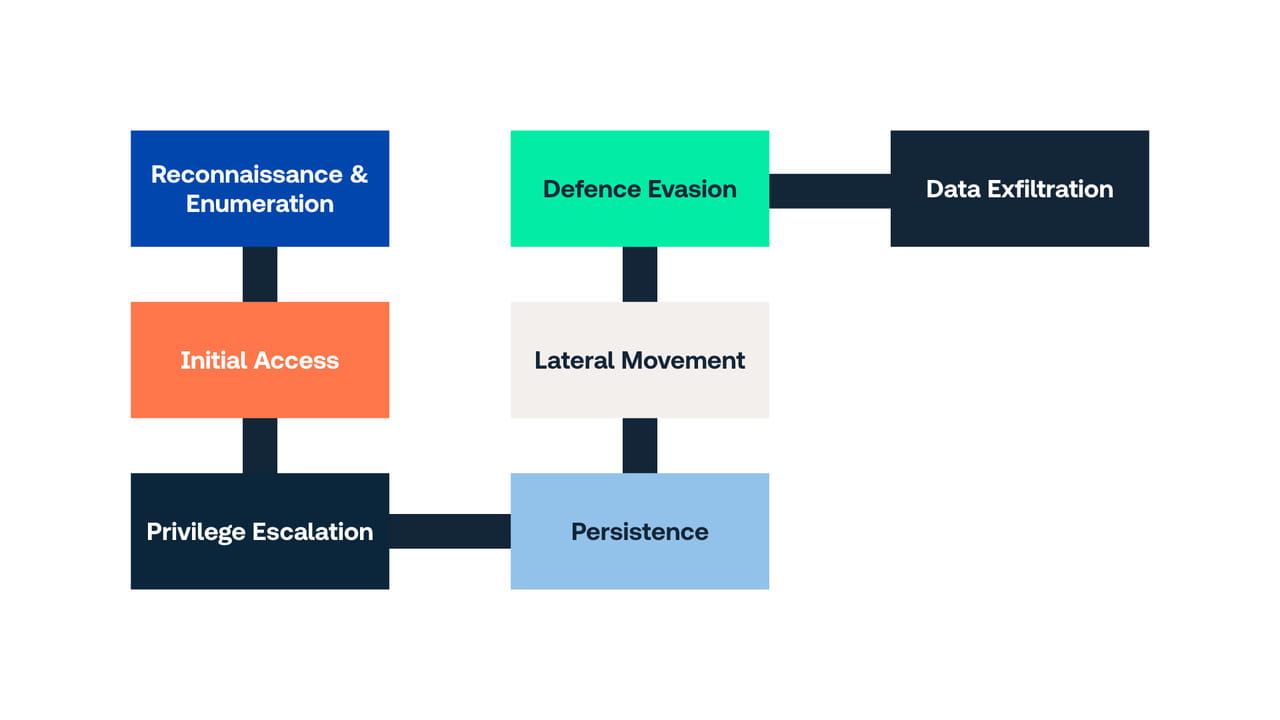
The objective of this phase is to map AWS resources, permissions and exposure points without triggering alerts.
Initial access is typically gained through exposed credentials rather than software vulnerabilities.
Once access is obtained, attackers attempt to elevate privileges. In AWS, this often leads to full account compromise.
Persistence ensures continued access even after the original entry point is removed.
Attackers expand their reach across services and accounts by exploiting trust relationships.
To avoid detection, attackers blend into normal AWS activity.
The final stage involves extracting sensitive data while minimising detection.
|
Tool |
Purpose |
|
ScoutSuite |
Cloud security posture assessment |
|
Prowler |
CIS benchmark checks |
|
Pacu |
AWS exploitation framework |
|
CloudMapper |
Visualise AWS environments |
|
AWS CLI |
Manual testing and validation |
These tools support both automated and manual testing during cloud security testing engagements.
Findings from AWS security assessments should be followed by practical remediation steps.
Identity and Access Management
Storage Security
Compute Security
Network Security
Monitoring and Logging
These controls strengthen outcomes from AWS security audits and ongoing cloud security programmes.
Cloud penetration testing is a critical component of modern cloud security strategies. As attackers increasingly target AWS environments, organisations must proactively identify and address weaknesses before they lead to incidents.
By combining:
TÜV SÜD supports organisations with structured cloud penetration testing and AWS security assessment services to identify misconfigurations, IAM weaknesses and exposed cloud assets before they lead to incidents.
Learn more about our penetration testing services.
Site Selector
Global
Americas
Asia
Europe
Middle East and Africa
