
Safety Requirements for Coin and Button Cell Batteries
Safety Requirements for Coin and Button Cell Batteries
Reese’s Law was established in 2022 to mandate coin and button cell battery safety requirements at a federal level, establishing requirements varying from certification to performance for the intended purpose of protecting children and consumers against the hazard of ingesting button or coin cell batteries. Reese’s Law employs ANSI/UL 4200A-2023 to ensure battery compartments are secure and battery packaging warnings are in place.
In September 2023, ANSI/UL 4200A-2023, became the CPSC regulatory safety standard for consumer products using Button Cell or Coin Cell Batteries in their design.
Toys containing Button Cell or Coin Cell Batteries would be regulated separately through the newest revision of the ASTM F963-2023 Toy Standard which also called out the requirements for performance and labeling requirements per 16 CFR part 1263.
Per ANSI/UL 4200A-2023, the requirements for consumer products containing or designed to use button cell or coin batteries are as follows:
By statute, the rule does not apply to toy products designed, manufactured, or marketed as a plaything for children under 14 years of age if the toy products are in compliance with the battery accessibility and labeling requirements of 16 CFR part 1250, which incorporates by reference ASTM F963-23; Section 4.25 of the toy standard contains requirements for battery-operated toys.
Section 2 of Reese’s Law, CPSC published a separate final rule that establishes warning label requirements for the packaging of button cell or coin batteries, including batteries that are packaged separately with a consumer product, per 16 CFR 1263.4. This requirement will apply to products manufactured or imported after September 21, 2024.
Section 3 of Reese’s Law requires “any button cell or coin battery sold, offered for sale, manufactured for sale, distributed in commerce, or imported into the United States, or included separately with a consumer product sold, offered for sale, manufactured for sale, distributed in commerce, or imported into the United States” to utilize packaging that meets the requirements of 16 CFR 1700.15.
On March 8, 2023, the Commission voted to instruct the Office of Compliance and Field Operations to exercise enforcement discretion for the packaging requirements for zinc-air button cell or coin batteries—a technology used to power hearing aids and other hearing assistive technologies; therefore, at this time special packaging for zinc-air button cell or coin batteries will not be enforced until March 8, 2024.
| Product Type | Requirement | Effective Date (and Source) |
| Button cell or coin battery packaging | Must be in packaging that meets 16 CFR § 1700.15 | Products manufactured or imported after February 12, 2023 (P.L. 117-171) |
| Zinc-air button cell or coin battery packaging | Must be in packaging that meets 16 CFR § 1700.15 | Products manufactured or imported after March 8, 2024 (enforcement discretion) |
| Product containing or designed to use button cell or coin battery | Must meet performance and labeling requirements of ANSI/UL 4200A-2023 | Products manufactured or imported after March 19, 2024 (enforcement discretion) |
| Button cell or coin battery packaging | Must be in packaging that meets 16 CFR § 1263.4 | Products manufactured or imported after September 21, 2024 (88 FR 65296) |
All applicable warnings must be in their complete form and entirety, with the package and product to inform the consumer of the presence of a small cell battery (coin cell, button cell or any battery capable of fitting in defined CPSC choke tube) per 16 CFR and or UL 4200A. The labeling guidelines are:
Package Labeling
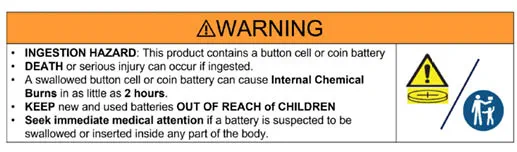
Packages with limited space may use alternative labeling.


Products without packaging must bear a full label via hang tag or sticker label on product.

Product with small surface area may utilize the following icon in its entirety.
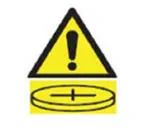
Product with surface area not possible for labeling must either:

Find out how you can navigate the complex certification requirements.
Learn More

Networks are shutting down 2G and 3G. Be prepared for the next era of connectivity.
Learn More
Site Selector
Global
Americas
Asia
Europe
Middle East and Africa
